Need some advice on my first tanto.

Joined
Nov 15, 2014
Messages
257
Greetings.

I'm making my first tanto. I have the design I like and a good steel, but I'm a bit confused about the bevel and I hope I can ask my question so it makes sense.

Grinding the bottom edge seems straightforward enough, but I don't know how to grind the angled part. Should I turn the blade so I'm grinding the angled edge at a 90 degree angle?

I hope that makes sense. Thanks.
 
Are you referring to the tip?

If so here is how I do it.

i knock the edge off just like you do the to the main bevel.

Then hold the tanto front edge so it is horizontal to the belt (perpendicular)

grind from the front edge a little at a time and move that grind line down until it is where you want it. You move the grind down by contacting the front edge to the belt, with it perpendicular to the belt, and then move the tang of the knife gently toward the belt and check frequently how the grind has progressed at the tip.

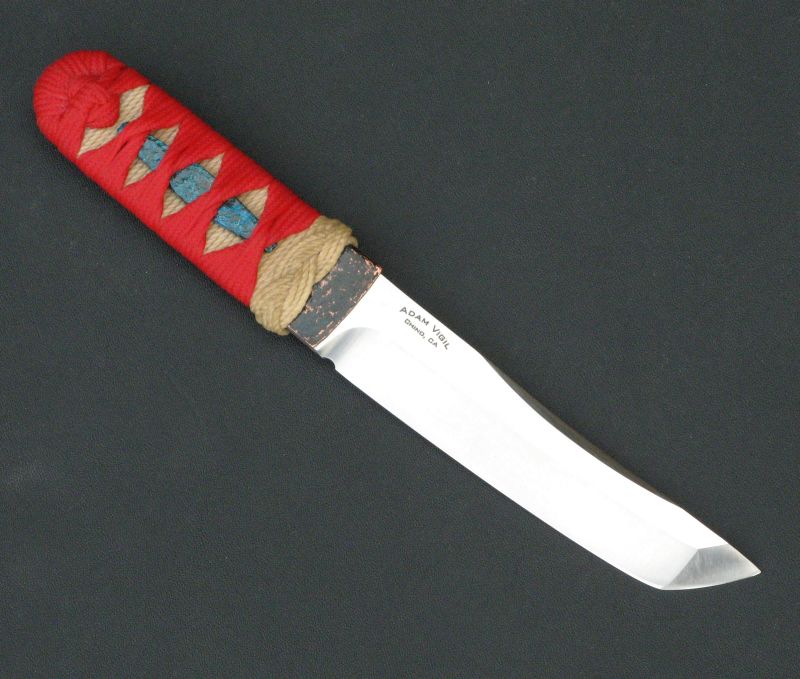
It ends up looking like this
ZbpAiR9.jpg
 
The main thing you have to get right on a tanto is that all angles need to meet crisply, all lines are straight, all surfaces are flat,...and that there are no rounded places. The tip - called the kissaki - is ground at whatever angle you need to hold the blade at to get the three lines to meet properly ( the point they meet is called the mitsukado). It is far better to use a file and sanding blocks to set the yokote. Use a very hard backing block. Aluminum is a good choice.

Tanto are best done by hand after the basic bevel is shaped on the grinder.
 
Are you referring to the tip?

If so here is how I do it.

i knock the edge off just like you do the to the main bevel.

Then hold the tanto front edge so it is horizontal to the belt (perpendicular)

grind from the front edge a little at a time and move that grind line down until it is where you want it. You move the grind down by contacting the front edge to the belt, with it perpendicular to the belt, and then move the tang of the knife gently toward the belt and check frequently how the grind has progressed at the tip.

It ends up looking like this
ZbpAiR9.jpg

Hi Adam:
Thanks for the feedback, and nice looking tanto!

What I'm referring to is the part of the blade that angles up toward the tip. You've got the bottom of the knife, or knife edge, and then the part at the end that angles up sharply. The blade I'm planning has a flat edge and then angles up at about 45 degrees toward the tip. I'm a bit unsure of how to grind it.
 
The main thing you have to get right on a tanto is that all angles need to meet crisply, all lines are straight, all surfaces are flat,...and that there are no rounded places. The tip - called the kissaki - is ground at whatever angle you need to hold the blade at to get the three lines to meet properly ( the point they meet is called the mitsukado). It is far better to use a file and sanding blocks to set the yokote. Use a very hard backing block. Aluminum is a good choice.

Tanto are best done by hand after the basic bevel is shaped on the grinder.

Hi Stacy;

Hmmmmm....perhaps I'm getting in a bit over my head here.

I'm trying to make this tanto as basic and simple as I can, as I'm still pretty new to knifemaking. I'm looking at some diagrams of tanto knives and I think I'm catching on.

So, the part of the knife that turns upward is called the kissaki and the dividing line is the yokote, right? So my confusion right now is how to grind the kissaki. Once I grind from the back of the blade up to the yokote, should I keep going and grind the kissaki in the same motion? Or, should I grind the main part of the blade first and then switch the angle of the blade and grind the kissaki separately?

I'm experimenting with a very crude kiridashi right now, kind of as practice for my tanto. I'm having a similar issue--whether to grind the two angles separately or together.
 
The line between the ha and the ji is called the shinogi. On the tip (kissaki) it is called the ko-shinogi. The vertical line of demarcation between the two is called the yokote. The temper line ( hamon) as it follows up along the kio-shinogi is called the boshi. The point where the two shinogi and the yokote meet is called the mitsukado.

As I said in the previous post, shape the ko-shinogi at whatever angle is needed to follow the kissaki-ha ( tip edge). Most people do not do the kissaki until the main bevels are completely done and polished up to a fine grit. the yokote and ko-shinogi will move all over the place if you start too soon. The only tip I can give on finding the angle is to start with the edge (ha) and walk it back to where you want it. You will have to change the angle slowly and minutely on two axes to get it to meet right at the shinogi and yokote.
 
Last edited:
To grind it use your tool rest.

I draw the angle I want on the blank and grind it on the tool rest.

IGsE791.jpg
 
Back
Top