
Need some opinions on latest blade

Joined
Jan 3, 2011
Messages
71
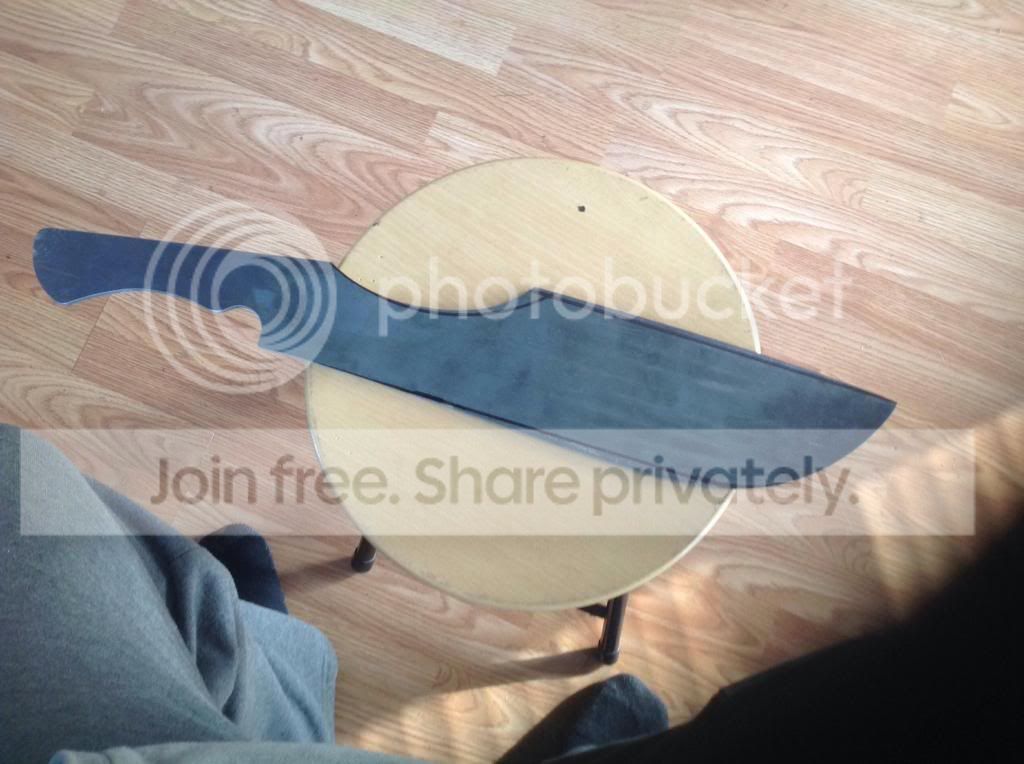
Its a really big knife. Its something ive been wanting to make for a while now. I used ideas from large knives, machetes and short swords like the greek xiphos. The idea is a large heavy blade built for chopping. When its complete ill have adjusted the weight distribution for a low polar moment and a point of rotation around the ricasso. Im trying to make it lively in the hand and less blade heavy than it looks. Its a rough grind right now. Im making various adjustments. You can see where I put black marker around the blade. Im thinking of reducing the blade by that amount. Im thinking of a flat grind from edge to spine. The handle is a little longer to allow the hand to move around a little and be repositioned. Also to counter some of the blade weight. So far the feel is just about right and it is quite maneuverable.
Im must not sure about the shape of the handle... It feels good but is missing something.
It almost seems like the upper part of the handle is too straight of that makes sense.
The finished blade will be of 5160. The handle is 8" blade 13" steel thickness 3/8.
Im open to any thoughts or ideas on this design.
One question: With the blade this length is 3/8 to thin ? Im trying to balance chopping ability, edge sharpness, and blade toughness. Thanks!
 
I don't see any pictures but 3/8 is plenty thick at pretty much any length. Lots of great bowies and choppers that length out there using stock thinner than that forsure.
 
Man... I guess it helps if I remember to attach the image lol sorry. Give me a few here to figure out how I did this last time.
 
image.jpg
 
So... how you planning to heat treat that?

But even before that, how do you plan to grind it? And why do you want SO MUCH steel at the front end, where it will do the most damage to your wrist (and back)?
 
So... how you planning to heat treat that?

But even before that, how do you plan to grind it? And why do you want SO MUCH steel at the front end, where it will do the most damage to your wrist (and back)?

I have an Evenheat furnace with rampmaster. As far as process goes I have a few details to work out. I know the theory but havent attempted it 100% yet.
For grinding I have all the files and belt grinders and whatnot. Im thinking of making the blade one flat grind from edge to spine. Not sure if there is a better choice for this application. In theory its just a big fancy machete. Thats also the reason for the heavy blade. Im trying to add or move some weight closer to the pommel and shave some more weight off the blade still. Your right I dont want it so tip heavy that it will torque my wrist. Im relying on overall weight and size of the blade for chopping.
 
I like some big ones in choppers but don't make them any more. My suggestion is to go to 1/4" blade steel. I believe the 3/8" is just too much. Frank
 
Go to a good outdoorsman shop with a caliper. Measure a bunch of GOOD machetes. I bet two of them laid on top of each other won't measure 3/8". Most machetes are closer to 1/8".

New makers have a feeling that mass will make up for proper balance, shape, and edge geometry. With the possible exception of a splitting maul that s pretty much wrong. Even in an axe, a lighter well shaped and balanced axe will chop and faster and split better than a clunky heavy one.

Machetes need fairly thin and tough blades.
 
The other thing most often overlooked is that a heavier tool wears down the user faster than a lighter tool. Adding mass means it takes more force to overcome inertia. That force comes from muscles in this case. Now if you're proposing to make something that someone can use instead of going to the gym, more power to ya.

I did some "screen measurements" and I calculate that your blade is about 4 inches wide for about 12 inches at the end of the blade. You say you want to go for a full flat grind all the way to the spine. Have you considered what that means in terms of the angle at the cutting edge?
 
Great for stopping Zombies....not so great for a machete.

I lived in Central America for years and the machete is a way of life down there. A good machete you can put the tip on the ground and push down on the handle and bend the blade into a "C" and it will spring back perfectly straight.

Think "thin" when making a machete.

On a side note.... I would count the number of men I would see with ONE arm because they lost it in a machete fight, common to see 1/2 dozen in a day. True story.
 
The other thing most often overlooked is that a heavier tool wears down the user faster than a lighter tool. Adding mass means it takes more force to overcome inertia. That force comes from muscles in this case. Now if you're proposing to make something that someone can use instead of going to the gym, more power to ya.

I did some "screen measurements" and I calculate that your blade is about 4 inches wide for about 12 inches at the end of the blade. You say you want to go for a full flat grind all the way to the spine. Have you considered what that means in terms of the angle at the cutting edge?

That is one thing I was wondering ? I just figured that would be the best way of grinding a machete type blade but no your right im not too sure what effect that will have on the cutting edge. Will it work or is there a better grind to go with ?

Wow thanks for all the useful advice guys! You pretty much hitt he nail on the head and cleared up my thoughs on this blade. I will trim the blade down a fair bit and reduce the weight. Ill also go with a thinner steel. This is a piece of scrap mystery steel I used so it wont be heat treated. I wouldnt know how to treat mystery steel just yet lol.
The shape of the handle seems ok ? Thanks again ! PS I think perhaps I typoed the thickness is 3/16 thats what I get for posting when im half asleep.
 
Last edited:
Clean looking profile work. 3/16" is quite a bit different than 3/8"! It might make a good chopper indeed, if ground with plenty of distal taper.
I like that you are drawing inspiration from the Greek xiphos. Combing the world and history for cool blades yields just mountains of ideas.
 
3/16" is a lot better. It is still a bit thick for a machete, but well within the usable range.

Grind the blade as a full flat grind from spine to edge leaving the edge about .040" thick. After HT convex the final edge.
 
3/16" is a lot better. It is still a bit thick for a machete, but well within the usable range.

Grind the blade as a full flat grind from spine to edge leaving the edge about .040" thick. After HT convex the final edge.

I like this idea! So like a hollow grind around the edge. But why after the HT is that so the thin material doesnt warp or crack ? I thought that would expose soft material below the surface ?
 
+1 for the convex grind on that puppy, but I would seriously consider taking Mr. Straub on the distal taper on it to help with the balance in swinging that bad actor around. properly done this can seriously improve the handling of a bigger knife.
 
+1 for the convex grind on that puppy, but I would seriously consider taking Mr. Straub on the distal taper on it to help with the balance in swinging that bad actor around. properly done this can seriously improve the handling of a bigger knife.

Oh yes definitely! I like that idea too, a good distil taper. Since Mr. Straub mentioned it ive been mulling it over in my mind. How to get a good distil taper and the flat grind taper from the spine to the edge with this blade shape. Any pitfalls I should watch out for ? The edge of the blade isnt straight it has a slight curve to it.
 
For me: I'm not as accurate of a grinder as a lot of guys on here and end up fixing some of my accuracy or mistakes with a file, and I have done a few distal tapers this way on a few as well. takes a bit of elbow grease, but its easier not to mess up. I have also used the horizontal belt sander using my palm to apply the proper pressure to "feel" as I went. I know there are better answers but I hope this helps.
 
Back
Top