
- Joined
- Feb 5, 2005
- Messages
- 299
I really love the look of the Nessmuck, and some of the fellas here who make interpretations of them are some of the most beautiful I have seen. But the question is not if I need one....of course I need one, I don't have one. The question is, what are the advantages of this knife design.
I realize that it would probably be quite a good skinner, but other then that I am having trouble seein the benifits. I also know it can be used as a spoon thought I doubt that is a priority for me, and can be used for food prep, but most knives could....
From looking at the design, I would think it would suffer in wood work with the blade dropping below you grip. My way of thinking this would cause you to get more lateral wrist torque the you might otherwise normally have with a conventional blade.
It seems the wide blade might get in the way of detail work.
I would think you would lose your ability to drill holes if needed for starting a fire, or augering out a hole for a peg or something of that nature.
I would think for around the house use the wide blade might get in the way of chores where you need a finer point to slip in to make a cut.
To me....I am having a struggle figuring out what is great about the blade design...help me my brothers!
AI
I realize that it would probably be quite a good skinner, but other then that I am having trouble seein the benifits. I also know it can be used as a spoon thought I doubt that is a priority for me, and can be used for food prep, but most knives could....
From looking at the design, I would think it would suffer in wood work with the blade dropping below you grip. My way of thinking this would cause you to get more lateral wrist torque the you might otherwise normally have with a conventional blade.
It seems the wide blade might get in the way of detail work.
I would think you would lose your ability to drill holes if needed for starting a fire, or augering out a hole for a peg or something of that nature.
I would think for around the house use the wide blade might get in the way of chores where you need a finer point to slip in to make a cut.
To me....I am having a struggle figuring out what is great about the blade design...help me my brothers!
AI

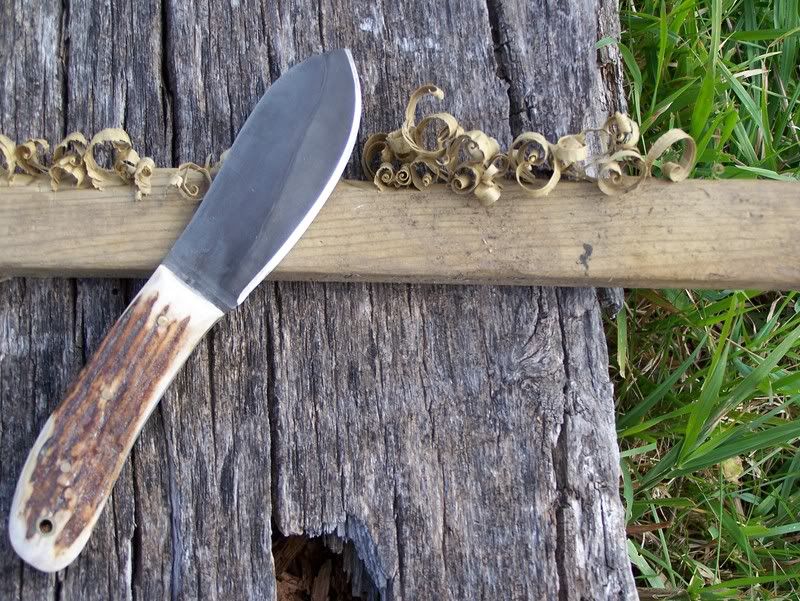
 My speculation is he wanted a thin blade because you can cut bread with it and peel potatos (he mentions taking both with him on his trips) It has sort of a skinner shape but with a sharper point so it can serve the dual purpose as a game cleaning and skinning blade since Nessmuk did kill deer on his tramps. Finally not my specualtion but I read somewhere someone who claimed (without real documentation) that the hump was in part to rest on the muscle when skinning a deer and to avoid dragging the tip in the meat. That seems to make sense.


