
new at sharpening please help

There is a good thread about stropping posted as a sticky. My explaination would be similar, but not as well written and without the visuals. Also, stropping is something of a personal preference, some people think it is the only way to put a good edge on a blade, while others think it should be reserved for push-cutting blades like straight razors and chisels. I like to use a strop as an edge touch up, just enough to clean things up without polishing away too much of the texture. Generally I'll strop a blade a few times between sharpening with stones.

As to when to switch between different grit sizes, there are a few different methods. The most staightforward is to let a slight burr develop. When you are done with a coarse stone the blade should feel sharp. In general, you should only need a few minutes with any grit stone before moving on.

You could actually do all of your sharpening with a fine stone, it would just take longer than starting with a coarse stone and working your way down.
 
There is a good thread about stropping posted as a sticky. My explaination would be similar, but not as well written and without the visuals. Also, stropping is something of a personal preference, some people think it is the only way to put a good edge on a blade, while others think it should be reserved for push-cutting blades like straight razors and chisels. I like to use a strop as an edge touch up, just enough to clean things up without polishing away too much of the texture. Generally I'll strop a blade a few times between sharpening with stones.

As to when to switch between different grit sizes, there are a few different methods. The most staightforward is to let a slight burr develop. When you are done with a coarse stone the blade should feel sharp. In general, you should only need a few minutes with any grit stone before moving on.

You could actually do all of your sharpening with a fine stone, it would just take longer than starting with a coarse stone and working your way down.

ok thaks. whats a bur. sorry im very new to this. and also when do i know to switch from sharpenning on one side of the knife to the other?
 
G`day, cobra pilot, and welcome to Bladeforums. You have been given excellent advise by all responders to your post. I, too, endorse learning to sharpen freehand, first. You state that you wish to enlist in the US Marine Corps. Outstanding! Thank you for your desire to serve. However, in the field (i.e combat conditions), then limitations on equipment weight and bulk apply. In country, therefore, a few strips of sandpaper are portable and light, and easy to use. However, back at base, or at home consider something like the paper wheel system. (Use the search function for " richard j" and "paper wheels" ). Learning to freehand sharpen is a cornerstone of readiness. Dont be put off by sharpening angles. Ninety degees is a right angle. Forty five degrees is half that , and half that twenty two and one half degrees. That is the reccomended angle for most "using" knives, and the reason that 22 degrees is often cited. Tougher, harder, steels can retain a usefull edge at more acute angles, such as 18 degrees. Try not to overthink. Learn how to put a usefull edge on your mums cooking knifes. Good luck, mate. Cheers,Mike.
 
G`day, cobra pilot, and welcome to Bladeforums. You have been given excellent advise by all responders to your post. I, too, endorse learning to sharpen freehand, first. You state that you wish to enlist in the US Marine Corps. Outstanding! Thank you for your desire to serve. However, in the field (i.e combat conditions), then limitations on equipment weight and bulk apply. In country, therefore, a few strips of sandpaper are portable and light, and easy to use. However, back at base, or at home consider something like the paper wheel system. (Use the search function for " richard j" and "paper wheels" ). Learning to freehand sharpen is a cornerstone of readiness. Dont be put off by sharpening angles. Ninety degees is a right angle. Forty five degrees is half that , and half that twenty two and one half degrees. That is the reccomended angle for most "using" knives, and the reason that 22 degrees is often cited. Tougher, harder, steels can retain a usefull edge at more acute angles, such as 18 degrees. Try not to overthink. Learn how to put a usefull edge on your mums cooking knifes. Good luck, mate. Cheers,Mike.

thanks mike :) i appreciate it ill look into the paper wheels.

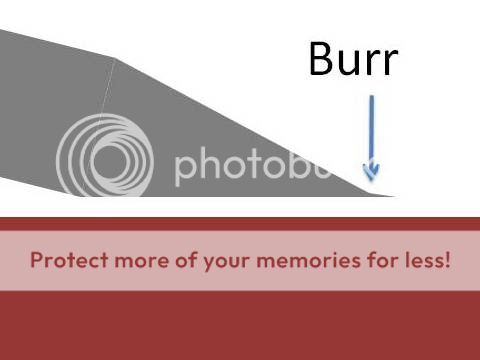
 
A burr is a thin strip of steel that is built up on the edge of a blade when it is sharpened.

Below is a diagram of the cross-section of a blade and a stone
burr1.jpg


If we zoom in on the edge we can see the burr
burr2.jpg


As soon as you can detect a burr the sharpener has done its job. You don't want a burr to get to big though. Some people look for a glint of light on the edge to indicate a burr, others can feel them with a thumbnail, Richard J just told me about using a needle suspended from a thread to find one. The needle will slide across the blade and then get caught right at the edge if there is a burr.

When there is a burr it is time to flip the blade and/or switch to a finer stone

Generally you want to get rid of any remaining burr before you are done sharpening, and there are various options for doing this. Very fine stones, ceramic sticks and strops are some of the most popular.
 
Last edited:
Back
Top