New Bladesmith Knife Edge Questions

Joined
Sep 16, 2015
Messages
7
Good Afternoon Everyone,

I am new to this board as well as to the Bladesmith craft. I am a retired Farrier so I have some forging experience. To get myself up to speed I have been reading The Complete Bladesmith. In the section on forging a single edged blade, it says to curve the blade around the horn with the cutting edge down, then it says to reheat the blade and using the peen strike blow along the inside edge of the bend. Which I imagine would be the cutting edge and this will straighten the blade out as the metal spreads. The parts that are confusing me are, do I really bend the cutting edge around the horn and then peen this inside edge and flatten it the the hammer face until it straightens out, or is there another way to do this.

Last question, which types of stock do you use Wolf Jaw tongs for?

Any advice will be helpful.

Thanks in advance

Best,

Tom
 
Welcome to the Bladeforums. First, I have not begun to forge yet. That said, I've been to enough hammer-ins and watched enough forging demos to know that, yes, you want to bend the edge down first because when you start stretching the metal along the bevels, it is going to push the spine the other way. There are some good youtube videos that demonstrate this but, you can also just go pound on some steel and see how it reacts.

Bob
 
In blade forging ( just as in farrier forging) the steel will move away from the hammer blow, resulting in a curve as you work along an edge to thin it. To compensate for this (and avoid a lot of straitening) you start with making the blade profile a downward banana shape. As you draw out the bevels, it will rise to straight. After some practice one can get a good feel for how much down bend is needed for a particular size blade stock. Suffice to say that the blade will curve up much more than you think it will.
 
Hi Ranger Bob,

Thank you for the quick response. For some reason the idea of turning the blade around the horn on the cutting edge side didnt seem to make sense to me. But after the explanation you gave it makes perfect sense. Now to muddy up the water a little it, if I was to pre-form the blade such as give the spine a belly towards the tip and then turn the cutting edge around the horn to peen the blade. Will that work or should I only counter turn the blade when it has a flat spine?

Best,

Tom
 
Stacy,

Thank you for your response. The book states that after I peen the inside edge of the curve(cutting edge) it should be flattened with the hammer face. Should this be done with the stock laying flat on the anvil face with the cutting edge on the outside edge of the anvil and stike flat along that edge or should the blade be angled a bit so that the spine is off the face and the edge is really the only part touching the edge of the anvil when I strike with the hammer?

Best,

Tom
 
This is how I teach forging a blade:

1) Shape the tip on the bar end.

2) Shape the tang and set the notch at the ricasso if there will be a drop to the edge (like on a Bowie). At this point the blade should be a rough silhouette of the final shape. It should be a tad shorter than desired, as the blade will stretch in the shaping the distal taper. The edge to spine height should be about 60-75% of the desired blade width. This will be stretched out in forging the bevels.


3) Make the distal taper. This is a continuous taper in the blade from ricasso to tip. The tip should end up half the thickness as the ricasso. The taper should be fairly even, but again, don't get crazy about exactness...you will do a lot more forging. If you wish, go to the grinder and clean up the profile to make the shape the way you want again.

4) Reverse curve the blade. Set the hot blade on the anvil horn ( called the bick) and curve the blade part of the knife down like a banana. The tip should be at least an inch down from straight.

5) Forge the bevels. Working from the tip back toward the ricasso, forge the bevel from the edge back toward the spine. Flip from side to side on each heat. Only work the blade while fully red. DO NOT forge when black. Work a small area at a time and go up and down the blade slowly drawing the bevels down to create the edge. If needed, curve the blade back down some more as it lifts up. Once the bevels are set, the blade can be made straight by placing the edge or spine on the anvil and striking the opposite edge/spine with the flat hammer face. A better tool is what I call a "schwaker". It is a wooden hammer with a hardwood head. Lignum vitae is the best, but oak or whatever hardwood you have will work.
When straightening out the blade, work it hot and also work the sides to get the knife flat and straight. The flat sides are more important than any slight curve or dip in the spine or edge. These will all grind out.

6) Clean it up a bit by working it at a low red heat( but not at black). Use light blows and work up and down the blade to smooth things up. Re-check that it is flat.
Once finished with the forging work, do several normalizing cycles and then a sub-critical anneal.

You are done with the forging stage and the blade is now ready to go to files or the grinder. Soak the blade in vinegar overnight to remove scale, and scrub off well the next day. Wash and dry.


Finishing:
Only do the grinding/sanding steps to about 120 grit to start. Once all the blade is right at 120 grit, then and only then should you go up the grits to 400 and get it ready for HT

7) File/grind the tang and ricasso flat and smooth. You can drill the tang holes now or later...but be sure to drill them before HT.

8) Start by cleaning up the profile. Shape the spine, edge, and tang to the desired final shape. Start working the bevels smooth and flat. Go slow and switch from side to side. Check the flatness and straighten if you bend it in grinding.

9) After things look good, set it aside for the night and look it over again the next day. You will likely see a few places that need to be adjusted or touched up.

10) If all is right, re-sand/grind the blade up to 400 grit. Set it aside for a day again and look it over really closely in a strong cross light. Look for any coarse scratches or places with dips or dents that should be removed. Don't do the HT until the blade is ready for it. Anything left to do after Ht will be a lot harder to work out.

11) HT the blade.

12) After HT, soak in vinegar overnight to remove ant scale. Start at 220 grit and go up the steps to the final finish. Do not let the edge get sharp in sanding. If it does ( which usually happens), sand it back a little to dull it.

13) Finish the blade as you wish, and assemble the handle.

14) Sharpen the knife and make a sheath.

 
Last edited:
Stacy has given some great advice so I won't go over everything just add a few items.

You don't have to curve the blade. Once you are good at it it works well but starting out you will likely over curve or under curve and still have to do straightening. Practice makes perfect but if you want to start with an uncurved bar of steel then make yourself a schwacker as Stacy calls it. Good hard wood is better but a three or four foot 2x4 with 4" shaped like a crude handle will work just as well. It won't last as long but it gets the job done. When you are straitening the blade, along the edge, you can mark the edge when black with chalk or soap stone and this helps you get a better idea on how straight the blade is. I straighten at the end of every heat or nasty bends can get away from you if left unchecked.

Stock and peening. I know Jim says he uses a peen in his book (I have it also) but I caution you against hammer marks. It is a tough pill to swallow when you forge a fantastic blade only to head to the grinder and find deep hammer marks you cannot remove without heavily modifying your original design. This is also true with the flat of the hammer, make sure you hit the steel with the face of the hammer and not the side or "fuller" area or you will end up with hammer marks.

Don't hit the side of the spine unless you have a surface grinder and are ok with thinning your stock. Light taps at low red to straighten are ok but too much and its start over or really thin it out. If you dont' have a good belt grinder or surface grinder this can be a problem.

I don't forge the entire profile first mainly because I start out with 3 or 4 foot bars of stock and use that without tongs. I forge my point then notch my ricasso then forge the bevels and finally the tang. There's no correct way though.

Finally Stacy has the patience of a saint (he is moderator here after all) and is ok with waiting days and using vinegar and all that. I on the other hand have not embraced that yet so I go strait from normalized/annealed to a 36 grit on the belt grinder. I will say that removing scale with vinegar will save you money on belts thought.

And one last tip, if you are serious about bladesmithing I recommend a quality 2x72 belt grinder with at least a 2HP motor. There are more options to purchase now than ever but there are also many plans and parts kits out there also. To me variable speed is also necessary but that is up to you.

Good Luck

-Clint
 
Here is a video by Matthew Parkinson detailing some of the techniques mentioned in this thread. Note he is using the peen and a large hammer. You can get away with that if you're experienced!

[video=youtube;rDh4aIFID9E]https://www.youtube.com/watch?v=rDh4aIFID9E&feature=youtu.be[/video]
 
Stacy and Clint,

Thank you both very much for the high quality answers you have given me. Being new to this trade, I get a little intimidated when I can't get the process down in the first go round. It's the journey to the completed knife that is the real enjoyment. I will keep you all posted as I progress. It was a relief to find this site.

Have a great night.

Best,

Tom
 
Clint,

When I use the schwaker, am I striking the cutting edge with it? Is this part of the straightening the the side bends and warps or for removing the upset parts?


Best,

Tom
 
The schwacker is used like a hammer, and can strike the edge, the spine, or the flats. It's big advantage is that it leaves no mark and moves no metal....just straightens.
 
It is intimidating Tom, I'm still a rookie when it comes to this stuff but i have been fortunate to have had some pretty good teachers along with a wealth of knowledge here and a few other places. But I've never enjoyed learning so much!

I'll hit the edge when taking the curve out. Basically laying the blade spine down across the anvil face and with a good heat, I will wack along the edge until the blade is straight. This will take care of the "up and down" or spine to edge curve but will put some warp or left to right curve in the blade or what we affectionately call "baconing". A little finessing and practice hammering the flats will take care of this and it becomes easier with time. This is why some will pre curve the steel. I was taught both ways by some very talented smiths. Try them both and find out which one you like better. And truthfully your doing a little of both no matter which route you take.

For tongs my thoughts are you can never have enough as a smith. For knifemaking I like Tom Tongs Z-Box, U-Box and Box Jaw while forging when I'm not holding the bar.

-Clint
 
Doh looks like Stacy beat me to it and without being so long winded :D

For the record schwacker's come in handy for many blade and blacksmithing tasks.
 
I have a tutorial build project with pictures planned for this fall on making a professional grade schwacker. It will be a thread of its own...hopefully within a month.

The name is something I cobbled together from the German schlagen, which means the same as the English whack. So, schlagen-wacker became schwacker. IIRC, Tai Goo used the same word. Probably not unique to either of us, but when I search it I only get articles I wrote using the word.
I used to sometimes spell it schwacher, but not everyone could figure out how to pronounce the work, so I went with the more phonetic schwacker.
 
Good Evening,

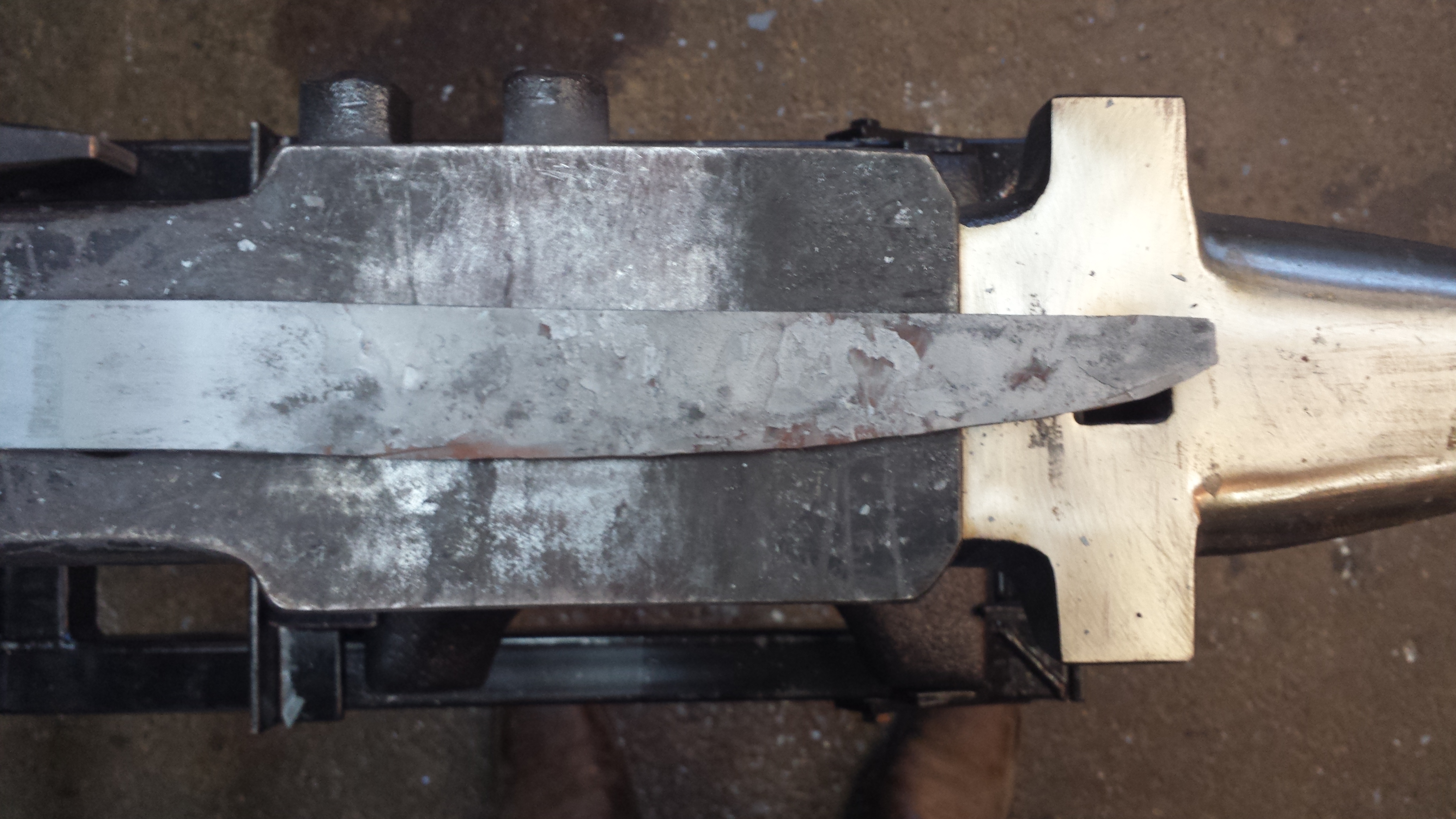
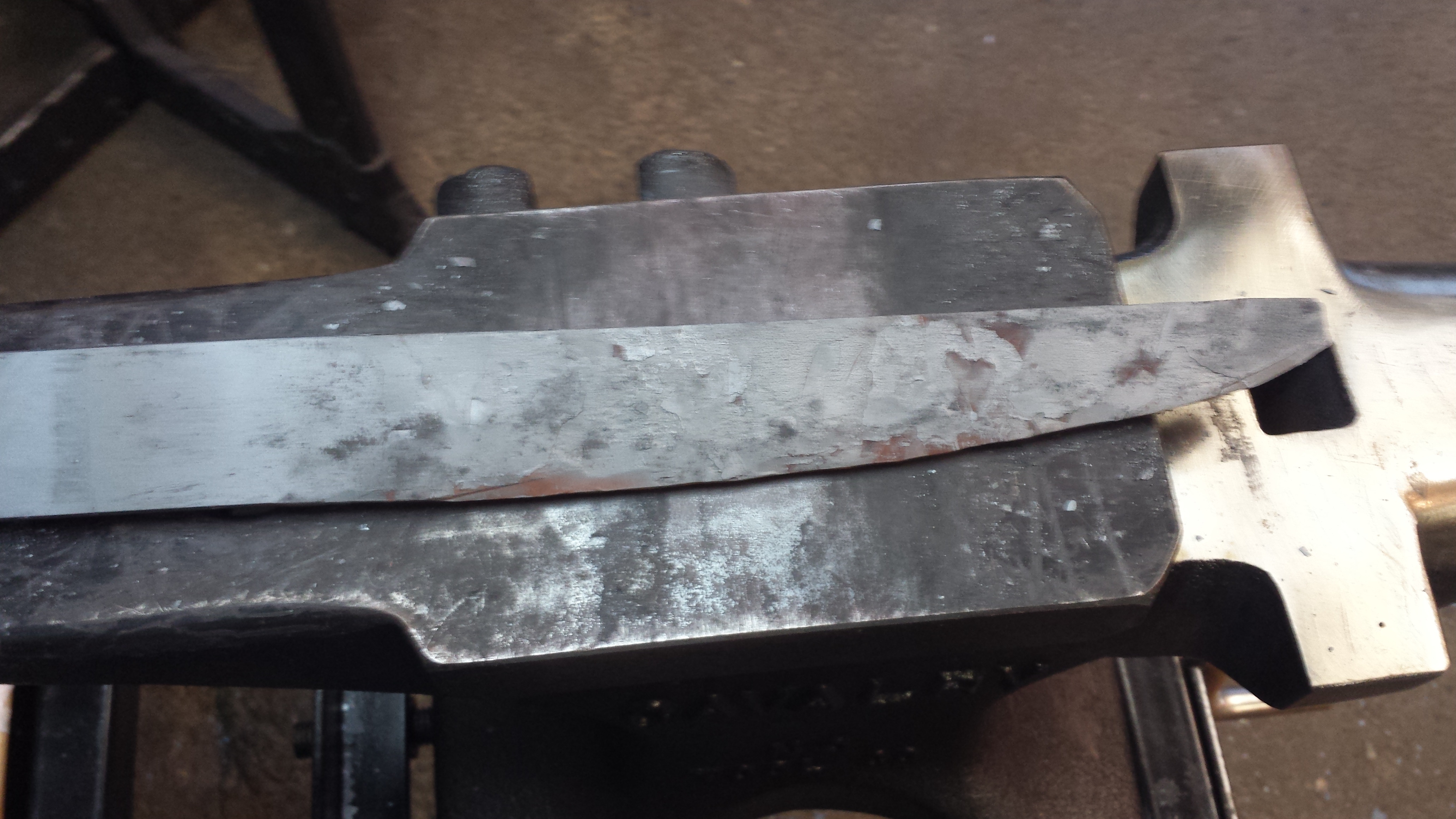
I just got back from the forge and wanted to post my second attempt at a blade. It is very clear that until my hammer hand and arm increase in strength, hammer control will be a bit of a challenge. I tried to follow the advice that was give to me on this board. It will be easier to follow to the letter when that pesky hammer control gets better. Below are a couple shots . I just want to make sure that I am on the correct track.

e1d26wJ.jpg


mLZ4BZX.jpg


Best,

Tom
 
Lookin pretty good!

When you forge in the tip, you want to hang the end of the bar just barely over the edge of the anvil, maybe around 1/4" give or take, and to forge the point, you hammer on the top corner at an angle and back towards yourself, not downward and away, otherwise you'll end up creating a "fish mouth" where the end of the bar forms almost a "U" shape instead of making a clean point. You're basically upsetting that top corner of the barstock, then hitting it flat, then upsetting it towards yourself again, then flattening again and so on.

There's a decent amount of good bladesmithing vids on youtube these days. The one posted above with Matthew Parkinson is deffinitely a very good one!

Here's another by Master Smith Lin Rhea, and he shows a few neat tricks, like how to correct the upward banana curve after forging in the bevels without having to give the blade a deep recurve prior to forging the bevels in.

[video=youtube;vt77Mut5l84]https://www.youtube.com/watch?v=vt77Mut5l84[/video]

I'll find some more vids for ya in your want. I've been adding quite a bit of bladesmithing vids to my youtube playlist for some years now, and only try to add the good ones ;)

Keep at it man!

~Paul

My YT Channel Lsubslimed
 
Last edited:
Back
Top