New Design - Tests - Questions (9 pics)

Burchtree

KnifeMaker & Moderator
Moderator
Joined
Mar 15, 2002
Messages
5,368
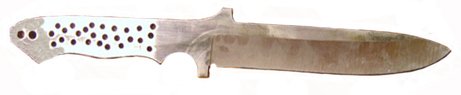
I believe I'm going to call this one the "B.U.S.K." (burch utility survival knife). It needs a lot of refining, but it is getting there. This is a project I've been wanting to do for awhile, but finally got around to doing it. I wanted to use a good, field-use steel and create some blades that can be comfortable and readily usable at the campsite, or in a survival situation.

After searching long and hard, I found a distributor that sold good L-6 in flat-stock of 1/4. The blade of this is 7 inches and it is 13 1/4-inches long. Obviously, it is just roughly-finished, but I wanted to test out the steel and my heat-treat. I went with a hollow ground but am wondering if I should do a flat grind due to the thickness of the steel.

Anyway, the handle is set up to allow for choking up, or "choking back" for heavy chopping. It has no problem going through wood and still shaved and sliced paper afterward. Any thoughts on other practical tests I could run this through? Any ideas or criticism on the design would be appreciated too. One thing that has been brought up is to upen up the choil to allow for another finger purchase.

Thanks for checking it out --

busk1.jpg


busk2.jpg


busk3.jpg
 
And some more -- I did some chopping into a 4x4 and a 2x4. It sailed through the 2x4 and actually threw the two pieces apart due to the thicker spine.

busk4.jpg


busk5.jpg


busk6.jpg
 
I did some lateral stress-testing by chipping away some treated 2x4s. I also drive the tip into a crappy pine and popped it apart. Afterward, it still shaved hair and paper without getting a touch-up.

busk7.jpg


busk8.jpg


busk9.jpg


So, there it is -- any criticisms, or thoughts on more testing ideas?

Thanks -- Burch
 
Test out the feel of it chopping wise along the blade with different hand grips, not just where you feel most comfortable. Do some wood cutting and shaping work as well as scraping. Try it out on various vegetations and as many types of wood as you can locally, fresh pine is very different than 2x4 lumber.

Use the blade when wet, misty or raining out to get a feel for how much corrosion is a factor. How long do you need to leave it unused when wet before you can see spots on the blade. Will it actually rust enough while just working in the wet to degrade the edge?

How versatile is the design? Does it work well as a draw knife, can you use it to fillet a fish, sharpen a stick for a cooking skewer and then baton split a twisted piece of knotty spruce?

Take it and do a fully hard power chop into a rock. Is the damage constrained to the edge or can you blow the primary grind? Use it for some very hard cutting like used carpet or digging and restore the edge with a benchstone *not* power equipment which no one will have in the field.

Do some point work, drilling in woods, fine work as wel as heavy, where does the balance of performance lie. Bend the blade, how much work does it take to flex it? Where will it take a set, where will it break? How does it respond to really heavy impacts, both being hammered upon/with?

-Cliff
 
I have always been intrigued by this steel and will be following this with great interest.


Cerberus :cool:
 
Good ideas on testing. This well be gun-koted, but seeing how corrosion effects the edge will be interesting. The blade should be "field sharpenable" and is one of the reasons I chose this steel over some of the new stainless steels.

I did a quick "photochop" on it to see how it would look with a bigger choil and a clipped front. I don't think I would lose much power in the chop with the clip but would get more versatility out of the blade. Any thoughts?
 

Attachments

  • buskclipped.jpg
    buskclipped.jpg
    7.8 KB · Views: 107
Looks great Burch. :thumbup: What was your recipe for HT? I wouldn't mind giving some L6 a try.
Scott
 
Assuming the speed holes are for weight, you might get a better feeling blade if it was tapered instead. Plus in general I don't like sticking holes in the handle of a blade which may be used for pyring.

-Cliff
 
Burch,

That blade looks nice. I really like the idea of a large choil as one needs to choke up on it now and then.

I think a forward balance is very important for chopping in a survival knife.

Test it full weight and imbedded for prying strength.

Looks like a nice start.

Skam
 
Razorback - Knives said:
Looks great Burch. :thumbup: What was your recipe for HT? I wouldn't mind giving some L6 a try.
Scott

slow heat, triple-normalized, triple-quenched and triple-tempered at 425.


Cliff -- the tapered tang might add some comfort, but I doubt the holes will give during any human prying.
 
Sweet blade.I like simple knives.The fewer pieces the better(less can go wrong with fewer parts).Great job :thumbup: :thumbup:
 
Nice looking blade. I'd vote to open up the choil since I like to be able to really choke up if necessary.
 
numberthree said:
Nice looking blade. I'd vote to open up the choil since I like to be able to really choke up if necessary.

I like this knife. I like the design except for one thing.
As I was reading this thread I found out that I'm in the minority. I don't like an open choil. It just seems to get caught on stuff.

Why not close the choil, bringing the blade back to the choil. Then you wouldn't have to choke up on it. It'd be safer to keep your fingers away from the blade. Just my opinion.
 
That is a good point. If you've already got a place to comfortably choke up, why not just bring the edge back to that area. A lot of things to think about for "Proto II." :)

And of course, a crappy photoshop pic of what that would look like:
 

Attachments

  • buskchoiless.jpg
    buskchoiless.jpg
    6.3 KB · Views: 54
I do mine somewhat like that.....deep finger groove as close to ricasso as possible, with a short ricasso. Obviously this isnt a wilderness knife, but heres a pic:
2.jpg
 
I supose the choil is there to use the belly, like on a shorter blade. If so, IMHO, the upper guard can get in the way. No use for it, again IMHO.
When chocking down the handle to chopping, maybe a sort of bigger bird's beack (sp?) would be useful.
 
The blade looks like it is coming aling, nicely, so far.

I like upper guards, and do find them useful.

I'd prefer if the finger groove behind the guard was a bit smaller, like the width of the choil. I have narrow hands, with light bones set pretty close together (which isn't that uncommon), and the way you have the finger groove would force me to spread my pointer finger and my middle finger too far apart from each other for a secure grip and for comfort.

I'd also prefer a full-flat grind.

--Mike
 
Back
Top