
-
The BladeForums.com 2024 Traditional Knife is available! Price is $250 ea (shipped within CONUS).
Order here: https://www.bladeforums.com/help/2024-traditional/
You are using an out of date browser. It may not display this or other websites correctly.
You should upgrade or use an alternative browser.
You should upgrade or use an alternative browser.
New "Dream Blade" material?
- Thread starter Will York
- Start date


- Joined
- Dec 5, 2005
- Messages
- 2,018
Let's put this into perspective folks. A monomolecular layer of "graphene" is 100x stronger than steel and transparent. However, a monomolecular layer of iron would be as transparent (metal films are transparent or nearly so up to several atoms in thickness because they are basically dense cores diffusely scattered within an electron cloud- and it is easy for a photon of light to slip between the nuclei when they are as diffuse as they would be in a metal monolayer), and completely unable to support itself (metal monolayers must be deposited onto solid supports). Saying graphene is stronger than steel is like saying a book worm is stronger than a worm. Look up the photoelectric effect for some more (and better) explanation of the properties of metal monolayers.
Metals derive much of their strength from their surrounding atoms. Each "layer," if you want to think like that, supports the neighboring layers- as the larger the electron cloud grows, the more metal nuclei that can be retained within (this is a pretty poor explanation but is approximately correct). Graphene layers stacked together great graphite. Graphite is great for a solid lubricant or pencil lead because each layer is only held to the layers next to it by the very weak van der waals forces. As anyone that has ever used a pencil knows, it is easy to create a line with graphite (and that line is graphene layers sheared from the bulk graphite substrate- the pencil lead). Graphene is not a wonder material, it is a monolayer of graphite.
By the way, many people know Einstein for his famous equation E=mc^2 and his theories of specific and general relativity, but few know that he won the nobel prize not for any of that but for his work on...
wait for it...
wait for it...
the photo electric effect.
Metals derive much of their strength from their surrounding atoms. Each "layer," if you want to think like that, supports the neighboring layers- as the larger the electron cloud grows, the more metal nuclei that can be retained within (this is a pretty poor explanation but is approximately correct). Graphene layers stacked together great graphite. Graphite is great for a solid lubricant or pencil lead because each layer is only held to the layers next to it by the very weak van der waals forces. As anyone that has ever used a pencil knows, it is easy to create a line with graphite (and that line is graphene layers sheared from the bulk graphite substrate- the pencil lead). Graphene is not a wonder material, it is a monolayer of graphite.
By the way, many people know Einstein for his famous equation E=mc^2 and his theories of specific and general relativity, but few know that he won the nobel prize not for any of that but for his work on...
wait for it...
wait for it...
the photo electric effect.

- Joined
- Jan 21, 2000
- Messages
- 8,888
Once layers of graphene are stacked together to create a 3d structure, that structure is graphite. Unfortunately, graphite does not make a great structural material, as there are no chemical bonds between the layers or sheets of graphene...
So now that physical separation of the graphene sheets has been accomplished, all that needs be introduced is a catalyst between sheets that results in a strong chemical bond? Sounds like we're practically there!


TheBladeMaster
BANNED
- Joined
- Jan 12, 2011
- Messages
- 471
What if you wraped it and fused it somehow around satin infi!
- Joined
- Dec 5, 2005
- Messages
- 2,018
So now that physical separation of the graphene sheets has been accomplished, all that needs be introduced is a catalyst between sheets that results in a strong chemical bond? Sounds like we're practically there!
Carbon can make 4 bonds. In cyclohexane (a six membered carbon ring), two of those bonds are to neighboring carbon atoms, and two of those bonds are to hydrogen atoms. Cyclohexane can adopt two conformations, one that is roughly lawn chair shaped, and one that is roughly canoe or boat shaped. In benzene (also a six membered carbon ring), three bonds are to neighboring carbons (one single bond and one double bond) and one bond is to a hydrogen atom. Graphene is essentially a sheet of benzene molecules linked together, where the bond to hydrogen is replaced with a bond to another carbon. Because of the orientation of the molecular orbitals (the flight paths of the electrons) aromatic carbon rings can only form bonds in a planar orientation. In other words, not only is carbon constrained to too few bonds to reach out and bond to adjacent neighbors when in graphene form, but even if occasional bond donors and acceptors were available, these bonds could not be made across the layers because they are in the wrong orientation (parallel to the plane of the layer and not perpendicular to the plane of the layer). Graphene derives it's strength from the aromtic nature- each carbon atom is bound to 3 other carbon atoms by 1.5 bonds on average (graphene is one hugh aromatic). Substituting in other atoms that could do cross-layer chemistry (in sufficient quantity to matter) would likely reduce or eliminate the aromatic nature of the graphene that gives it strength...
- Joined
- Jan 21, 2000
- Messages
- 8,888
... Substituting in other atoms that could do cross-layer chemistry (in sufficient quantity to matter) would likely reduce or eliminate the aromatic nature of the graphene that gives it strength...
Okay, so I guess maybe it's not a done deal.
Seriously, I appreciate your succinct explanation. One of the reasons I like this place is that among INFI lovers are many blade afficionados well-educated in the physical sciences. I doubt I would have found nearly the wealth of information contributed to this thread from a scientific standpoint if I'd posted in the General Discussion forum.
That said, "likely reduce" still leaves us a little wiggle room for the imagination, and as Einstein himself pointed out, "Imagination is more important than knowledge." Obviously, the properties of carbon structures are widely varied in nature and still beckon us toward new horizons of discovery.
Fun stuff, at least to me. I remember many years ago having a dream about a knife that began cutting out beyond the visible part of the blade flat because the edge was so thin it was invisible to the human eye. The description of graphene in the article reminded me of that dream. I still wonder if it was the result of divine vision or, more likely, bad pizza.
Thanks to all for humoring me.

AZTimT
The Stripetition Finish Guy (inactive)
- Joined
- Oct 15, 2009
- Messages
- 4,506
I'll stick with INFI. Before you get too excited about the concept be aware that this is the most expensive material on the planet at around $3,000 per gram,  unless the price has changed recently. I specifically remember listening to an hour long show on the radio several months back about graphene and that was what got me over my excitement about the same possibilities in a hurry.
unless the price has changed recently. I specifically remember listening to an hour long show on the radio several months back about graphene and that was what got me over my excitement about the same possibilities in a hurry.
- Joined
- Jul 20, 2009
- Messages
- 283
LOL. You guys are too much.


- Joined
- Mar 10, 2002
- Messages
- 19,808
any thinner than that and you would ne splitting atoms!
.
.
Unfortunately it seems that most of these new "strongest materials ever" are only strong when looking at the strength to weight ratio (as previously noted).
And more importantly that's tensile strength, not the incredibly high compressive strength that a knife needs, along with tensile strength, flexibility, plasticity, not to mention wear resistance and potentially corrosion resistance.
On one end we have ceramics, which would be great if only they had a little flexibility and plasticity. On the other end we have stuff like Graphene, which will probably replace carbon fiber someday, but is even less suitable for use in a knife.
And more importantly that's tensile strength, not the incredibly high compressive strength that a knife needs, along with tensile strength, flexibility, plasticity, not to mention wear resistance and potentially corrosion resistance.
On one end we have ceramics, which would be great if only they had a little flexibility and plasticity. On the other end we have stuff like Graphene, which will probably replace carbon fiber someday, but is even less suitable for use in a knife.
- Joined
- Apr 20, 2010
- Messages
- 111
By the way, many people know Einstein for his famous equation E=mc^2 and his theories of specific and general relativity, but few know that he won the nobel prize not for any of that but for his work on...
wait for it...
wait for it...
the photo electric effect.
I was the only 16yr old at our state's Physics Olympiad who knew the answer to that and it won our team a shiny new HP calculator each!
... First time I've thought about that for 15 years. Permit my self indulgence

And yeah, graphene is like carbon nanotubes. Too early in development for it to be awesome in anything except laboratories. I'm hanging out for a diamond blade. If they can forge a MOAB shaped/sized diamond and polish an edge on it....
Very interesting article.
"The article states that graphene is believed to be the thinnest and strongest material in the world, more than one hundred times as strong as the strongest steel. It is "virtually transparent, extremely dense, and impermeable to gases and liquids," according to the article"
My first thought was it would revolutionize windows
especially in high rises. Flexible glass stronger than steel!
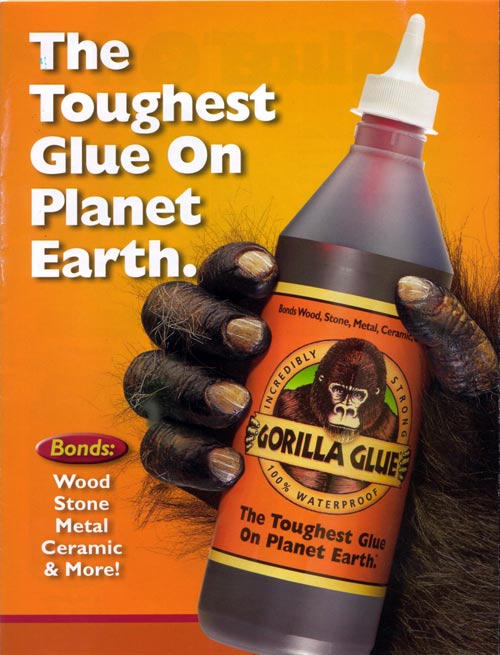
Duct tape and Gorilla Glue

"The article states that graphene is believed to be the thinnest and strongest material in the world, more than one hundred times as strong as the strongest steel. It is "virtually transparent, extremely dense, and impermeable to gases and liquids," according to the article"
My first thought was it would revolutionize windows
especially in high rises. Flexible glass stronger than steel!
Once layers of graphene are stacked together to create a 3d structure, that structure is graphite. Unfortunately, graphite does not make a great structural material, as there are no chemical bonds between the layers or sheets of graphene....
Duct tape and Gorilla Glue
- Joined
- Dec 5, 2005
- Messages
- 2,018
the van der waal's forces that hold sheets of graphene together are very weak relative to those of adhesive compounds. Adhesives adhere, surprise surprise. Graphite can be used as a lubricant- and as a writing implement. It is about as far from an adhesive as there is. I stand by the contention that graphene makes a poor structural material. If you want a knife made from gorilla glue and duct tape, more power to you- but I bet they don't make a great blade either.
- Joined
- Jul 20, 2009
- Messages
- 283
Sooooo----
Two atoms on the edge of a new miracle material blade were talking, when suddenly one says "Hey, I think I just dropped an electron." The other says "are you sure?", and the first says "yeah, I'm POSITIVE!"
Two atoms on the edge of a new miracle material blade were talking, when suddenly one says "Hey, I think I just dropped an electron." The other says "are you sure?", and the first says "yeah, I'm POSITIVE!"