New guy saying Hi.

Joined
Jan 26, 2008
Messages
11
Hello all my name is Gabe. I have been lurking here for a while soaking up tons of knowledge. I have decided to post some pics of my latest knife for you guys to review. This is the 11th knife I have made. The knife is 1095 HC with Cherry heartwood scales. Blade is 5" long, 3/16"thick and 2"at its widest. Thankyou for feedback in advance.
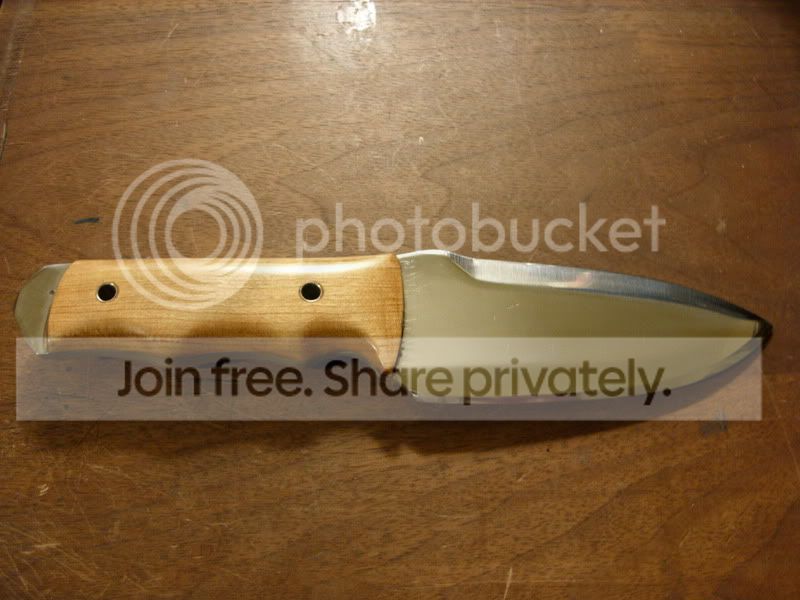
SDC10091.jpg
 
Welcome to the forums.

Overall an OK job.
Bringing the grind up the blade a bit will make a big difference.
Finish the blade a bit more next time before assembly ( and you won't have those scratches at the ricasso).
Stacy
 
Hello! welcome and thanks for posting a pic! man I gotta say your handles and overall polish is really good! A few things that need addresed is your bevels.
The Bevels need to be extended at least 3/4 up the blade.
and the grind/file scratches should all be sanded out.
You might want to use some tape on your blade after you polish it to keep those pesky scratches away.
Otherwise not to bad there man! :D :thumbup:

Jason
 
Gabe
Welcome.
Bring the grinds up some will help alot.

Where in central Ky? And how 'bout those Cats!
 
I am still working on blade geometry. I appreciate any advice or tips. Is a higher bevel simply aesthetics or does it serve a purpose? I live in Lexington, as for the Cats, well I am abnormal because I don't watch college sports.
 
Is a higher bevel simply aesthetics or does it serve a purpose?

Its both.
Think of a razor, that would be a zero grind, where there is little or no secondary bevel. There is very little steel behind the edge, so it slices through whatever you are cutting with little friction.
By bringing the grinds up you are reducing some friction while cutting.
 
So what angle should I use for the initial bevel and second bevel. Also is just a stingle flat grind better or is it better to have a second bevel.
 
an angle around 3-6 degrees per side with about 1/64" - 1/32" for the edge would be ideal for most knives, and the edge can be convexed to flow with the bevels.
 
I am partial to a full-height primary bevel, and a small 30-degree inclusive secondary bevel.

I like the slicing ability of the full flat grind, but it requires a secondary bevel. If you simply have a full flat grid terminating in the edge, the edge will be too thin to withstand any abuse.

I usually take the primary grind down to a thickness between .025" and .010" at the very edge. I then add the secondary bevel to establish and edge around 30-degrees inclusive. I thin blend the shoulder of the secondary bevel into the primary bevel (convex). This makes for a smooth transition between geometries.

Here's a photo illustrating the idea:

3555167018_5040128e46_o.jpg


The result on this knife, is a blade with low mass that slices with very little resistance and has a keen edge that is still durable.

Phillip
 
I figured after lurking for over a year I should finally post something. I am very glad I did. I have received lots of good advice to help me step up my skills. Most of which are the same things you said.
 
Welcome Gabe. I am about 45 minutes away from you in Anderson Co. Give me a holler if you want to hang a bit. I have a coal forge and all the fixings , up to a point.
 
Welcome, New Guy! No need for me to parrot previous comments, so let me just say keep on learning and good to have you.

Salem Straub
 
Find a maker that is available to have you come in the shop and learn, it is the quickest and best way. I learned more from Wayne Clay in 4 hrs than I had in 2 yrs on my own. That was 27 yrs ago, I'll be in Misery before the snow falls, you can come by if you like, can put you through making one that will answer a lot of ?'s.
 
I think its awesome. Keep making and posting pics.

Look up Mike Carter, and tell him I said hi. He is in Kentucky, and I know him to be quality people. There are a bunch of good makers in Ky. Gil Hibben lives there.
 
Back
Top