New Kitchen Knife Design *opinions*

Joined
Jan 10, 2011
Messages
1,448
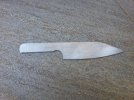
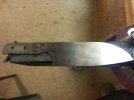
So I had a different project that I scrapped. I'm glad I posted the pics on this forum, because the opinions were right and the knife would have sucked. Below is my new design it's made out of 1/8 52100 steel. The blade is 6.25 " and the OAL is 10.5". I'm still messing with the handle contour.

I have seen some designs for kitchen knives were the plunge lines are hidden. I don't know how to do them any ideas?

20130714_151711.jpg
 
it looks alright for a "utility knife" (a short chefs knife) I would drop the point a bit. and for the plunge lines just do a full flat grind or a good convex and there wont be much if any plunge lines. hope that helps.
 
I would round the spine down to the point in a smooth curve. There is no point ( pun intended) in an angular tip like that on a kitchen knife.
Make the blade a FFG from spine to edge, with no plunge line at the edge. I just sweep in and out of the "plunge" as I grind the bevels and make it a smooth transition. The edge should be a continuous sharp surface right to the heel.
The handle you have will work, but is a bit blocky and may be a bit hand unfriendly. Look at some knives in your kitchen drawers and see what feels the best to you.

1/8" is a pretty thick kitchen knife, so be sure to add distal taper all the way down the blade and grind the bevels from spine to edge. This will lighten the blade as well as create a good slicing edge. After HT, take the bevels to an almost sharp edge. It should be just a barely flat surface down the edge. Maybe .005". Then finish everything else, and after the knife is done, put on the final sharp edge.
I find 400 grit is a good place to stop on kitchen blades.
 
Stacy ,

Should I start the plunge where the blade meets the handle ? Thank you for the advice.
 
you really dont want anything but edge down at the edge profile (no bolsters or plunge cut extra meat )
 
As Butch says, you just want the edge to be an edge. I grind the bevels as a FFG....right to the edge. As I reach where there would be a plunge, I just lighten the pressure and it makes a "rounded" or "curved" plunge. This starts right after the heel of the edge, and stops before the handle. It is much harder to explain that it is to do :) .

I have a batch I am working on. I'll try and take a photo tonight.
 
Careful not to take the edge too thin before heat treat. I made this mistake with an oil hardening steel, and I got the wavy bacon edge. I am no expert, just something to consider.
 
Here is a photo of the "sweeping" plunge I use on kitchen knives. The camera is aimed is directly at the edge after I pre-ground the bevels before HT. The stock is .125".
 

Attachments

  • DSCF1134.jpg
    DSCF1134.jpg
    36.7 KB · Views: 189
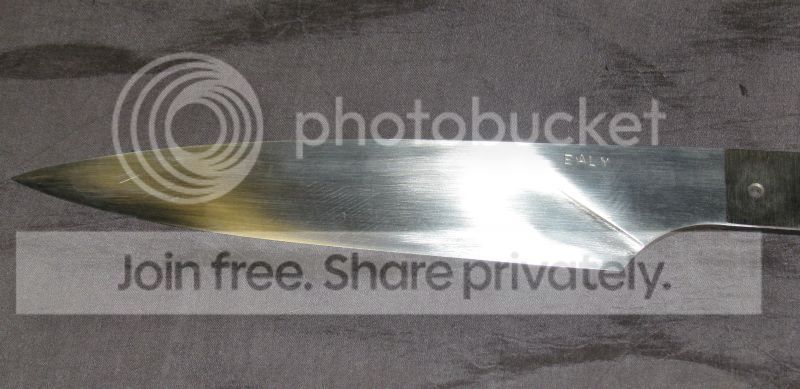
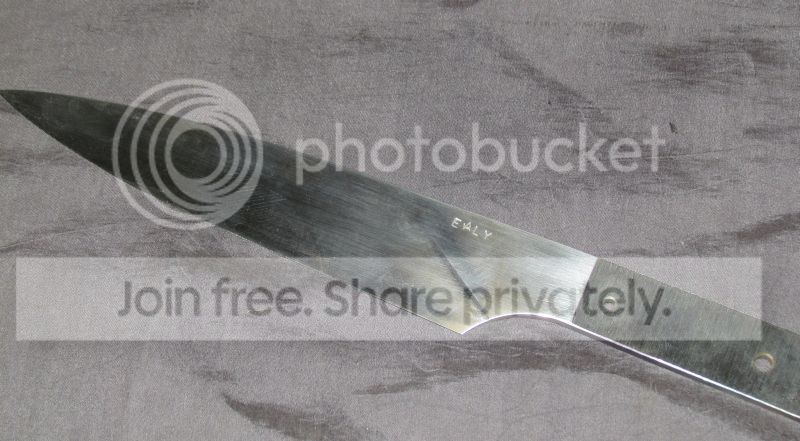
This is how Delbert Ealy does with his kitchen blades.
deb001_zps305c3636.jpg

deb002_zpsdc943281.jpg
 
There are many examples of classic chefs knives that do indeed have an extension of the bolster (that some call a finger guard ). this piece extends all the way to the edge. The one example in my kitchen is the J.A. Henckels .
That being said , to make a knife with such an extended bolster by stock removal would require some interesting solder work , or some seriously thick stock.
I have taken 1\8 inch down after the bolster to give that some more meat, and i have angled the " plunge" back as many have suggested. The angled plunge is easy but not classical or the only way to make a chefs knife.
Some prefer all edge , some dont.
 
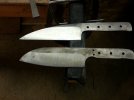
Here is an update to the kitchen knife I'm making for a friends wedding present. Per Stacy's advice I changed this to a santuko design. I have done a lot of grinding with a 60 grit blaze and feel like I have a ways to go. My question here is what should I do from here. These are both 1/8" 52100 and have been heat treated w/ cryo to 58-60

Take the grind all the way up and file the bevels flat ? Should I do a zero grind then add a micro bevel?

I put in the other design too, because I wanted the same advice.
attachment.php


20130830_203858.jpg
 
Those should be good kitchen blades.
Yes, take it to a zero edge and add a secondary micro-bevel for a very keen edge. I like a 400 grit finish then a Scotch-Brite belt for kitchen blades. Do all that and after the whole knife is done, add the secondary bevel as the very last step.
 
design looks good. don't understand the HT. perfect blade and steel for Rc62 at least, especially with the grind you chose. don't understand why you are using cryo on basic high carbon steel. jmho.
the old sailor
 
I agree with Scott about the hardness. Nothing wrong with Rc 58-60 kitchen knives, but you should easily be able to get Rc-61-62 from 52100 with the right HT and sub-zero/cryo. On a kitchen slicer, the extra wear resistance can be a big advantage.

Scott-
The HT for 52100 is a bit more complex than a simpler high carbon steel, because the 1.5% chromium makes it act more like an alloy steel. There are two commonly published schools of thought on the HT regime, and variations on those two. Hopefully, all of them are attaining the same results. I feel that if you carefully follow either system, you will get a good blade.
The metallurgical process requires spheroidizing the blade before HT and assuring a fully annealed, fine grain, and stress free blade. The spheroidization will make sure the carbides get evenly distributed in the austenitization. How to attain this is well and frequently discussed, and there is no need to repeat it here.

Once the blade is ready for hardening, austenitize at 1525-1550°F and soak for around ten to twenty minutes.
This is followed by a quench in a good quality medium speed oil.
The quench must be IMMEDIATELY* finished ( * see notes below) by lowering the blade to a minimum of -70°F and holding it there for at least one hour, which can be easily reached with dry ice and acetone ( home freezers don't get to -70°F). As soon as the blade cools in the oil to be cool enough to handle, wash and rinse it off gently, and place in the sub-zero or cryo tank. Whether cryo at -300°F gains any detectable extra toughness by converting the carbides is debated for 52100, but -70°F or lower is required to get full hardness.
Tempering must be done IMEDIATELY* after the blade warms up from the sub-zero treatment. Tempering at a minimum of 250°F is required too convert the brittle tetragonal martensite into tougher cubic martensite. 300°F will yield around Rc63, and 350°F will get Rc61-62.
Temper twice.

*NOTES:
Some use a 30 minute snap temper at 250F to avoid cracks forming in the sub-zero/cryo end of the quench.....and some don't. Both camps seem to claim the same end result, so how necessary a snap temper is, is arguable. It may cause a loss of a point in hardness, but gain several points in sanity for those who can't stand the risk of a blade cracking in HT. My understanding is that the HT guys who do this professionally go from quench to sub-zero in a continuous drop. Some home shops guys recommend suspending the blade over the LN for ten minutes and then lowering it in to allow the blade to cool down more gently. With Dry ice and acetone, I don't think there is any need to delay the quench cooling beyond bringing the blade down to around 100°F and washing it off ( which should cool it more, to about 70-80°F), then placing it in the dry ice slurry.

If not doing a sub-zero/cryo treatment, the temper should follow the quench when the steel has cooled to around 100-120°F. Without the sub-zero/cryo, there will be some amount of stable/permanent RA. This isn't a harmful thing, just something that will affect the final hardness by a point or two.

IMMEDIATELY in 52100 is really immediately. Any delay will result in lower final hardness. The quench does not finish converting the austenite into martensite until it reaches -70°F, so any delay in getting it down to that temperature will aid in stabilizing the RA, yielding lower final hardness.
Use good sense in determining what constitutes a "delay". There is no need to run across the room in a hurry to dunk it in the LN, but don't go eat dinner or wait until morning while the blade is cooling off from the quench, either.

 
I recently did a 52100 blade with a very similar HT to what Stacy posted. I did the HT twice, because the first time the tip didn't fully harden. I went from quench to 400f temper, and I think I didn't keep it in quench long enough holding too much heat in the blade. I used my freezer on the second attempt, which doesn't get completely to -70, but -35 is better than +72 at room temperature. I will be getting dry ice for the next blade I do. This blade turned out to be the best blade I have made thus far. I cut over 100 pieces of 8oz leather, chopped through a 2x4, and it still shaves. It went to my hunter friend who will be testing it on a moose this fall.
 
I didn't decide to do cryo. Paul bos does it for all blades they heat treat. I might be wrong on the hardness. My kid threw away the work order so I need to call them to get a new one.
 
to all:
just going by advise received in another forum. heat 52100 blade to 1625-1650, allow to equalize, cool in still air to room temperature. heat to 1475-1500(for best results, do not exceed 1500), soak for 20-30 minutes, quench in medium oil, temper at 350 for 1 hour, Rc62-63 should result.
want to make sure recipe is right, Aldo is selling Annealed 52100 with 95% spherodized carbides 52100 for less than 1084 and it is available in 3/32" thickness; just what I need for paring knives and kitchen slicers.
the old sailor
 
Last edited:
Update pic. This is hand rubbed to 400 and buffed I'm going to 500 then 600 then buff with white compound. Let me know what you think.

BTW The edge is ground to .002

attachment.php


20130903_225317.jpg
 
Back
Top