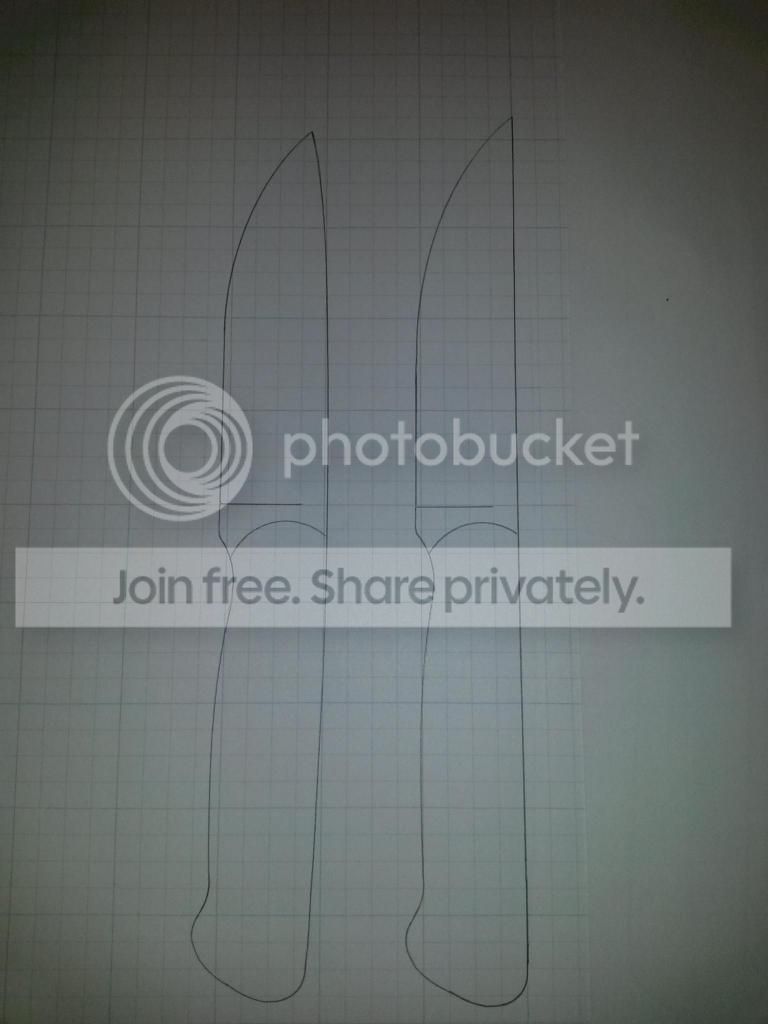
I like the top one best. Probably due to the fact that I am not a big fan of scandi grinds unless it is really thin stock. If the middle one isn't intended to be a scandi grind then you might want to think about raising your bevel closer to the spine. One thing that does stick out to me (pun intended) is the termination point at the top of the handle on the pommel end, kinda pointy and if it doesn't effect the grip then it might still cause some discomfort if worn in a belt sheath. In the bottom drawing you have rounded that part and I like it better. Also there might be a little too much curve to the spine if you trace the outline of the big french curve fully. One thing you can do is trace half of the spine with the part of the french curve that has the largest radius then flip it over to do the other half. The point won't be so far down then. I like my point to drop about 1/4" or less, on a one inch wide blade, from the highest point of the spine in a drop or clip point but that is really just personal opinion. (really all of this is just personal opinion)
As far as using the french curves, I've looked for appropriate tutorials or instruction on how one is "supposed" to use them with very little success. One of my assistant coaches (I'm a high school girls soccer coach) is an art teacher and I asked her if there was any special technique for their use and she really didn't have anything to offer beyond connecting two points or a series of points. I have just played around with them and tried to find different parts to use here and there. I use the big one the most. I like the little ear shaped protrusion on the bottom (if the the big increasing/decreasing radius is on top) for the pommel end of the handle tracing. The middle size one is good for making a round handle end if you trace the top half of the curly cue on the end, then flip it over to complete the bottom half. Hope that makes sense.
One thing that I bet you have on hand are some plastic cups and bowls like the big tubs margarine comes in. These work great because you can squeeze or manipulate the amount of radius at the rim to suit various tracing needs. A big soft plastic serving bowl like my wife uses for potato chips at bday parties, also works well in the same fashion. Steaming a chop stick and setting a slight bow in it can give a really nice large radius curve. A heavy gauge piece of copper wire can be used likewise. Don't waste your money on one of those flexible curves, they are very difficult to get nice consistent transitions with, at least for me.
While drawing, not only do I try to keep in mind what my intended purpose is but also what the potential materials are and how I will go about making it if so inclined. Sometimes I draw a knife around a particular type or piece of handle material I see while shopping the suppliers sites. As an example a lot of my drawings lately have been for a drop point or clip point hunter with bolsters fore and aft and a piece of stag or rams horn in the middle. I'm still working on getting the proportions of the bolsters and horn right but they are looking better. On another reoccurring design, I always picture red linen micarta as the handle material and draw accordingly. I have no idea why that particular color and material inspire this certain profile but that's just how my mind works I guess. Keep in mind the 3 dimensional curve of the handle when indicating pins or lanyard holes. Can't put them too close to the edge cause it's hopefully gonna be rounded there.
I think that we are both mostly envisioning full tang construction and that is where I am at skill wise. But I also like to draw hidden tang and frame handle designs along with traditional construction Japanese tanto designs. These are well beyond my abilities at present but it has really helped me to under stand how it all goes together. I also like to draw kukri and kukri inspired full tangs which are well down the road for me. But they are so visually appealing. Point being I was initially afraid to try and draw such but once past that hurdle I have found that it has really increased my ability to envision or zen-like practice knife making.
Okay, well you guys thought Ian Hall was long winded.

Happy drawing, maybe some more people with much more knowledge than I will chime in concerning your designs or knife drawing in general.