New Member...First blades

Joined
Nov 13, 2013
Messages
201
Couldn't really decide where to post this, so if I am in the wrong subforum, please advise.

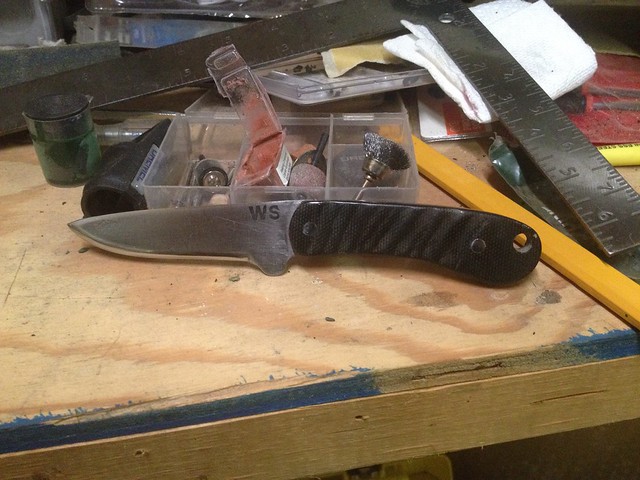
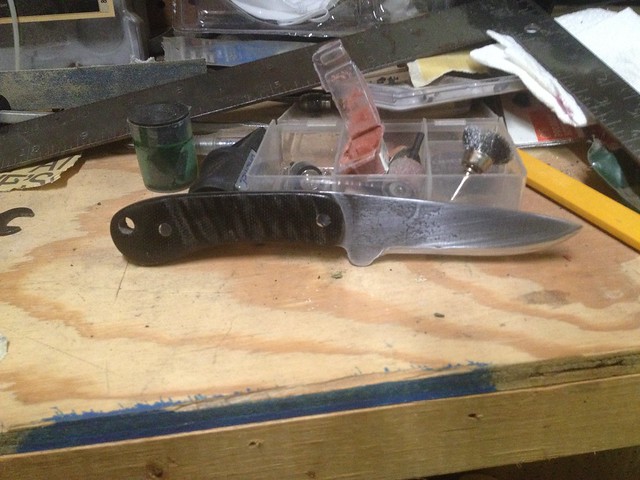
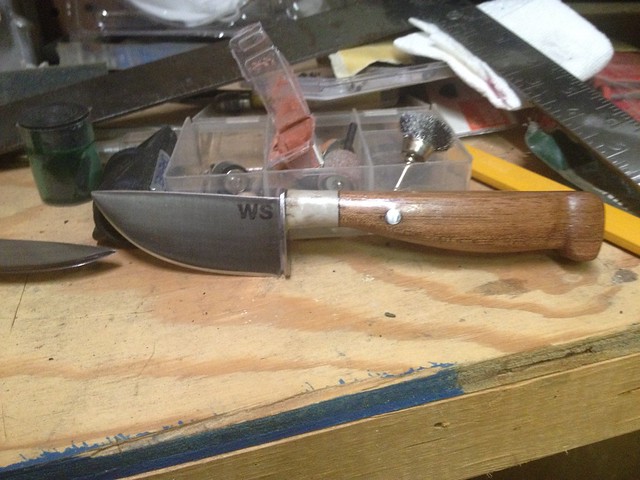
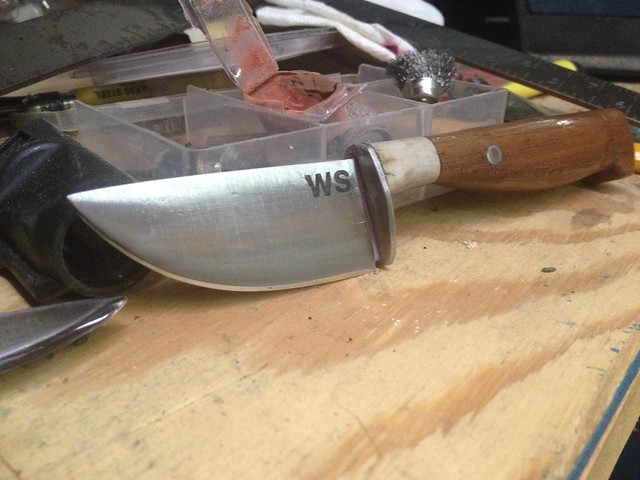
Im new here, and generally new to knife making. I have carried pocket knives most of my life, but would not have said I have really been "into" knives. Then a few months ago I saw someone talk about "making" knives by buying blanks and putting on handles. I decided that was something that interested me, and off I went. After a few of those and doing some research about knife making, I decided it was time to try to make a few blades. I got a few old saw blades from my dad's shop and a HF 1x30 and off I went. Here are the first 2. I designed, profiled, beveled, heat treated, handled, and sharpened these. HT was done in a webber grill with a squirrel cage fan hooked up to the intake, and quenched in peanut oil and tempered at 400 for 1hr. I plan to make a few more saw blade knives, and then move on to known steels.
10917694056_7924598729_z.jpg


10917777904_ddc5e33688_z.jpg


10917625205_aa6101cb65_z.jpg


10917687096_d8f0caf4a6_z.jpg


Well that is my intro to BF, and I appreciate any comments or feedback.
 
Welcome to Shop Talk. My wife is from Gulfport and we have family down there.

The smaller knife is on track, but the big one is terrible.
The edge on the smaller one looks like it does not have much of a bevel? The lines of the blade and handle are good.
The big one looks off in almost every proportion and alignment.
 
Last edited:
Looks like you are hooked,stick with it.I have been to Gulf Port many times,we use to go every year to the Gulf Port Drag Strip/BlowOut.All Harley Drag Race.Good times in that town.
Eddie
 
Thanks for the welcome (FYI - It's one word...Gulfport. :cool:)

The steel is only 1/16" thick so I def struggled with the bevels. The smaller one is just a convex bevel that I did on the slack part of the belt. On the larger I attempted to use the platen and get a flat grind, but it didnt turn out so well.

When you say "off in almost every proportion and alignment" are you speaking of the bevels or the knife as a whole. If the bevels, I understand and agree. If the knife as a whole, can you explain further?
 
Looks like you are hooked,stick with it.I have been to Gulf Port many times,we use to go every year to the Gulf Port Drag Strip/BlowOut.All Harley Drag Race.Good times in that town.
Eddie

Yeah, I'm hooked, only limited by time and $$$. :rolleyes:

"The Blowout" is pretty wild. My dad used to go pretty regularly, and I've seen plenty pics!

I lived in Bham for a few years post Katrina...still own a house there.
 
By off he means the proportions and flow of the pattern.

One trick I've taught myself is once I get a pattern roughed out, to imagine it in painter's strokes, or perhaps the graceful strokes of a Asian calligrapher.

IMO, a "good" pattern should be something that you could lay down with a few fluid swipes of a brush. You want the lines of the handle and blade to flow into each other, and also be in proportion to each other. You don't want an excessively long handle on a short blade, or too skinny of a neck on a wide blade.

I've seen some paring knives and even some skinners with slim necks so they can be spun easily between the fingers, but they should have a slim blade and overall profile to match.

Not aesthetically speaking, the handle might be a bit thin mechanically as well.
 
Ok...I think I am following a little better, but may be a little confused as to which of the two we are talking about as off. "Smaller" isn't working for me as a designator, as they are about the same size, but one (the first knife) has a shorter and a little wider blade, and the second has a little longer blade.

FWIW, my personal opinion is that knife #1 is a bit off on everything after the blade itself. From the guard back everything is a bit out of square. And though the neck looks strange, it actually feels pretty good in the hand. Knife #2 I think has a decent "design", but I think the bevels came out terrible (can't really tell in the pics though).

So with that being said, do you agree that #2 is the one that is on track, and #1 is off???
 
The handle should never be higher then the blade. Well, never say never, but... The pin is to big, or, the handle is to thin in that area. The smaller one looks pretty good. Each one will get better. The more you learn, the more you "see". It amazes me how I can think something look great, only to have someone point out how it would look better, then I can't see how I ever liked it before.
 
Great job! For your first two knives, you're on the right track. Keep up the research and practice practice practice. They will only get better from here on! :)
 
Last edited:
I don't think either one of them look "Terrible". If you are indeed new at making knives, I think you are headed in the right direction.

My only advice would be to:

#1. Look at other knives. Look at their overall shape, handle design, guards or finger grooves, and try to visualize how it would function in your hand.

#2. Do lots of reading, both on steel choice, heat treating, and blade geometry.

#3. Find a maker in your area and see if you can visit him/her. Attend any hammer-ins in your area. There are a lot of great makers in MS. Seek them out and learn from them.

Keep working at it.

Robert
 
The handle should never be higher then the blade. Well, never say never, but... The pin is to big, or, the handle is to thin in that area. The smaller one looks pretty good. Each one will get better. The more you learn, the more you "see". It amazes me how I can think something look great, only to have someone point out how it would look better, then I can't see how I ever liked it before.

Ok. That helps.

Thanks all for the replies.
 
Dang autospell....yes, it is Gulfport.

Keep at it , and the shape will become more self intuitive. The second knife has a good general shape, but the big bump at the end of the edge needs to be refined or eliminated.
As suggested, look at a lot of pictures of knives and see what the common features are. You will discover that a slight curve to the spine and handle. A smooth flow from handle to spine. And a blade edge that roughly matches the line of the bottom of the handle are great features. You did well by including all of those.
 
Back
Top