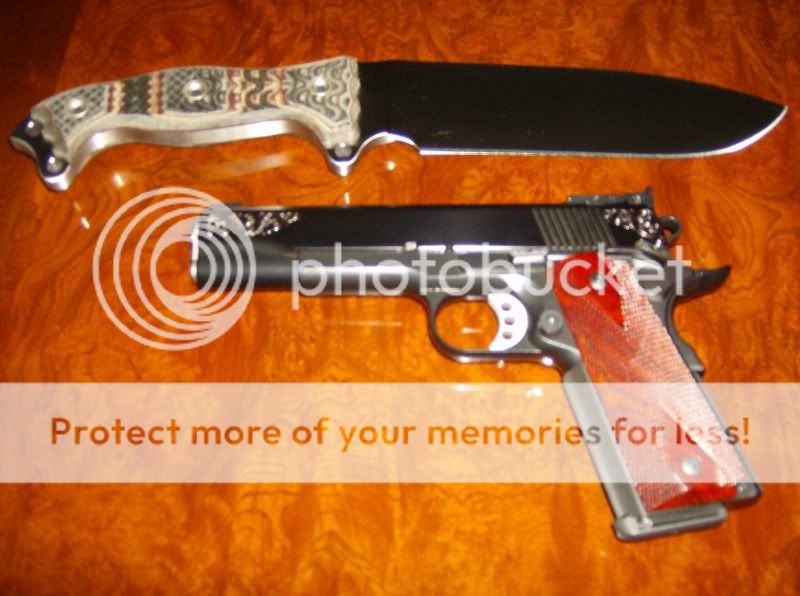
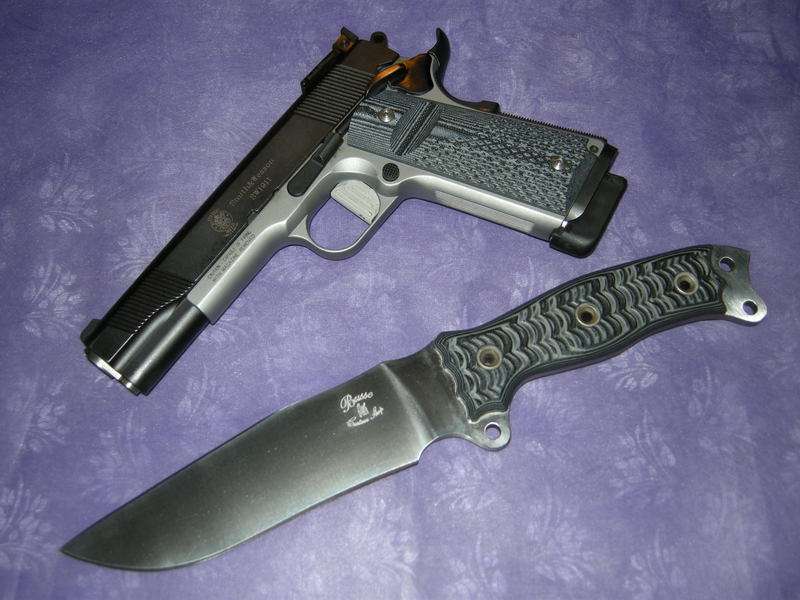
Very nice looking sidearm you picked up there... Congrats!!
Now if I can just learn how to take better pictures...
Follow the links here for tips 'n tricks 'n techniques on taking pics of knives and the like.
Overall, I'd say your pictures are composed interestingly to show the very nice subject matter. You seem to have an eye drawn to geometric or architectural composition.
Picking backgrounds can get tricky. Plain untextured backgrounds like you used work well for not distracting the viewer's eye from the subject matter and make composing the shot much simpler. This is especially true for neophytes, who have a tendency to overwhelm the subject with all the cool things they can jam in the frame with it. However, plain backgrounds do not offer much support via context, repetition, or implication for the subject, i.e. things like molle gear or other military/combat accessories for your EB piece.
Note how UDDwaine's shots have backgrounds similarly textured to the texture of the grips -- burlap crosshatching with the diamond grips and wrinkles with the zigzagging micarta knife handle and grips -- but done with colors that contrast with the subject. I'm not sure if he did that on purpose or if it is a coincidence, but it is an interesting effect. That can be a double-edge sword. The similarity of texture gives unity to the entire frame and ties it together. The danger is that the lack of textural distinction of the subject can cause it to get lost visually, disappearing into a too-similar background. UDDwaine's color contrast saves his shots from that fate.
Your lighting appears to be somewhat insufficient and spotty. A light diffuser (tent) is your friend.

More light sources and reflectors to create fill light would eliminate a lot of the localization of light. Note that your "nose shot" with more even light distribution on the subject doesn't suffer this condition as much as the shots that were taken from further back. That points again to a diffuser as a solution. At least you didn't use the on-camera flash, which almost inevitably leads to flattening of the subject matter.
Not sure how true-to-life the colors are or if the perceived color shift is due to the background color and/or lighting color, but your shots appears to be shifted toward the yellowish or reddish segment of the spectrum. Setting your camera's white balance with a sheet of white paper can at least get the lighting and the camera in sync as far as the color temp goes.
Do you use or have access to Photoshop or other image manipulation software? Sharpening, contrast enhancement, or color adjustment can get handled post-session with them pretty readily. Most digi-cameras, especially point 'n shoot ones, create a fuzziness in the image that sharpening post-session helps a lot.
HTH.