Newb question - stock removal

Joined
Apr 10, 2010
Messages
2
While I gather my parts and supplies to build my no weld grinder, I am reading voraciously here and other forums.

I have bought a few knife blanks from Ebay and from Texas Knife suppliers, all with the edges cut in, and some with bolsters to practice putting scales on.

My next step is to have some knife blanks that are all the same cut out (Am working on the CAD drawings now). My intent there is to practice on the same knife blank to better my grinding technique.

I have a question though.

Is it acceptable to make a knife from a premade (polished with edge) knife blank? Do people sell those knives or are they only for their own personal use?

What percentage of knife makers; forge; stock remove; premade?

Thanks in advance.
 
I am still new to knife making but I have learned that forging to basic shape saves a lot of money. My first 3 blanks I did stock removal and nothing like watching money go up in smoke. I have blanks 4 and 5 shaped by pounding out the tangs and blade shape and have lost very little stock so far. Only stock I have lost is squaring the finger guard area. When it is all said and done what I started with will be a lot closer to what I finish with compared to the stock removal. For practice buying a pre-made blank would be a good practice piece but I would never consider it my knife I made. But that is just me.
 
yes its acceptable as long as you state that when selling the knives. as long as they know they are buying a knife made with a premade blade blank and fitted with a handle by you then its honorable and the educated buyer wont have an issue with it. i dont know about percentages but id say its a small percent that make knives for a living that use premade blanks but i have seen some out there. the most famous would be harry morseth who during some years had his knife blanks stamped out for him at the brussleto factory but to his own design and he then handled them himself. they had both brussleto stamping as well as morseth stamping. i guess its a little different since it was still his design but kind of applies here. in the long run i think most makers wont settle on using someone elses blank because that limits there creativity and the heart of the knife is in its blade so most makers wont put there trust elsewhere when it comes to this. hope this helps...
as a side note handling blanks are a great way to learn the craft in steps and again theres nothing wrong with selling these to an educated buyer. in the long run though you like all the rest of us will surely submit to the calling you feel to forge or grind that blade!
 
When I first started making knives a few years ago I just put handles on Jantz blades. I think that’s a great way to get started. It really helped me on handle and guard/bolster design. For me that is still the hardest to get right even after forging my blades. I'm with justyme it won't be long until your grinding or forging your own stuff. Until then have some fun and spend a little time reading on here and fill out your profile. There are plenty of guys that will offer an invite to their shop if you live close. Good luck.
 
I am still new to knife making but I have learned that forging to basic shape saves a lot of money. My first 3 blanks I did stock removal and nothing like watching money go up in smoke. I have blanks 4 and 5 shaped by pounding out the tangs and blade shape and have lost very little stock so far. Only stock I have lost is squaring the finger guard area. When it is all said and done what I started with will be a lot closer to what I finish with compared to the stock removal. For practice buying a pre-made blank would be a good practice piece but I would never consider it my knife I made. But that is just me.

You're fooling yourself. You may have saved maybe two dollars in steel, but you lost that much or more fueling your forge. Knife steel is cheap for the return. Even the exotic steels pay their own way. One way or another. Whether grinding, or forging, the cost to produce a blade equals out pretty close.
 
I am still new to knife making but I have learned that forging to basic shape saves a lot of money. My first 3 blanks I did stock removal and nothing like watching money go up in smoke
kinda hard to tell what you meant by this because it isn't a sentence, but speaking of watching money go up in smoke how much does fuel cost you? and if you use regular steel it is pretty cheep
 
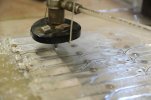
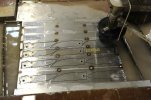
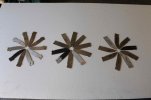
I'm just getting started also. I bought 5 of the $2.40 utility knife blades from North Coast Knives to practice on. I tried different materials and shapes on the handles and I even reprofiled 2 of the blades to practice my grinding skills. I totally screwed up one of the blades, but at $2.40 ... oh well. My next step is to try a couple of blanks from Great Lakes Waterjet that U.S.A Knifemakers has. I'm using mostly hand tools and a 1" X 42" Kalamazoo Grinder my friend lets me borrow. If I do the GLWJ Blanks I'll send them to Texas Knifemakers Supply for heat treat. I have been giving my knives to my friends because I don't feel right selling them until my quality is MUCH better.
 
Blanks made easy.
I save time with the bandsaw, bandsaw blades, belt grinder and belts.

H2Oknife
 

Attachments

  • DSC_2316.jpg
    DSC_2316.jpg
    49.4 KB · Views: 38
  • DSC_1866.jpg
    DSC_1866.jpg
    41.4 KB · Views: 44
  • DSC_1863.jpg
    DSC_1863.jpg
    57.7 KB · Views: 37
  • DSC_1868.jpg
    DSC_1868.jpg
    40.3 KB · Views: 41
A hammer may outstrip a belt grinder for bevels (probably not if you've got a 2 hp grinder) but it will not beat a bandsaw for profiling unless you have production forging equipment. The fuel cost vs. dust on the floor dosen't even address the biggest variable, which is your labor.
Forging does have it's uses, it can allow you to make better use of your stock size, and you can use stock that might otherwise be unuseable, but you have to be pretty fast to make it worthwhile to forge a blade of any complexity entirely to shape. Or maybe I'm just too slow with my hammer...
 
Back
Top