Newbee Open to any tips!

Joined
Dec 8, 2014
Messages
814
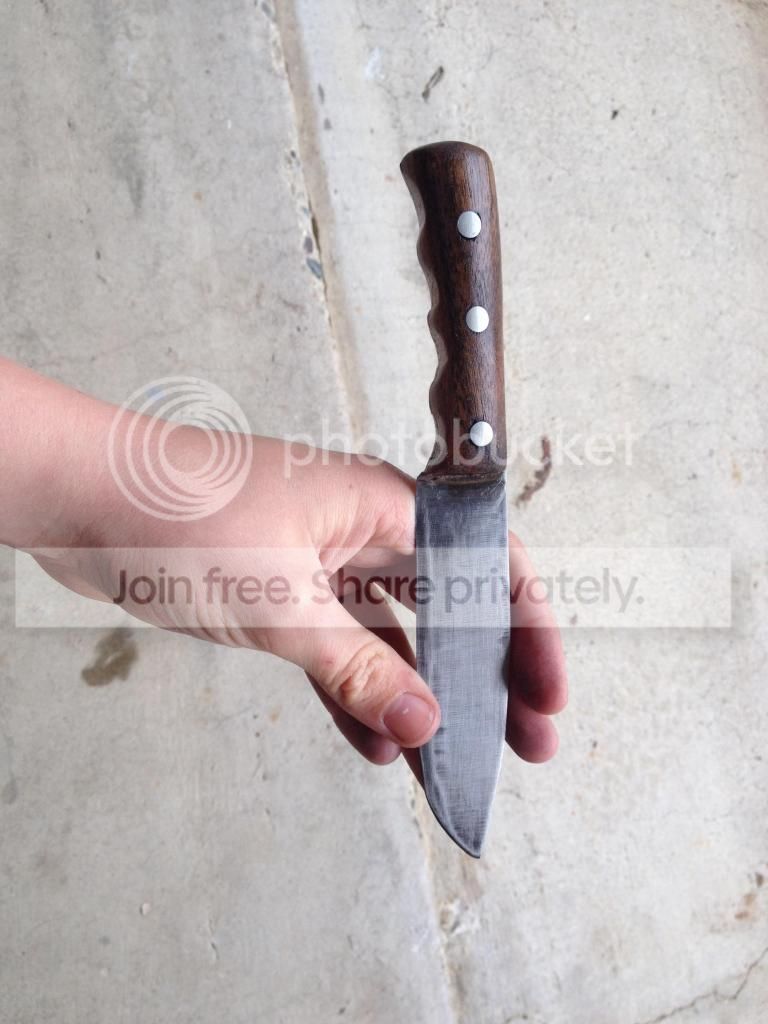
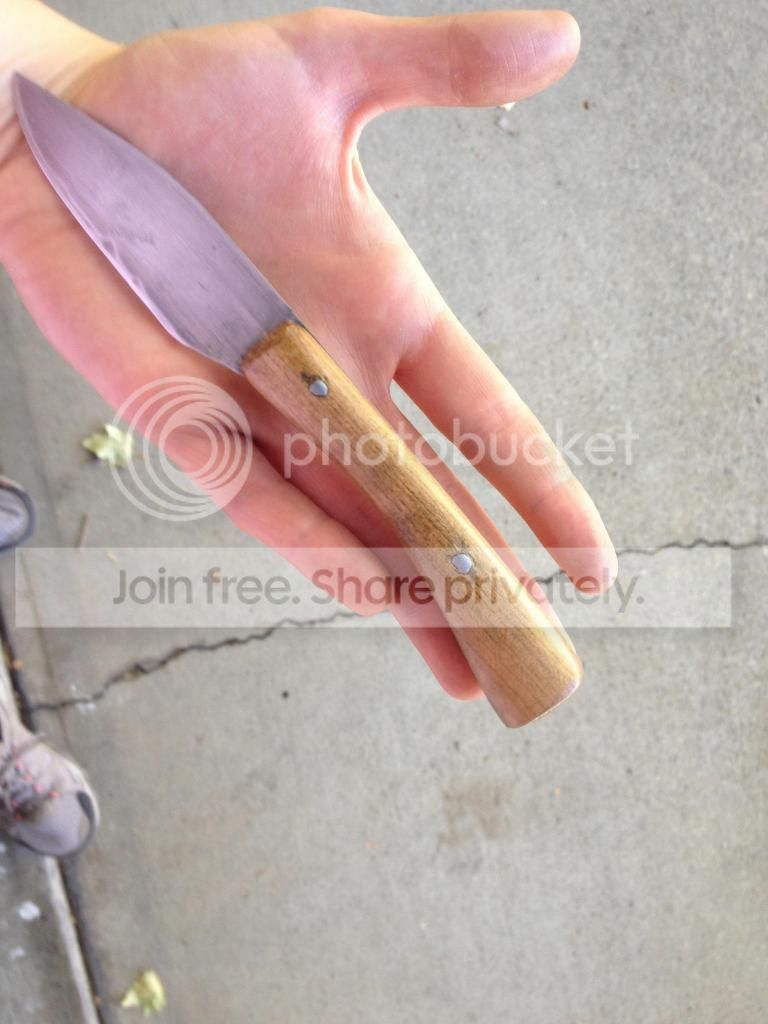
So far I've made two knives and really enjoy making them and want to get good at it! Looking at slot of the knives on this forum, there are a ton of really great knives and Id love to learn how to make knives like them! So far, I've just used saw blade steel...and have already been told to get rid of that and use 1080. Any special tips, secrets, ideas?
image_zps9fb89155.jpg


image_zpsdd0934ff.jpg

The first one has cherry handles, steel pins, blade is ban saw steel.
The second had walnut grips, 1/4 pins, and thick mill saw steel
 
Last edited:
If the steel works, don't worry about it.. An unknown steel can give you unknown results, but, if it holds an edge, then it looks like you have it figured out. Maybe do some testing like cutting rope to see how well it compares to other knives. Bandsaw steel is a good story to go with the knife.

Maybe draw up one with just two pins, see what that looks like. I suggest just making more of these and see what you can do.

I think you got the same pic twice.
 
Yea, I can shave with it it's so sharp!! Oops, I fixed that. The big knife is mill saw blade, the small one is bandsaw. Ok, thanks! I tried 2 pins, but it felt like something was missing, is that just where I put the two pins maybe? With a knife that size, if you do 2 pins, where would you put them?
Thanks for your input!
 
Folks get flack here for using unknown steel and while I agree with the sentiment behind it, I disagree in regards to not using it at all. Your knife has imperfections as you know, which is why you are here asking for advice. Had I used good steel on my first few knives it would have been a waste of money, they sucked! I say use junk steel and 2x4 scales until you know you can make something worthy of the cost of good steel and scales unless, of course, money is not an issue. I did at first and now I use Aldo's steel. But if I'm going to grind something crazy and I'm not confident I can, I will still attempt it first on weld steel I keep around that costs me about 1$ a foot or less. Now once you are confident use known steel, primarily because through proper heat treating you can get the most out of the steel and the best performance out of the knife you've put so much effort into.

In regards to your questions and requests for advice; read more. You are new and asking a lot of basic questions that are easily answered watching a 10 minute video or reading the stickys. It's not as fun or as quick but ask yourself how bad do you want to make knives? No one is going to point out every flaw or walk you through every step in the knife making process in a couple of posts. You'll eventually get a lot of RTFM replies which is shorthand for "read more knife books" if you are unfamiliar with the acronym :) In addition to that knife making is expensive. Those nice knives you speak of can cost hundreds in materials for wood, steel, pins, liners, epoxy, etc. and that doesn't include the thousands you will have in tools. I am in no way trying to discourage you here, rather the opposite. If you want to make great knives you can and will if you put the time and effort in. If you ask how to heat treat lawn mower blades or how to make damascus you probably won't get a lot of help after a while.

Guys like Aaron Gough and Nick Wheeler have generously spent a lot of time making freely available videos on youtube that can not only teach you how to make knives but make great knives! Take advantage of their offerings and come back and ask us (really not me I don't know what I'm doing) the more difficult questions that you will eventually have.

Good luck and I look forward to seeing your progress!
 
Read, read, read. Start with everything in the sticky section at the top of the Bladesmith Q&A page. Your stuff is looking good but don't cut corners on the next one.
 
Ok, thank you for all the feedback!! I'll start reading and watching those videos, and keep you posted on my progress!! All that is encouraging! I want to get good, so I'll hit the books I guess...as soon as hitting my textbooks studying for stupid finals is over, high school can really suck :)! I'm working on getting proper tools and stuff like that as well, there is only so much you can do without I have found! Question for Marc, what do you mean by cutting corners, using saw blade steel or what?
Thanks Guys!
 
Last edited:
It looks like you are getting tear out when you drill your handle pins. When you drill the next one, clamp your handle to a piece of hard wood, drill slowly with even pressure. Don't push too hard either. You should get cleaner holes that way.
 
Nic.,

I know you are a high school student and have limited tools. But you have the interest and obviously your hands work just fine. The knives you made are pretty good! But even with limited time, tools, budget and experience you can do far better work than you think. It comes down to patience and determination as well as having or developing an eye for details. If you check out Aaron Gough's excellent video on his filing jig you will see the kinds of results you can achieve with limited tools. Also search You Tube for Walter Sorrell's videos on making a knife. Then watch Nick Wheeler's vids on hand sanding. In the beginning many new makers rush the process out of inexperience and raw enthusiasm. In order to progress you will need to slow down and do your very best at every single stage of the process. When grinding the blade, make measurements, strive to get crisp and symmetrical grind lines. Make sure lines are smooth and graceful. When shaping the handle, make sure your finger scallops are evenly spaced with smooth precise scallops. Make sure pins that are supposed to be evenly spaced are exactly that. When sanding the blade and handle, make sure you work your way up through the grits and that every trace of the previous scratches have been erased by the grit you are using before moving on to the next higher grit. The list goes on and on but you get the idea. It doesn't have anything to do with budget or materials. It has to do with adopting a mindset from the very beginning that you are going to do precise and detail oriented work at every step. Most things that are done on machines by those that have the budget for those tools can be done by hand with patience and effort. If you don't have a lot of money or tools you make simpler knives, but you make them as perfectly as you can. When you get more experience and some more tools you can make fancier stuff. Just don't make excuses for not putting in the effort if you honestly know you could have done better. I'm not saying this is the case with you. I'm speaking in a general sense about an attitude that will serve you well when building knives in the future.

 
It looks like you are getting tear out when you drill your handle pins. When you drill the next one, clamp your handle to a piece of hard wood, drill slowly with even pressure. Don't push too hard either. You should get cleaner holes that way.

Ok, thanks, that's a great tip! Will do!
 
Nic.,

I know you are a high school student and have limited tools. But you have the interest and obviously your hands work just fine. The knives you made are pretty good! But even with limited time, tools, budget and experience you can do far better work than you think. It comes down to patience and determination as well as having or developing an eye for details. If you check out Aaron Gough's excellent video on his filing jig you will see the kinds of results you can achieve with limited tools. Also search You Tube for Walter Sorrell's videos on making a knife. Then watch Nick Wheeler's vids on hand sanding. In the beginning many new makers rush the process out of inexperience and raw enthusiasm. In order to progress you will need to slow down and do your very best at every single stage of the process. When grinding the blade, make measurements, strive to get crisp and symmetrical grind lines. Make sure lines are smooth and graceful. When shaping the handle, make sure your finger scallops are evenly spaced with smooth precise scallops. Make sure pins that are supposed to be evenly spaced are exactly that. When sanding the blade and handle, make sure you work your way up through the grits and that every trace of the previous scratches have been erased by the grit you are using before moving on to the next higher grit. The list goes on and on but you get the idea. It doesn't have anything to do with budget or materials. It has to do with adopting a mindset from the very beginning that you are going to do precise and detail oriented work at every step. Most things that are done on machines by those that have the budget for those tools can be done by hand with patience and effort. If you don't have a lot of money or tools you make simpler knives, but you make them as perfectly as you can. When you get more experience and some more tools you can make fancier stuff. Just don't make excuses for not putting in the effort if you honestly know you could have done better. I'm not saying this is the case with you. I'm speaking in a general sense about an attitude that will serve you well when building knives in the future.
Thank you! That is much appreciated! Those videos sound great, when I get a chunk of time I will definately watch those! Your tips are great, and I will make sure to follow them with my next one! I think my main thing with those crisp lines is making a good jig that will help keep my grinder/ sander work percise! I do the best I can, just need practice and more refined skill! Thank you very much for your input and encouragement!
 
Nic
Hold on to those knives and resist the urge to "correct" them as you learn more. They are a way of seeing your progress as you improve.

DON'T RUSH - Many mistakes and flaws happen for me when I am in a hurry to get something finished.

You can't correct flaws if you can't see them. - I'm 64 yrs old and my eyes and the rest of my body is going down hill, but I noticed a large improvement in surface finishing when I started looking at it with magnifying glasses. It's not that I couldn't SEE the flaws, rather they didn't seem big enough to worry about until I looked at them magnified.

Progress is made with each knife you make as you learn new techniques, get more experience and gain more knowledge. Knife making for me is a "journey" not a "destination". I enjoy the learning progress even though it can be frustrating at times. Each new knife seems to present new problems that I need to find solutions for.

I want to make good quality knives and do not dream of being a professional knife maker, and when it stops being fun then I'll stop making knives.

My brother-in-law has a saying, "The only person who doesn't make mistakes is the person who isn't trying new things." So, the more mistakes you make the smarter you'll be! (I think)

Good luck

- Lonepine, AKA Paul Meske
 
Nic
Hold on to those knives and resist the urge to "correct" them as you learn more. They are a way of seeing your progress as you improve.

DON'T RUSH - Many mistakes and flaws happen for me when I am in a hurry to get something finished.

You can't correct flaws if you can't see them. - I'm 64 yrs old and my eyes and the rest of my body is going down hill, but I noticed a large improvement in surface finishing when I started looking at it with magnifying glasses. It's not that I couldn't SEE the flaws, rather they didn't seem big enough to worry about until I looked at them magnified.

Progress is made with each knife you make as you learn new techniques, get more experience and gain more knowledge. Knife making for me is a "journey" not a "destination". I enjoy the learning progress even though it can be frustrating at times. Each new knife seems to present new problems that I need to find solutions for.

I want to make good quality knives and do not dream of being a professional knife maker, and when it stops being fun then I'll stop making knives.

My brother-in-law has a saying, "The only person who doesn't make mistakes is the person who isn't trying new things." So, the more mistakes you make the smarter you'll be! (I think)

Good luck

- Lonepine, AKA Paul Meske
Hey Paul, thank you very much for the words of wisdom. I very much enjoy making them, and want to learn tibe better at it and enjoy seeing my progress and learning more and more... From where ever I can learn!! And taking time to strive to make every detail better.
Thank You!
 
Back
Top