Newbie first blade update, more questions

Joined
Sep 16, 2002
Messages
1,577
Hi all,

I've got my bevels filed in now, and I have some more questions:

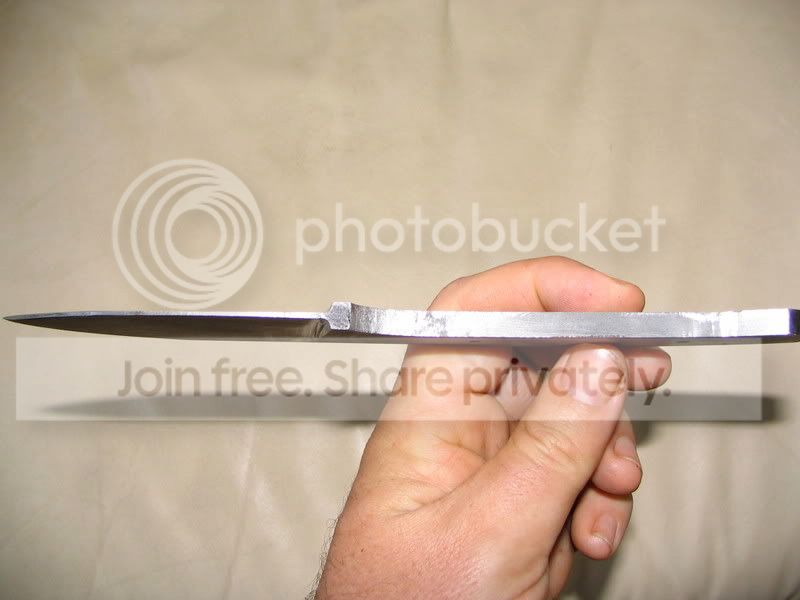
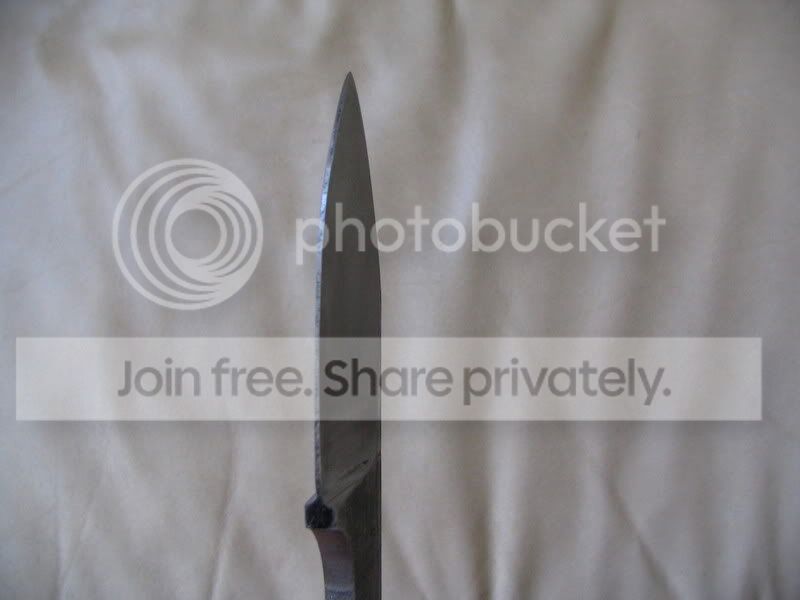
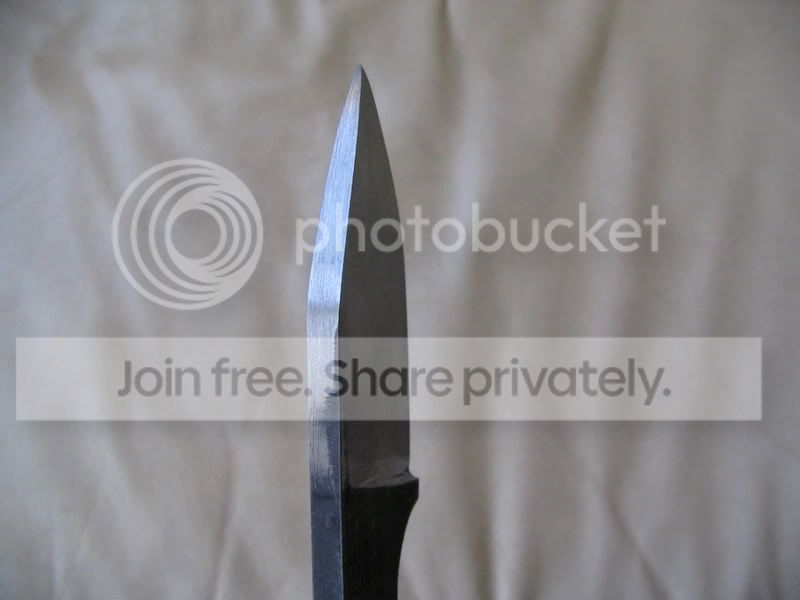
-Is the edge thick/thin enough for heat treat and cutting ability? It's a bit thinner than a penny in the belly and about penny thickness at the tip. I'm assuming sanding etc. prior to heat treat will bring it down a touch.

-I was barely able to drill the pin holes with my hand drill, so there's no way I can do more. I've seen where people drill several holes to help with glue adhesion to the scales...how critical is this and will my handle stay together without them?

-How far do you take the finish before HT...I'm thinking about 400 grit or so, but not sure. Also, do you do the same to the handle area, or leave it rougher?
IMG_0855.jpg


IMG_0854.jpg


IMG_0856.jpg


Finally, a few observations...these are probably obvious to most of you, but maybe it will help another newbie along the way:

-1/4" thick 5160 without power tools or filing jigs is really hard work, at times very frustrating, and in hindsight a really bad choice for my first blade! My wife has encouraged me to buy some power tools and/or start another with thinner stock, but I just can't give up now that I've made it this far!

-I'd starve to death if I tried to do this for a living, as I probably have over 20 hours into this so far and I'm quite certain it will be worthless to anyone but me when it's done!

-If I continue with this hobby, I need some power tools and/or to forge, and need to be much smarter about the material I start with.

-I'm glad I didn't start with recycled, unknown steel.
 
First off, it is looking very nice! You're right, 1/4" is a bit thick for anything that small. Most guys use that thickness for big choppers/campers. Reguardless, great job so far. Your filing work is better than some of my grinding work :D.

Remind me what type of steel you're using and how you will be doing the heat treatment. That can help determine how far to go before HT.

Even so, my opinion would be to take the edge down a bit more with a file. Sandpaper will remove some material, but not enough to really notice, depending on how deep your scratches are. I'd go to maybe half of a penny. Keep in mind that you won't be able to file after the heat treat.

I usually finish to 320 to 400 grit sandpaper before heat treatment to the blade and bolster areas, and you'll likely need to start back at 220 and work your way to higher grits after heat treating. Personally, I just finish the under-scale areas to 400 grit on the grinder, and do the blade/bolster areas by hand. If you've got some deep scratch marks on the handle area, I would go ahead and hit it with at least 220 to even it all out. Use a good wet/dry paper, some cheapo honing or cutting oil, and a backing stick (i.e. a piece of micarta, or even a file with a bit of tape around it). The oil will make a slury while sanding and help to let the paper cut much longer and better.

As for the handles, a few pins and epoxy should be plenty for this go around. I recommend slightly oversizing the pin holes in the metal to allow a little epoxy to fill the gap. I would definately invest in a drill press before too much else; makes things soo much nicer when drilling :). The extra holes help the epoxy have more bite, but with many epoxys running 3500+ psi adhesion, you should be fine.

Like I said, looking great!! Keep it up. Get some power tools, and you'll be hooked!

--nathan
 
I agree with the above. I put about a hundred hours in my first, and it still did not come out as well as yours. In 1971, there was very little info available on knifemaking.
pennyknife025.jpg
 
Wow guys, thanks for the kind words!

Nathan, the steel is 5160 and heat treatment is still up in the air at this point, so I can't tell you how that's going to happen. The thought of more draw filing kinda makes my stomach hurt, but I'll take the edge down a bit more. The pin material does fit snugly but fairly easily in and out by hand...is that good enough? If not, I might opt to sand down the brass a bit rather than trying to drill anymore with the hand drill.

I was thinking that leaving the handle with a coarser finish, but flat for a good fit with the scales, might help give the adhesive more to grab onto. That's interesting that you take it down to 400 grit.
 
If you keep your handles thin it will be less of a handfull, maybe 1/4 at most. That will give a max thickness of 3/4 which is good. Looking at LRB's knife remember you will have a bevel for the edge you just need to decide how thick this will be and file to that point. Given the overall thickness you may not need to take off alot and this will make a pretty sturdy edge.

How many pin holes do you have?? The holes will be countersunk (very slightly) and the head of the pin peened to hold the handles, the glue will keep water out and help hold the handle a bit.
 
You have way more gumption than I've ever had! Gold Star day.

The only thing I'd add to what has gone before is to take most of the next filing off the one side that isn't as deep as the other. One thing many new makers don't do (and I still fight) is get the edge thin enough. The thinner your initial edge is, the better your final geometry will be. I know how hard it is to get that thin edge, but it's worthwhile. I try to get it about as thin as the cardboard from a new shirt's packaging. I rarely succeed but when I do I'm happier with the knife.

Just my .02. Have fun! That's a great knife.
 
Being an old dog learning new tricks I finally grabbed a set of dial calipers off the lathe and started measuring the edge...I don't know why I didn't do it sooner!
 
If you keep your handles thin it will be less of a handfull, maybe 1/4 at most. That will give a max thickness of 3/4 which is good. Looking at LRB's knife remember you will have a bevel for the edge you just need to decide how thick this will be and file to that point. Given the overall thickness you may not need to take off alot and this will make a pretty sturdy edge.

How many pin holes do you have?? The holes will be countersunk (very slightly) and the head of the pin peened to hold the handles, the glue will keep water out and help hold the handle a bit.

I have 2 pin holes currently. I wasn't aware that the pin heads were peened...I thought you just stuck them in, glued everything together, and then came back when dry to grind/file/sand everything flat and even.
 
looks great!

I was tired of filing by hand, so I whipped up a filing jig in 2 mins.

take a piece of metal bar and clamp it to the tang of a handle-less file. Clamp the blade, edge forward on a surface (table saw for me)

Find something shorter than the table, for me, It was an adjustable stand for cutting long pieces. Run your extended file handle on the stand, and have fun (even with the jig its not much fun, but that is what made me want to build a 2x72" :D).

keep up the good work!
 
Being an old dog learning new tricks I finally grabbed a set of dial calipers off the lathe and started measuring the edge...I don't know why I didn't do it sooner!

I don't have a lathe, but do have reloading calipers. I'm ~.04-.05 on the belly, and ~.06 at the tip.
 
looks great!

I was tired of filing by hand, so I whipped up a filing jig in 2 mins.

take a piece of metal bar and clamp it to the tang of a handle-less file. Clamp the blade, edge forward on a surface (table saw for me)

Find something shorter than the table, for me, It was an adjustable stand for cutting long pieces. Run your extended file handle on the stand, and have fun (even with the jig its not much fun, but that is what made me want to build a 2x72" :D).

keep up the good work!

Hi Keith, that sounds like a great idea...except I can't really picture what you are describing :) Do you happen to have a picture?
 
Ah, I see now...thanks a lot for posting the pics! I think if I go much further with this hobby I will at a minimum buy something like the Sears 2x42 sander.
 
Back
Top