Newbie Introduction and Pic

Joined
Dec 24, 2012
Messages
28
Good day all. I have been lurking and studying for a few weeks. Not sure why, but decided to try to make a few knives. I am a garage guy by hobby, playing mostly with motorcycles and a few restoration projects. So far I have enjoyed all aspects of the new hobby and will try to post up a pic of my progress for comments. I have thick skin and all are welcome. I figured that my post may also help a few folks that were in my shoes a few weeks ago.

At this point I will thank those in the know who post up daily with their expertise. Any moves or decisions that you see posted below that were done "right" were a direct result of you taking the time to care and post up. Thank You.

I ordered 1084 from NJ Steel 3/16 in 48". At this point I'm wishing I had ordered a few pieces as im sure it would have save me shipping as I plan to order more.

I'm looking more for skill building than I am for knives that have a constant use purpose. I am a casual knife user and tend to carry very small folders that fit in small pockets. However, while studying shapes I seem to be drawn to thick or fat looking flat grind neck knives. That being said, who wouldn't love for their work to be able to be used and for the blade to hold up.

My design is inspired by (or ripped off from) Boker, I chose a design that I liked, sketched it, and then used a copy machine to make numerous different sizes of the same design. I also felt this design may be a good choice for newbie due to the mostly flat blade. Boker's had a very slight curve, my first is totally flat.

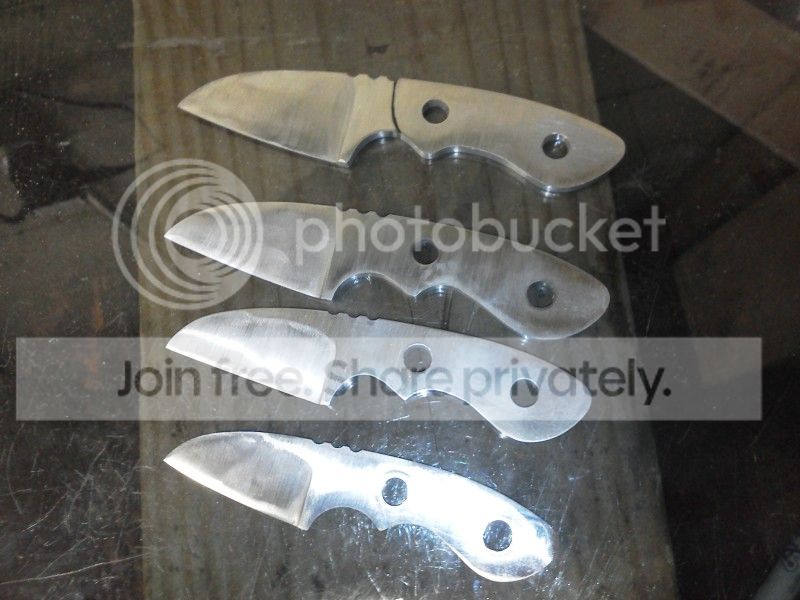
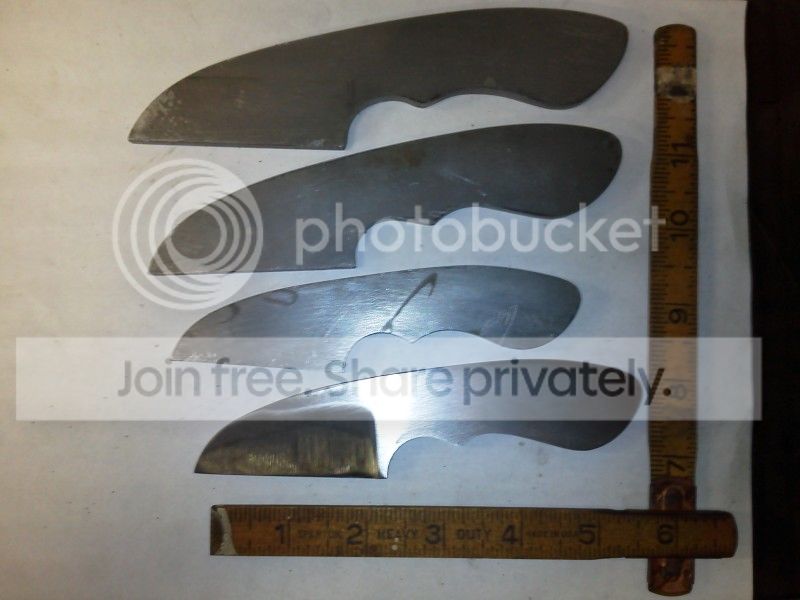
I cut it out with cut off wheels and air powered die grinder. Not much fun there. Then refined the shape with a bench grinder, followed by filing with numerous applications of a sharpie marker to see what needed to be done. I made 4 different sizes to practice and hoping for the best that they all come out ok.

My blade one only one so far was formed with a craftsman 2x42 all stock at this point. Im currently at 140 grit (or close). I do not desire a highly polished finish. I found the machine more than adequate and used a bucket of water to keep my work cool.

Im a bit concerned about heat treating. I have never done. I do have a break drum at the ready and prepared to make a brake drum forge with some kind of forced air. However, I have read a few posts that call this technique advanced so am willing to entertain alternatives like the paint can forge. Suggestions welcome here.

As for scales. I have not made any decision. I do have a nice length of hardwood flooring. Brazilian Ebony I was told. Most dense piece of wood I have ever held.

Thanks in advance, and all comments/ criticisms are welcome. Just keep in mind, these are my attempts at knife #1
Knife1Custom_zpsfd3147e7.jpg
 
Your general styling is okay and quite popular with many beginners. I do believe on the next one the end of the handle should be lower. As well, the handle behind the finger pocket that I like to see could be narrower. As it is now there would be a tendency for the tip of this one to always be higher than you want. Keep going ! These things are not easy to design or make in a good manner. It will happen if you stay with it. Frank
 
Good start.

A tip is to take a piece of 3/16" plywood and make a prototype
Take it and hold it in your hand....how does it feel?
Now, pretend to cut up some string on the tabletop with it....how does the blade meet the table?
Is the knife comfortable to cut with?

Make new plywood blades until you like the feel and look. Then use that to mark the steel and cut the blank.
 
Looks like a good start.
You probably want to drill your holes before you heat-treat.
Ebony sounds nice.
 
Stacy gives some great advice. I do something similar. I draw my profile on paper first. Scan and print, so I can go back to the drawing if I need to.

The paper gets glued to card board (sometimes plywood or particle board), then cut out and sanded to the profile. I then test it as Stacy describes. If it isn't right, sand or modify the cardboard profile. It's a good reality check. Then I can use it to trace my pattern.

Another thing I like to do is to show someone else the profile and get their input on the shape and feel.

ric
 
I am still a rookie at this so I am still piecing things together myself.

If using a forge to HT with you will have to learn to watch the color and check with the magnet often. Say you make a gas forge down the road you can get a PID and probe and once you figure everything out can usually maintain temps relatively close to what you need. Some guys on here can maintain within a few degrees of there target temp. I am not as good but can usually handle within 10 or 15 of my target.

With a coal forge I imagine this is a little more difficult so you have to keep an eye on the steel, check it often once you start seeing the red color to see when it transfers to non-magnetic. Once it does note the color of the steel. Not saying once you learn roughly the right color to stop checking with the magnet it just makes it easier. Give it another few minutes and quench (when using 1084). Other simple steels require soaks and what not for best performance so gets a little trickier using a coal forge I imagine.

Gas forges are pretty simple and I would recommend looking into the stickies and online tutorials for making simple ones. You can piece them together pretty easy for under $100, the temp readout and probe are a little pricier but can be had for about $75 if I remember correctly.
 
Thank you much for the tips so far. Ive enjoyed reading them. I do see some problems with the design based on the string technique. At least with the smallest ones. Perhaps ill work on the handle and finger grooves a bit with a template for the larger ones, to see if I can improve at least that aspect of usability. Thinking I might want to add a slight bit of curve to the blade for the same reason.

As for forging, I have been reading up a bit on the paint can forges etc. I do have an empty helium tank that might just make a good one (bbq propane tank sized). Currently looking into the kaowool etc and options along those lines. Something about that charcoal fire in the back yard really appeals to me though. Not that it would make my product better, just because it seems like a cool thing to do.

Thanks again folks, Ill keep at it.
 
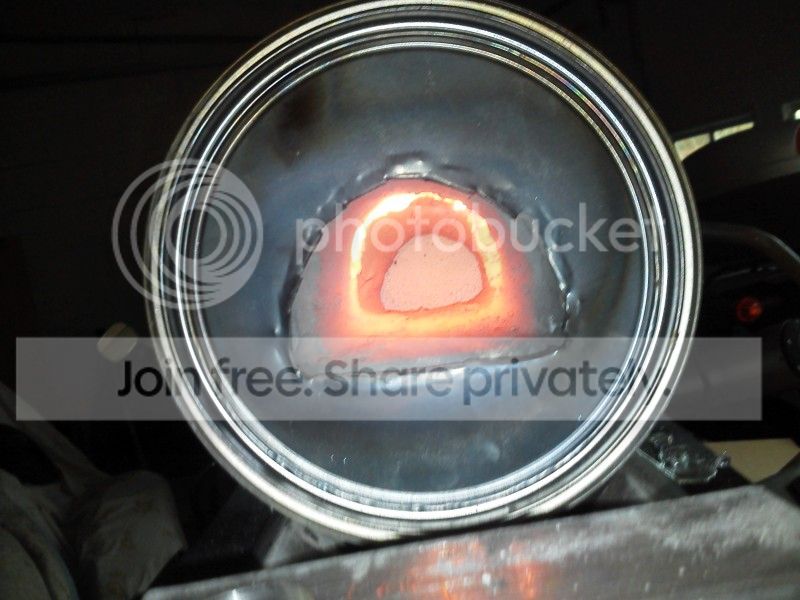
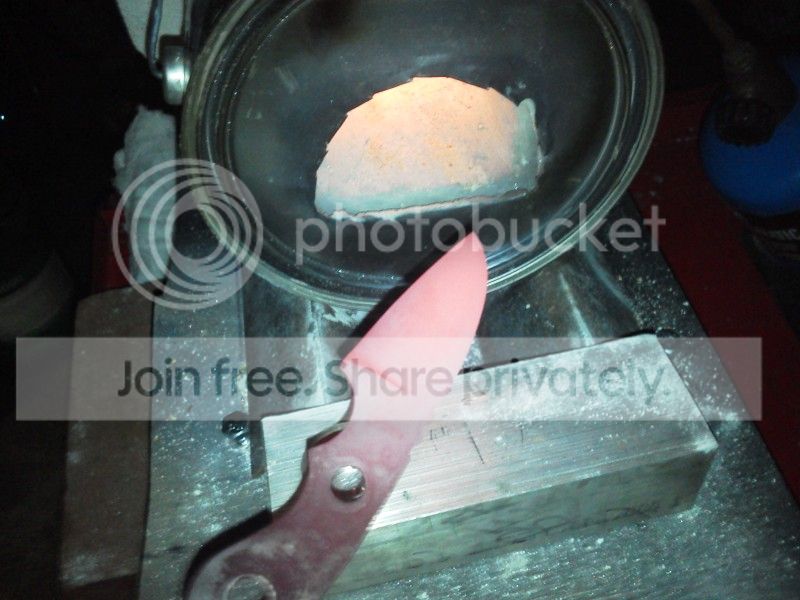
Well I think Im ready for my first heat treat tomorrow. I spent some more time shaping all 4. The blades certainly are not perfect but, Im ready to move on. I built a paint can forge and tested it by normalizing all 4 blades 2 times each to non magnetic, and then air cooling back to a temp I could touch. I did this because I shaped the blades with cut off wheels, bench grinder, and files, and in doing so I'm sure I overheated the steel unevenly. I attached a few more pics: the 4 blades that I've shaped, and a few pics of my forge. The forge seemed a bit hot dead center so the next heat I will have a soft fire brick on both ends with a patch of kaowool and satanite to block most of the openings. The pic of the heated blade is a mess because I left the flash in the cell phone. Seems a worthless pic. but I attached it anyway.

I think I'm ready to try a heat treat. I have a hot plate, canola oil, thermometer, and a toaster oven ready to go with the forge. Since I will not be able to see, I have some idea of when they reached non-magnetic temp during normalization. My plan is to begin checking around that time with the magnet, put the knife back in for a couple minutes after I find it doesn't stick, and then go to the 130 degree canola quench. The 3 temper cycles at 400 in the toaster oven.

So I think I'm ready, but you all may know better, Criticism is welcomed.
IMG_20130111_224854Custom_zpsc5d994f9.jpg

IMG_20130113_171112Custom_zpsa8b7ac8e.jpg

IMG_20130113_183641Custom_zps55face2c.jpg
 
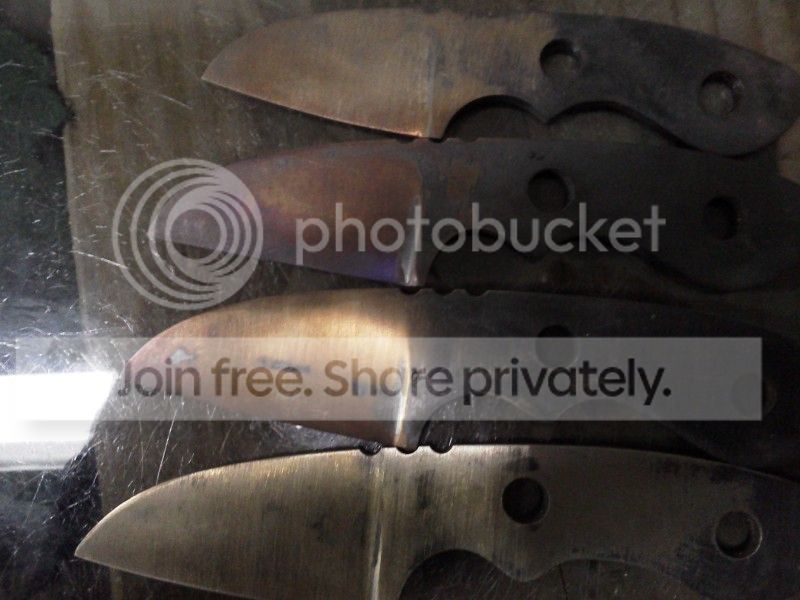
I think the heat treat went well. Of course coming from a first timer. One thing I failed to study was the colors that appear during tempering. I tempered 3 one hour cycles at 400. I had some interesting colors appear which leads me to believe that I did get at least some hardening of the blade. I posted a pic post tempering of all 4 blades. Although, the colors do not come out in the pic very good. I noticed golds similar to a grade 8 bolt, and some purplish tints as well.
IMG_20130117_234737Custom_zps74d62455.jpg

Again, criticism welcomed.
 
Something Rick and a few others discussed a while back was making sure you use a pan (baking dish) lined with foil. I usually put a piece of foil on top as well. This will keep the temperature spikes from the oven maintaining temperature from affecting the knife as much. Ya should if I am not mistaken get that nice straw color like you were talking about.

Now the hard part, testing. Gotta put a sharp edge on one or two and test the snot out of it. Even breaking one to test if it has some flex and look at the grain structure to make sure it looks good really helps. Dont forget to grind the decarb layer off, it will give a false sense of softness for a very thin layer. Atleast that is what I would do to check your HT. If everything comes out good then remember what you did and repeat that every time.

Lookin good so far.
 
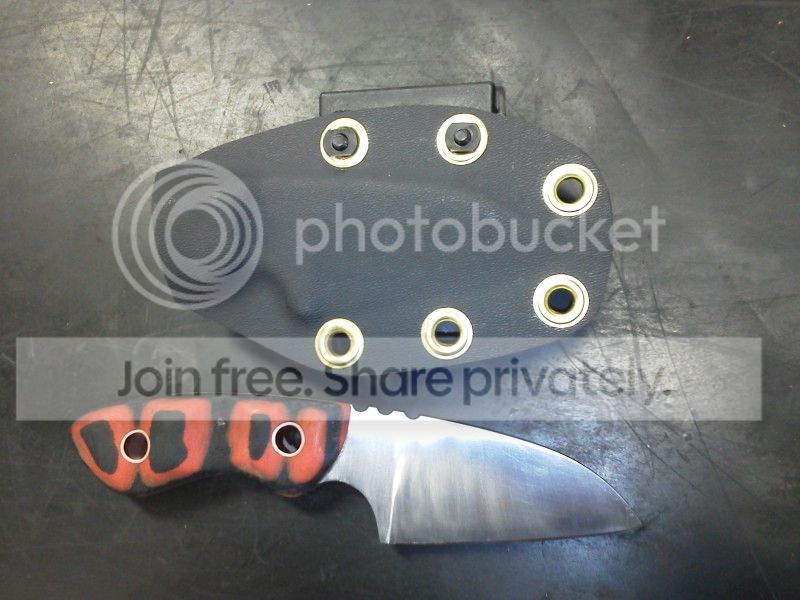
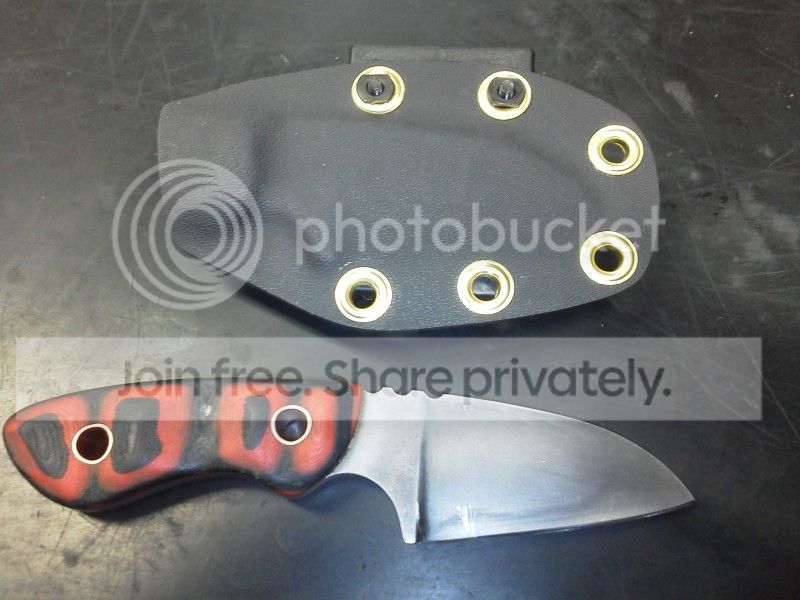
Proceeded from heat treat with an attempt to finish one of the four. I did a final flat grind, but with a slacked belt. Sanded up to 360 I think, though not real obsessive about it. I made a free hand secondary bevel grind on the belt sander and then tightened it up with a Lansky system. I made micarta scales. These are 36 layers, 8 of each color per layer 2x. My next batch had thinner layers to look more wood-grainish, but this overall thickness was pretty good. I still ground alot away. Sheath is made from kydex, with a tek lok. Then I attempted a patina with hot apple cider vinegar, that is the second pic below.

Criticism welcomed as always.

knife1Custom_zps4fc2a696.jpg

knife1wpatinaCustom_zps934feb5d.jpg
 
I see good work for your first ones. Of course if you do more, I believe even more improvements will happen. Frank
 
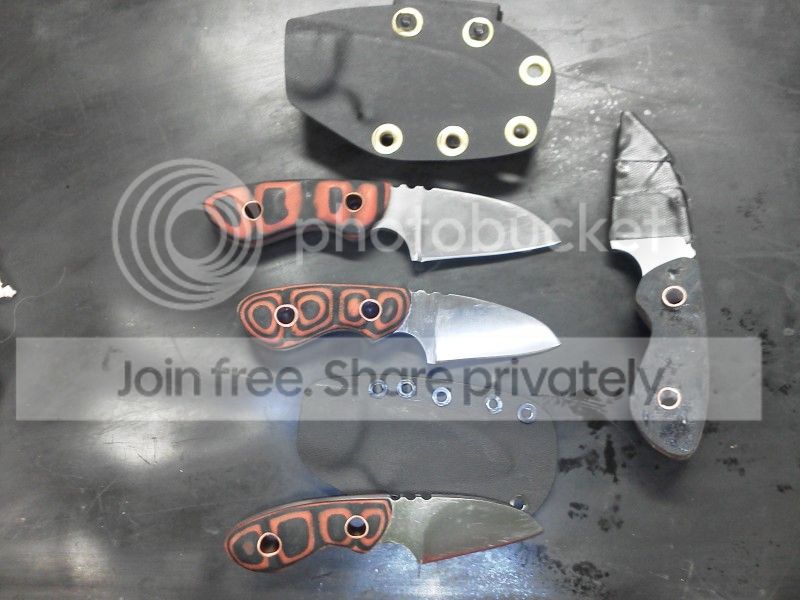
I'm having fun with this, call it more of a blog to help newbies, whatever. I had some frustrations moving on from number one. I think my mistake was to try to finish the next three on the same schedule instead of total focus on one at a time as I learn to finish. Regardless, I now have three finished, 2 with sheaths, and one left to finish.

Not sure if this is proper, but I find myself making minor compromises in the final finish to match earlier mistakes. I'm finding my finish obviously homemade with marks evidencing that style. Not sure of my compromise at this point is laziness, just the finish that I prefer, or just my acceptance of my learning curve.

Ive used number one to cut two huge roasts in the raw, it really did slice nice despite having a 30 degree edge. I felt proud using the knife for a purpose.

UpdateCustom_zps79f66d94.jpg
 
I really like the scales on the middle one, but like the size of the top one a bit more. It really is a good feeling when you actually get to do work with a knife you made isnt it. I remember cutting more paper and cardboard and carpet than i could handle, but the first deer it ever skinned was completely different and more gratifying.
 
You made your own micarta, AND knives! That's awesome, man! The micarta looks great! (obviously, the topic of this thread, the knives, look great too)
 
Back
Top