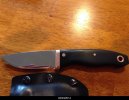
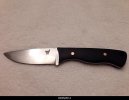
The face of the blade must be almost absolutely flat to most easily remove all scratches by hand sanding. This (obviously) is limited by your tools/equipment and by experience.
As mentioned, proceed through the grits with different approach angles and don't move on the the next finer grit paper unless every scratch has been removed. Inspect the blade for residual scratches under various lights (indoor, outdoor, etc) and at different angles. Spend some extra time sanding at the bevel at each grit. This helps to assure that you don't end up with visible scratches there, as this is the most difficult area to finish, in my opinion. I have found blue layout fluid to be very useful in quickly locating low spots and deep scratches; I prefer the spray versions rather than the brush-on type (purchase at MSC Industrial Supply or some knife maker supply houses). I use this religiously when grinding too.
Finish the ricasso completely before attaching guards, bolsters, or handles to the tang.
Use a flat sanding block. I use a flat block with a fairly hard piece of rubber bonded to it. This seems to be more forgiving of minor low spots, than an absolutely hard and flat sanding block.
Use something as a cutting oil while sanding. WD-40, Windex, and honing oils are all possibilities. I prefer WD-40.
Keep it up. Good luck.
Mike