Newbie Question About Chef's Knives

Joined
Nov 15, 2014
Messages
257
Greetings;

I'm getting ready to make my first chef's knives. I've noticed that a lot of chef's knives have no bevel, like the Henckels knife I use in my kitchen every day. Why is this? Is it just a matter of aesthetics? Of preference? Is a bevel unnecessary on a chef's knife?

Thanks,

Sprayman
 
When you say no bevel what exactly are you referring to? There's lots of variation in kitchen knives but full flat grinds with secondary bevels are pretty standard.
 
I'm guessing he means they don't have a scandi grind. I've never seen a chef's knife with just an edge, there almost has to be some kind of bevel or the steel would probably be too thin or thick. Sprayman does the knife taper from the spine to the edge? If so that is a flat grind and you are probably thinking of a scandi or hollow grind if my terminology is correct and those are more for bushcraft/hunting type knives. If not post a picture so we can see it!
 
I believe he is talking about a flat grind from the edge to the spine. We have several Henckels as well, and even the 2" chefs knife is flat. There is a secondary bevel at the very edge, but the majority of each side is flat. My 2" chef knife is .113" at the spine. The small secondary bevel on mine are 18° because that is what I reground them to.
 
Augus7us, zhyla;

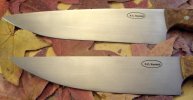
I'm attempting to post a photo of my own chef's knife, but the website doesn't seem to want to accept it. The knife gently tapers from spine to edge, but has no visible bevel. It's sharp as hell, though. Thanks. I'll keep working on that pic.
 
I think what you are describing is not a bevel, but what the Japanese call a "shinogi." Most good kitchen knives have a full flat grind, which extends the full width of the blade. This allows for superior performance by minimizing wedging. Crappy kitchen knives usually have a narrow grind because it's cheaper to manufacture and their customers won't know the difference.

Chris
 
There are several grind types. The main two are a sabre grind, where the bevel goes part way up the blade side....and Full Flat Grind, where the bevel goes all the way to the spine.

Most all kitchen cutlery ( and most knives in general) have a FFG. This makes the knife have the thinnest cutting cross section, while retaining strength at the spine.
 
Are you referring perhaps to the plunge line? This is the area where the bevel starts. Many kitchen knives are "plunge less," either the entire profile is tapered or the plunge is blended in near the tang to make it unnoticeable.
 
For a chef knife you typically want a full flat grind from the edge to the spine, the edge is ground to 0.015 (or less). and then there is a very small 18 degree bevel (or less). This way the knife can slice through without the thickness getting in the way. BTW not much reason to go over 1/8 thickness,. these are 3/32
 

Attachments

  • HPIM5778.jpg
    HPIM5778.jpg
    40 KB · Views: 73
Patrick;

Yes!!! This is exactly what I'm talking about, and my own kitchen knives look much like the knives in your pics. Thank you so much. Now I know that I need to refer to a "full flat grind."

The steel I have is pretty thick--thicker, I think, than a chef's knife should be (.200). Would it be a good idea to give it a sabre grind, so the thickness doesn't get in the way?

By the way, thank you all. You guys are very generous with your time and advice, and it makes getting into this hobby much easier for a hack like me. I've already learned so much more than I could have if I had tried to go it alone.
 
With a saber grind, the thickness will get in the way even more. Thinness is what produces cutting ability. With a full flat grind, it takes the full width of the blade to reach maximum thickness, which means that it is as thin as possible for as long as possible. A saber grind will reach maximum thickness much more quickly, therefore diminishing cutting ability. Your steel is too thick for any type of kitchen knife except for a cleaver and no type of grind (save a surface grind) is going to fix that. If you really want to make a kitchen knife, buy a piece of steel that is 3/32" thick and make your knife out of that.

Chris
 
With thick steel you need to grind all the way from the edge to the top of the spine, that will give you the best slicing 1.8 is .125, I figure your steel does not have a perfect surface and may not be completely flat, cut your shape and sand flat and with a good surface, you should be down to about 0.18 a bit thick but a full flat grind will give you a pretty good angle to edge, I have made so thick kitchen knifes for hard use such as cutting up chicken, you can hack right though the bone and spit the back with no problem. A saber grind will not slice as well.,

How wide is your steel, if it less that 1.25 I would really look for another piece, also what type is stainless, 440c, ats34, or simple carbon 1084, 1095?
 
.200" is WAY too thick for any normal chef's blade. I use .060" to .010" for mine.

All chef's blades should be a FFG.

If you are determined to use the .200" steel:
Profile the blade shape.
Make a distal taper from butt to the tip, leaving the tip at .030".
Then do a FFG from spine to edge.
That will cut the weight nearly in half.
 
Yeah... .200" is combat/survival knife stock, not kitchen cutlery stock ;) ... unless maybe if you want to make a serious cleaver. Even then I think you would want it at least 3" wide so you could still get a nice acute overall bevel on it.

You can get good kitchen cutting performance out of .125" stock, if it's fully tapered both all the way across the blade and all the way down it. When in doubt, go thinner rather than thicker. Thin is in and light is right :) No one's going to be chopping down trees with a chef's knife.... I hope. :eek:
 
Full disclosure: I have two ryodebas on my bench right now that are 3/16" (0.1875") thick. If you want to make a knife in this style, your steel will work. But this is not a normal style kitchen knife, and I don't really recommend you try to make one of these unless you have a powerful grinder.
Also, you still haven't told us what type of steel you have. That's kind of important, too.

- Chris

ETA: If you are serious about kitchen knives, I can't recommend Murray Carter's book, "101 Knife Designs," highly enough.
 
I have used gyuto's that cost $500 plus that are 1/4 at the spine over the heal. They cut great but you cant get that with a full flat grind. Edge thinness (less thatn .005) and proper geometry make it happen. Look at a Kato gyuto to see what I am talking about. A full flat grind leads to sticking of the food on the bevel which can be just as irritating to a chef as a thick knife that wedges too much. It is all about finding the balance.
 
James, Hesparus, Patrick, Stacy;

Thanks for steering me away from using that thickness of steel on chef's knives. My wife is actually vegetarian, so I don't think she needs such a thick hunk of steel to cut through a brick of tofu :D. It's 1084. I bought the .200 because the price was good, the supplier was out of thinner stock in 1084, and frankly, I didn't really know any better. I'm sure I'll find some use for it, though....maybe a good, hefty survival knife or hunter.

You guys are awesome. Thanks again.
 
Hesparus;
I'm not familiar with a ryodeba. Could you direct me to pics somewhere?
Thanks for the book suggestion. I'll look into it.
 
That's very interesting to me. My first question is, why?

I'm not being a smart-alec, I'm honestly interested to learn about them.

I really dont know why they are that thick. Maybe some chefs prefer a heavy blade that still cuts like a thin light blade? From my understanding the Kato has quite a following.

I also forgot the mention that starting with too thin stock and making a distal taper too aggressive can lead to a knife that flexes too much. I had a chef return a knife because it was too flexible and he cut himself. Looking back the knife was way too thin and flexible to be used as a versatile chef knife.
 
Back
Top