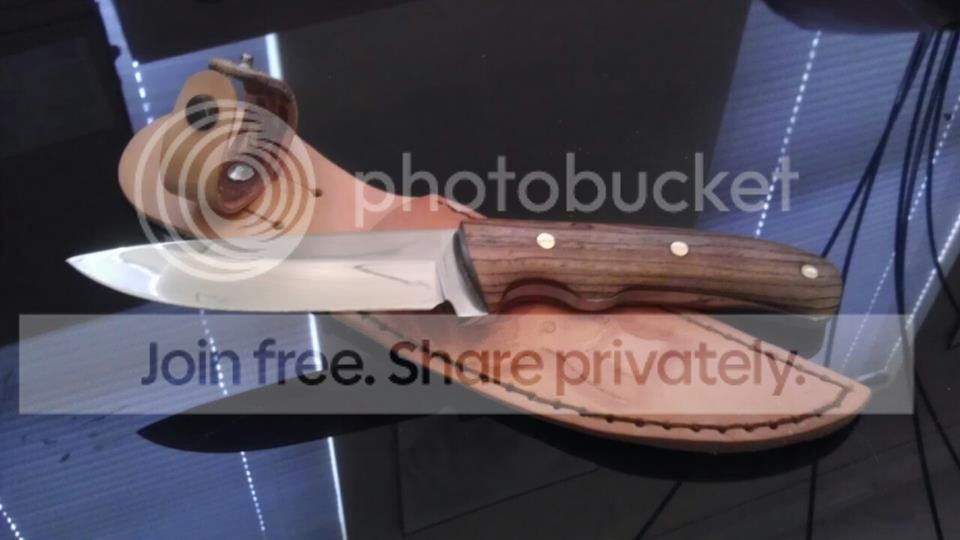
Newbie's first knife with pics

Joined
Sep 14, 2012
Messages
8
Greetings all. My name is Josh. I've been lurking around these forums for the past few months soaking up as much knowledge as I can and last week I started on my first knife. Progress is going well. I started with a pre-made blade from a local shop here in Houston and bought the scales separate. I thought this would be a good starting project based on what I'd read. I'm now to the point where I'm about to put a final sanding down on the wood handle scales and afix them to the tang. I just had a few questions about how to actually finish them. I would like to stain them darker, is that appropriate for such a material? Would/should I apply a clear coat or lacquer to the outside before or after I've fixed them to the tang? (I would do a final polish by hand afterward as I don't have a wheel. I work in an apartment shop so most of the work has been done by hand with files and sandpaper. I do have a 1" x 30" belt/disk sander that I've used to flush the scales with the tang, which I still need to polish. Any help you guys could throw my way before I peen the pins down would be much appreciated. As promised, pics!

389849_10152104264605046_1178026657_n.jpg


420883_10152105085745046_2126685319_n.jpg


540140_10152108943275046_795575399_n.jpg

I switched to Bocote wood handle material because the first scales were rosewood and very difficult to work with with a coping saw, i cut them way to tight to the tang to allow for adjustment.

534448_10152109117650046_1910713622_n.jpg

Test fitting.

545382_10152109006295046_1440100631_n.jpg


308146_10152111860930046_1392745610_n.jpg


564875_10152111861430046_1066042691_n.jpg

Note: gaps are there because the bolts don't actually hold anything together.

560391_10152111862050046_705604275_n.jpg

Not enough flash :(

Anyway, I think I'm making good progress. I just have to polish up the scales and finish them with something.
Any comments and criticism are welcome.


-Josh
 
Last edited:
very nice work. I really want to get to the point where I can make handles especially for my Spyderco mules, I still don't understand how pins work or how to affix them. Any tips on your trials and tribulations would be good to include in your thread here.

Hopefully someone with much more experience than I will chime in here.....
 
So far the biggest mistake I've run into is that I didn't leave nearly enough margin on my first set of scales to allow for finishing. I won't be doing any pinning until I'm completely sure of how to finish the handle. Hopefully someone with experience in doing so will chime in and I can go ahead and finish this thing.
 
Not really an expert, but I thought I'd at least give you some ideas.

Mark at Burl Source often has a lot of good suggestions for finishing wood. I usually take mine to at least 1200 grit, with a coat of danish oil applied and sanded in when I switch grits. That may be unnecessary with your wood; I can't remember how naturally oily rosewood is. Then finish with a coat of paste wax, although you can carefully paint on some lacquer if you so desire. Keep sanding until all the marks from the previous grit are gone. I also am one of the odd few who epoxies the handle onto the knife and pins it before shaping and finishing the handle scales. Then I can polish the tang of the knife as I'm polishing the handle scales. I just have to make sure to tape the blade heavily around the ricasso to avoid scarring it. Good epoxy is good too. Lots of folks recommend Acraglass.
 
Thanks for the tips, if I can finish the wood with the pins in then I might just do that. Do you work the wax in with a wheel? Can that be done by hand? I guess I wasn't specific when I mentioned that I switched materials, I'm now using a Bocote wood. I'll update the OP.
 
Nice, I love bocote. I use that extensively. I find that danish oil is a good thing for bocote. Being such a dry wood though, it will warp if you take it somewhere wet, just FYI.

20120920_193346_zpsbe1463f1.jpg

20120824_122133.jpg

20120403_195100.jpg


It will take a good sheen on it if you take it to high grits. Also, the figure in the wood responds well to texturing, as in my last picture. Not sure if that's something you want to do, but it's fun stuff to work.
 
Welcome to Shop Talk.
Keep at it, it gets easier as you go.

I noticed one big problem right away, and it shows that you haven't read any of the instructions or tutorials very well.
The first step in putting a handle on is Taping Up The Blade. This will protect the blade from scratches and you from a bad cut. This is double true with a pre-made and sharp blade. Please tape that blade up before doing any more work.
 
That will keep the scratches down, but it won't help your hand if it hits the edge.
Use 3M blue tape or some similar type for a complete coverage wrap with at least two layers over the edge.
 
WIth a sharp knife I usually use some cardpaper and tape around that.. I'd rather be overcareful. But the worst cut I have got doing this is the side of a 1x42" belt meeting my finger :(
 
Up until I started using the grinder i was storing the blade in the cardpaper sleeve you see in the first pictures while I worked the handles into shape. Once I was ready to shape the scales to the tang I put some tape around the blade. I'll put some more tape on it before I start working on it again.
 
From what I can see, it looks like you are using screws as pins? I would definitely recommend getting some brass or stainless rod for your pins.

For gluing, I prefer west systems gflex epoxy. Lots of people swear by acra glass, but I have never had a reason to try anything other than gflex.

Bocote is a very easy wood to finish since it is so oily. Just work your way down through the grits.

There are a ton of tutorials available online that will answer most of your other questions. Take the time to read and watch through them - they are good.
 
When I started putting together cutlery I used corby rivets and cutlery rivets. A drill press and special drill to countersink the holes for the heads of the rivets is a must. The corbys are nice because they give you a lot more thickness to remove while shaping the handle. Cutlery rivets are less expensive but leave little room for shaping the handle after they are set. I've never pinned a handle but I think care needs to be taken to keep from splitting the wood.
 
Just wanted to throw down an update on this old thread since I'm about to start a few more projects. The knife turned out pretty well for my first.

knife_zps0981ba27.jpg


406010_10152374763875046_384905563_n.jpg
 
Back
Top