

- Joined
- Dec 18, 2008
- Messages
- 760
Hello Everyone,
This is the first knife out of my new workshop. The only electricity I used on this one was in the drilling of the fittings. Everything else was hand tools and muscle power.
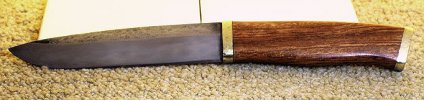
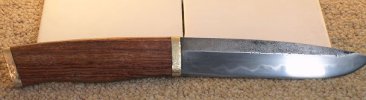
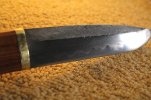
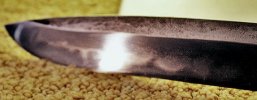
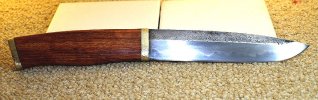
The blade is 1075, with a vivid hamon. There is a slight medial ridge, with the spine and top bevel left as-forged, though I did wire brush the scale off and pickle with vinegar.
The blade is 6", the handle is 4.5".
Textured brass
bubinga with tung oil finish for handle.
This knife is very thin (especially the handle). It would be very good for use in an outdoor/camping/hiking setting. Of course, it is also just beautiful.
$175 plus shipping. pm me if you are interested.
Thanks for looking,
Kevin
This is the first knife out of my new workshop. The only electricity I used on this one was in the drilling of the fittings. Everything else was hand tools and muscle power.
The blade is 1075, with a vivid hamon. There is a slight medial ridge, with the spine and top bevel left as-forged, though I did wire brush the scale off and pickle with vinegar.
The blade is 6", the handle is 4.5".
Textured brass
bubinga with tung oil finish for handle.
This knife is very thin (especially the handle). It would be very good for use in an outdoor/camping/hiking setting. Of course, it is also just beautiful.
$175 plus shipping. pm me if you are interested.
Thanks for looking,
Kevin

