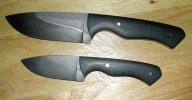
O-1 hamon?

Joined
Feb 5, 1999
Messages
1,068
Hey guys,

Does O-1 make for much of a hamon line? I have an O-1 blade to heat treat and I thought i'd try some clay on it. I understand that I can't do a proper soak that way, but I'm curios.

Thanks,

Gene
 
Gene, don't waist you time. No worky. You'd have better luck getting something if you used a torch to harden the blade.
 
I've gotten hamons on 01 with satanite and using a torch back in the days and quench in warm vegetable oil edge quench. doing it that way, you can see the hamon after you temper it and grind the blade down even with an 80 grit belt. obviously you will have to polish it out more if you want it to show more.

if you heated the entire blade in a forge or kiln and quenched it even edge quenched, the hamon would probably be fairly straight and boring.

Perhaps Hamon is like most of you say, the wrong word. Edge Hardened is more like it.
 
Brian Goode's (blgoode) knives are almost all O1, IIRC... he edge quenches them to get an obvious delineation to show the differential heat treatment. He's probably the best example I can think of to demonstrate this effect.

I cringe every time I hear these lines referred to as hamon, as that effect is more than just a line, and usually has much more significant detail to it... I know, I'm just being nitpicky!
 
Yes - I've yet to see a hamon on O1....and believe me, I've tried. :D


If you've done it, let's see some pics. ;)
 
here is 0-1 with hammon but not like Daniel is talking about.

MOst of my knives are 0-1 but I dont clay coat and the upper portion of the blade isnt hardened. Thats where the contrast comes from. Onkly the lower portion ever gets to hardening temp.
 

Attachments

  • bladegrims.jpg
    bladegrims.jpg
    66.1 KB · Views: 142
Yes - I've yet to see a hamon on O1....and believe me, I've tried. :D


If you've done it, let's see some pics. ;)

CIMG0482.jpg

Certainly not the smoky, whispy hamon, created with a 10 or W series steel, "rather plain and boring indeed", but a hamon no less. Satanite, full soak, and full quench in AAA.
Matt Doyle
 
I'm no purist....and avoid sword forums at all costs....:D....but do hold to a hamon being best performed on a low alloy water-quenching steel. :thumbup:

Can-do and Should-do = 2 different things.


Interesting pic, Matt. Will have to think about that one. :thumbup:
 
I don't know if this is any help....just messing around one evening quite a while back....

O-1 steel Satanite coated, heated and held at non-magnetic for about 10 minutes, edge-quenched in tough-quench at 130 deg. tempered at 400 deg for 2 hours.


Forgot to add... sanded to 800 grit (last sanding used the sandpaper until it wore out) with couple white vinegar etching sessions. When first getting into the hobby, I sent many of my blades to bearclaw and he did a real nice job of getting interesting effects in 0-1. Just draw the effect you want on your blade and he can usually get close to what you have in mind.
http://www.bearclawknives.com/

DSC00107.jpg
 
very interesting, cgdavid...what thickness was the steel at heat-treat?
 
The overall steel thickness is 3/16th. It is flat-ground from about 1/4" from the back edge down to .040" - .050" (eyeballed). I did a little additional grinding after heat treat so that there is nearly no edge bevel/secondary edge. I know there's a term for that but can't remember what it is at the moment.

PS

I borrowed the blade design from a picture one of you guys posted. Sorry I can't remember who it was to give credit to...
 
Here are two pictures of O1 that was quenched with a clay coating of APG #36 refractory cement in olive oil. Finish to 400 grit. Spine thickness is 3/16". This experimental blade was done a number of years ago but I had to dig up the pics for this thread. First picture is pre etch.

O1-PreEtch.jpg


Second is post etch with 1 part FC 3 parts distilled water.

O1-PostEtch.jpg
 
Back
Top