O1 practice knife + other test knives (more pics)

Willie71

Warren J. Krywko
Joined
Feb 23, 2013
Messages
12,214
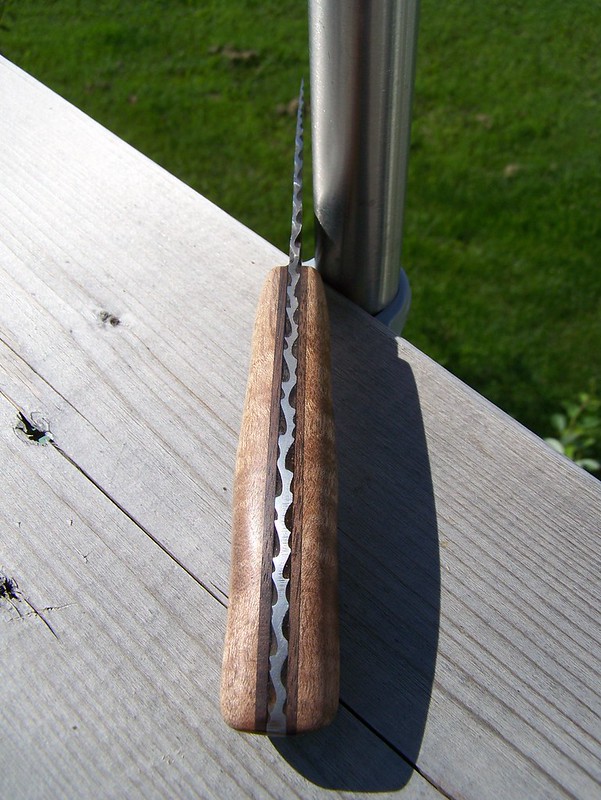
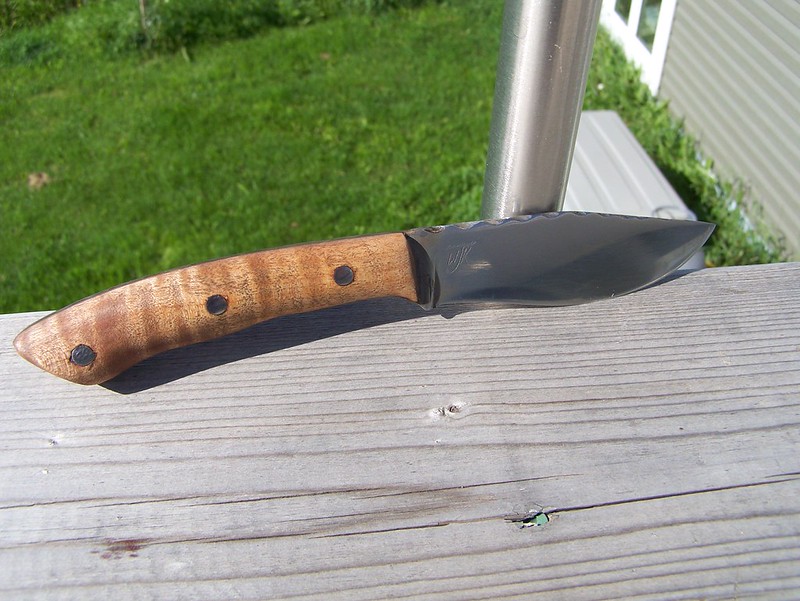
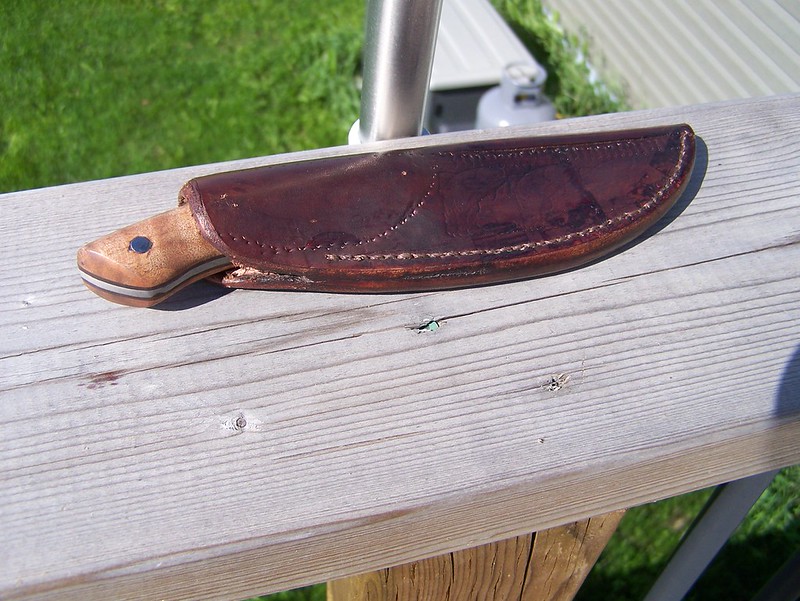
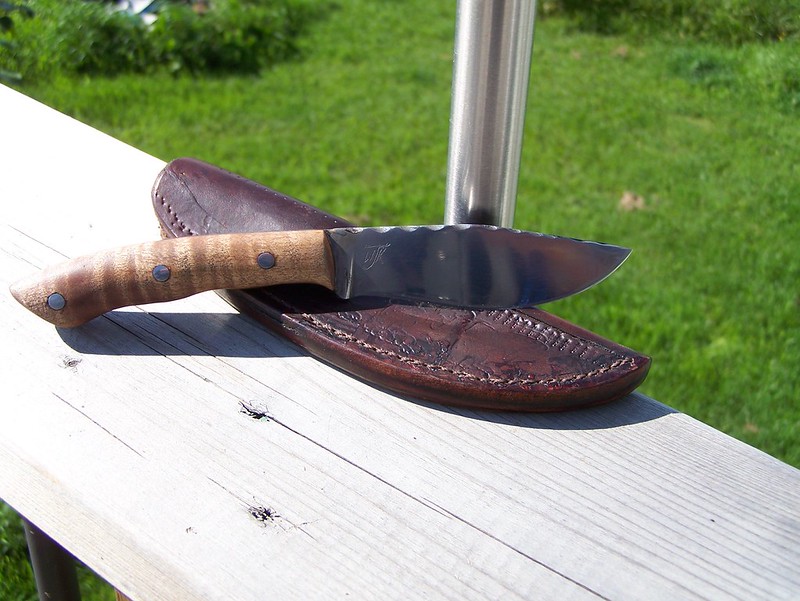
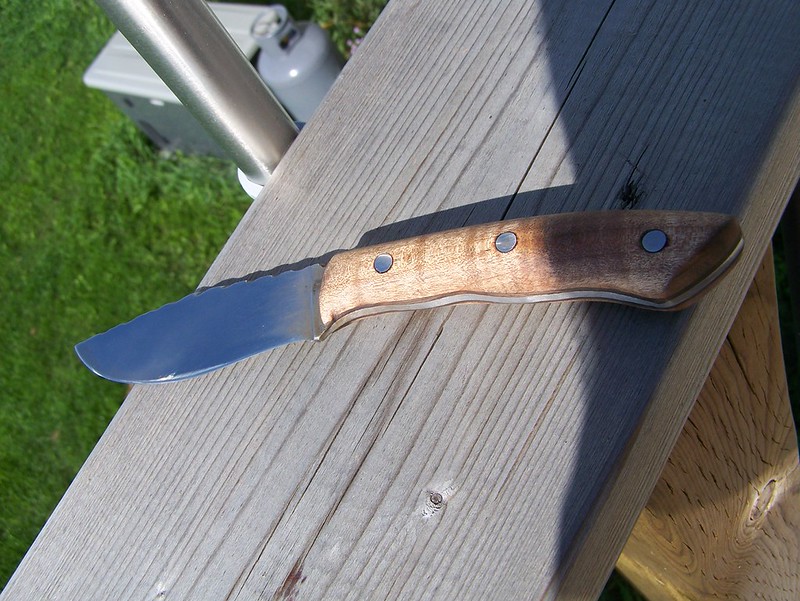
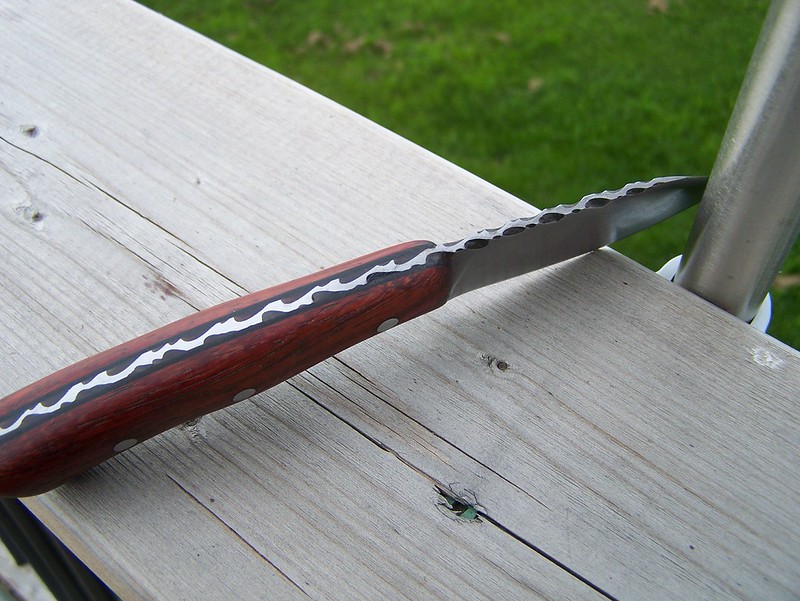
This was going to be one of my rejects, once I made a mistake grinding the bevels. My brother in law who covers everything in duct tape and will likely abuse this knife, agreed to be a tester for me, so I used it as a practice knife to test heat treat, fit and finish. I learned a few things along the way. Stabilized wood will tear out, just like regular wood, but it doesn't swell after drilling, so a hair bigger = gap around the pins. I need to sand the top of the filework at the handle a bit better, but the filework was practice as well. My wife calls it "dragon's breath" rather than "vine." This is my third sheath.
9359645047_55fe97902b_c.jpg


9359645649_eb3878402e_c.jpg


9359646333_e44cf99005_c.jpg


9362424112_a3e8cbf28b_c.jpg


9359647721_97b4a51e5f_c.jpg


Any critiques are welcome. Its 1/8" O1 steel, 3 3/4" blade, and 7 3/8" overall. Full flat grind with a small edge. This is the sharpest knife I have ever held (albeit my experience with high end knives is limited.) It will be used as a fishing knife with smaller fish, typically freshwater and less than 10lbs.
 
Last edited:
Good work so far. You know where the places are that need work, and seem to be addressing that.

I would forget that "block" stamp on the sheath. They are OK for tooling a belt with a repetitive pattern, but look odd on a sheath. Sometimes simpler is better. Read a few tutorials on sheaths and tooling to se some examples. I would fill that area with cam ( short for camouflage) marks. A border or cam tool stamped in a repeated pattern looks sort of like scales, and fills the open area nicely. Another great choice is a "basket-weave" stamp. They are fast to use, and fill a space with an elaborate looking tooling.

That file work pattern is called "vine and thorn" or "bramble brier". While some randomness is OK in file work, try and keep the pattern and spacing as even as possible. It looks like it got a little wonky in the handle area.

Here is a tip for the next one like this. Use thin G-10 or similar liners for the scales. Mix colored epoxy to match the liners, and glue everything up with it. When you sand out the handle the colored resin will fill all the voids in the handle file work, and will make it look like it is imbedded in a colored stripe. Try it, I'll bet you will like the look better than the two-tone wood. Black is the simplest, red is the most bold.

The only real critique of the knife is that it seems to have too many angles and curves....that don't match each other. The blade belly, spine, and handle all look like they belong on different knives. Try for a smoother curve from tip to butt on the spine, and a few less dips in the finger area of the handle.
 
I like your file work. Stacy's comment got me wondering if you might try allowing the voids on the spine to fill with a colored epoxy to match the liners, so that the tang looks embedded as well.
 
I used the Walnut in this one specifically for my brother in law, as it matches a guitar neck, and he is an exceptional musician (We used to play in a band together.) I personally like the random look in the file work, and did it that way on purpose. If I was selling a knife, I would ask the customer if they preferred even or random. The file work on the handle is filled with clear epoxy, and is flush with the scales. It looks different in the picture compared to real life. The clear epoxy looks almost black when holding it in hand. I appreciate the comments on the sheath, and as soon as I stamped it, I realized it looked like crap. I agree with you Stacy on the handle. I did what my brother in law asked for, and it doesn't look right. I think there is an important lesson in there.
 
I think it's a good start. Your wife is right, it does look like Dragon's breath. I actually like it. It looks like a muted down version of Matt Bailey's filework. The blade seems really big for fish though.

I like the overall shape of the sheath. Haven't seen one shaped like that in a while. You learned your lesson on the hole size for the pins. I'm not real crazy about the curves on the bottom of the handle. Looks like they're not in the right place. Other than that, it looks good. Let us know what your BIL thinks about it.

Oh, 01 does hold a keen edge, but try 52100 for the keenest edge I've seen. 01 is intimidated by it ;)
 
I like the shape but agree with Bladsmth about too many finger dips the handle should've reflected the recurve in the blade. I like the Walnut, is it quilted? (Do the stripes dance in the light if you change your viewing angle?). My only other comment is that these are perhaps not the best choices of materials for a fishing knife. While stabilised wood is kinda waterproof constant contact with water (especially salt water) will mar any highly polished surfaces enough that you may have to smooth off/polish with micromesh. also O1 needs a little bit more care around water than a stainless.
 
That's a very nice reject! 8)

What are the dimensions of this project?

Overall Length:
Blade Length:
Handle Length:
Blade thickness:
Target hardness:
 
Thank you for the comments guys. I was originally going to give it to him as an EDC, but he told me a couple weeks back that he would primarily use it at the lake for fishing, so the purpose changed mid stream. He is so ADHD, he makes me look like I'm in a coma, and I take a high dose of Concerta daily LOL :). I ground it thinner for better slicing. I aimed for Rc 60/61. Its 1/8" O1 steel, 3 3/4" blade, and 7 3/8" overall. Full flat grind with a small edge.
The main wood in the handle is flame maple. This is the first time I used a stabilized wood, and it is VERY different from the natural wood I have used for 30 years in various projects. Its the liners that are black Walnut. I did seal the handle with danish oil. It took about 6 coats to saturate the pores. If I knew he was going to use this for fishing, I would have used an oilier wood, but the purpose changed midstream. I have it to him yesterday, and he loved it. He didn't see the flaws at all.


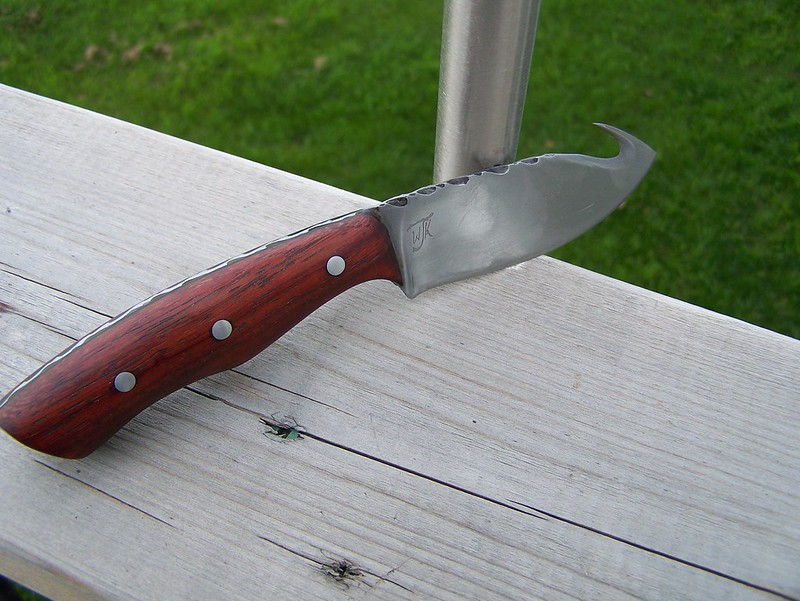
I am nearly done another knife for a friend at work, and he is using it for salmon fishing. He typically goes for 30-60lbs fish. This one is 1084, and about the same dimensions lengthwise to the one above. I'm not crazy about the shape or flow, but this is what he wanted. I don't know if I will ever do another guthook.

This one is 1084 at rc 58/59. Weak Hamon.
Handle: Padauk with black micarta liners and SS pins (same pins and drill bit as O1 knife- no gaps.) Danish oil finish. I didn't go for the perfect higher gloss finish as this is a work knife.
OAL 7 3/4, blade 3 3/4"

9368496831_ea9c99b1b3_c.jpg


9368496243_1bed0f0928_c.jpg


This one isn't quite done. I have a few touchups left, but it goes to my friend on Monday.
 
Your stuff looks really good. I hear you about the gut hook thing. Why is it that every knife maker I know always has at least one "friend" that wants a gut hook!!
 
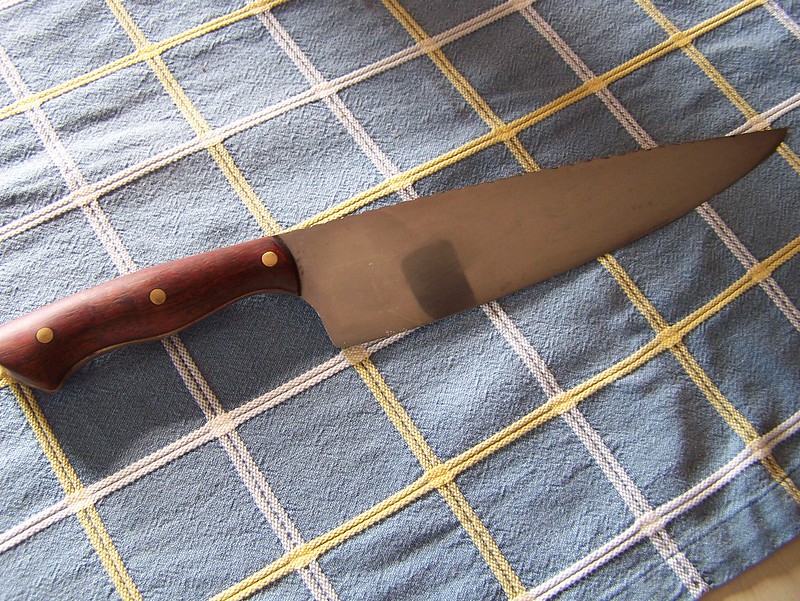
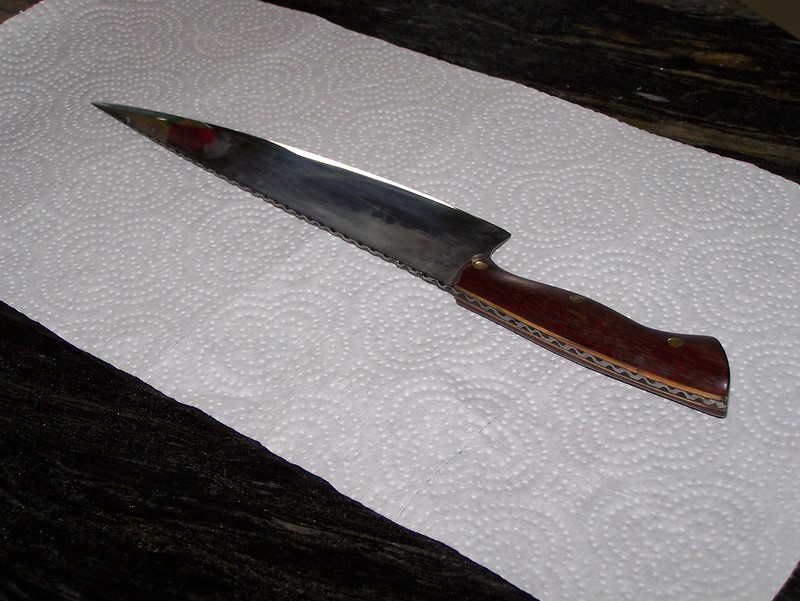
I have a couple other testers out as well. This is a kitchen Knife I gave to my mother for her birthday. She's been using it nearly daily since the beginning of April, and its still sharp as a razor. Its developing a nice patina, and the differential hardening lines are defining themselves more with use. You can't really see them in the crappy pic, but in hand it looks nice. This one is O1 as well, 1/8"x3". Blade is 11" long, and handle is padauk with maple liners, and filework along the spine. I got a slight warp in the blade with HT, and got it down to 1/16", but I was not as sure of myself then and left it. I would put more effort into straightening it now.

9374894732_73c886d02a_c.jpg


9062939374_8c4ef3e5b2_c.jpg


And here is another O1 knife. I did more detail work after this picture, but this was my first large knife, and it was a birthday present for my brother. 11 3/4" blade. The guard, handle, and blade were polished before delivery. Unfortunately, he won't use it and keeps it on display, so not much use as a tester.

0


This one has a weak Hamon as well. I wasn't going for one, but it was there faintly (I did clay differential HT, but didn't expect it to show with the O1 deep hardening.)
 
Last edited:
Not much for gut hooks either but there is something about that knife I really like
 
I think its the Padauk that sets that knife up. Its subtly beautiful and classy. Sometimes I find the spalted woods, or burls too busy, and they distract from the knife. To date, every one of the padauk handled knives I have worked on has been a hit with the receiver. The Brazilian Tigerwood is a hit as well. I have done a mild white vinegar then lemon juice etch, and there is a nice subtle darkening of the steel that seems to be well liked as well. I rub the etched steel with 3000g trizac abrasive.
 
Next skinner/hunter you make, make it without the gut hook. Then make a matching small knife with only a gut hook ( no blade). Gut hooks on blades are ugly, and a nuisance.

Your kitchen knives have clean lines and look well make.
 
Thanks for that suggestion, re: the second knife for the gut hook. I really felt the guthook ruined a really nice little knife. I'm surprised no one noticed the misaligned pins on the guthook knife. I was going to use brass bolsters, but changed my mind. I had some holes for the epoxy drilled too, and they were almost in the right spot for the pins, but not perfect. I polished the handle last night while I had relatives over. I'll post a pic later.

I will be doing a lot of thinking on the liner suggestion as well. I will be doing some matched sets, some with contrasting wood liners, and some with micarta or CF liners.
 
Bladsmith, for a larger kitchen knife like the one above, what steel thickness would you recommend? That one is 1/8, but what would be ideal? I can get O1 and 1095 in 3/32. I could always have the local machinist surface grind it thinner.
 
Back
Top