
-
The BladeForums.com 2024 Traditional Knife is available! Price is $250 ea (shipped within CONUS).
Order here: https://www.bladeforums.com/help/2024-traditional/
You are using an out of date browser. It may not display this or other websites correctly.
You should upgrade or use an alternative browser.
You should upgrade or use an alternative browser.
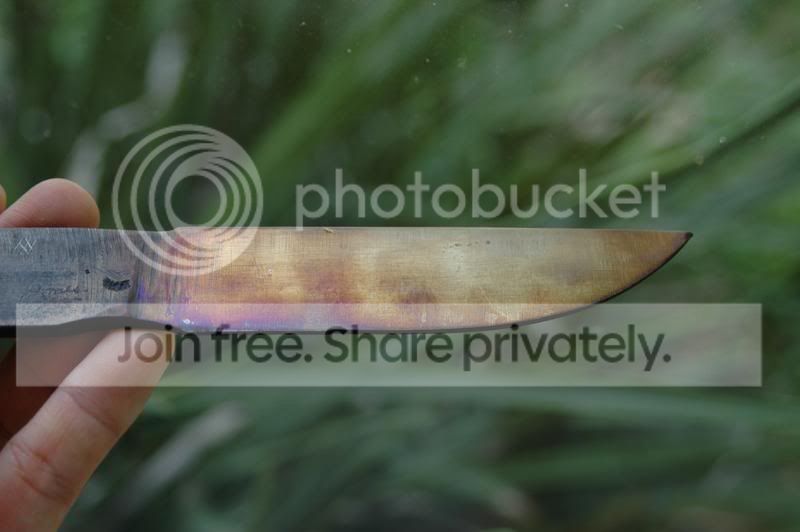
Oh no, did I "over" temper?
- Thread starter physh
- Start date

- Joined
- Dec 6, 2004
- Messages
- 6,212
purple bad for most steels so far as temper temp goes
if i remember right purple and blue are in the 600+ range
if i remember right purple and blue are in the 600+ range
- Joined
- Sep 9, 2003
- Messages
- 2,361
If you did it in a good oven with accurate settings, relax, you are probably just fine. Tempering colors are simply a result of oxidation so are much more dependant upon the amount of oxygen getting at the steel then they are upon the actual temperature. This is another one of those old time methods and indicators that has been passed off as much more reliable than it really is. To get a better understanding of it I think everybody should give a go at heat bluing on some mirror polished carbon steel at least once, then they will get it. Any oils, particularly finger oils, will have very profound effects on those colors, in fact any deviation in the surfaces contact with the atmosphere will give you patches of different colors. Whenever I have done open air tempering, the edge area comes out darker, I believe this is due to that area being at temperature in the initial oxygen rich furnace longer because it gets there quicker.
It is also worth noting the huge difference in oven tempering and torch tempering. Those colors are a result of time at temperature, in an oven they are slower to come on and reflect a lower temperature for the given color. The fact that one can get purple and blues in seconds with a torch should tell us that since time has so shortened temperature has to increase to make up for it, so one is bleeding much more heat into a blade with a torch to get tempering colors than they are with an oven. Often blade done in an oven will show no color at all after an hour or two but then take on a rich straw color after exposure to fresh oxygen while cooling.
It is also worth noting the huge difference in oven tempering and torch tempering. Those colors are a result of time at temperature, in an oven they are slower to come on and reflect a lower temperature for the given color. The fact that one can get purple and blues in seconds with a torch should tell us that since time has so shortened temperature has to increase to make up for it, so one is bleeding much more heat into a blade with a torch to get tempering colors than they are with an oven. Often blade done in an oven will show no color at all after an hour or two but then take on a rich straw color after exposure to fresh oxygen while cooling.

Mark Williams
Moderator
- Joined
- Nov 28, 2000
- Messages
- 4,760
Test the blade. I just chopped a 3"x3" piece of kiln dried hickory in half with a 1065 blade that was getting some purple spots here and there. Most likely my finger oils.
Still shaves just fine after the chopping.
Still shaves just fine after the chopping.
- Joined
- Dec 6, 2004
- Messages
- 6,212
i stand corrected
i ll keep this in mind for next time the ? pops up thanks
i ll keep this in mind for next time the ? pops up thanks
- Joined
- Jan 24, 2001
- Messages
- 501
I nearly panicked the first time I tempered some blades after HT in salts. Talk about some funky colors - but they were all OK.
- Joined
- Sep 9, 2003
- Messages
- 2,361
i stand corrected
i ll keep this in mind for next time the ? pops up thanks
No, you are still absolutely correct, darker purples and blues are generally indicative of temps in excess of what we would want to temper at, and if you are drawing a spine or tempering with a torch any purple or blue on the edge will invariably result in a soft spot that will be evident on the sharpening stone and also in cutting. But one would need the entire blade to reflect that color in order to really get concerned with an oven temper, in that case you need to look at all the colors and sort of average them out to get an idea of the tempering effect.
Heck, since I do my tempering in salts, the colors are totally meaningless to me, I work off pure temperature and resulting rockwell. Also there are some alloys that if fully hardened can get to purple and still work, O1 or 1095 can go to temperatures that would actually result in purple and still not drop below 58 HRC, which is pretty darned good. But you need a certain ammount of austenitizing soak to obtain that level of sustainable hardness.
- Joined
- Dec 6, 2004
- Messages
- 6,212
ok thats cool
and yes there are some high temper alloys :thumbup:
i ll just keep filling my head with all the info i can in hopes that i can spit it back out when i need it
and yes there are some high temper alloys :thumbup:
i ll just keep filling my head with all the info i can in hopes that i can spit it back out when i need it