- Joined
- Dec 1, 2010
- Messages
- 161
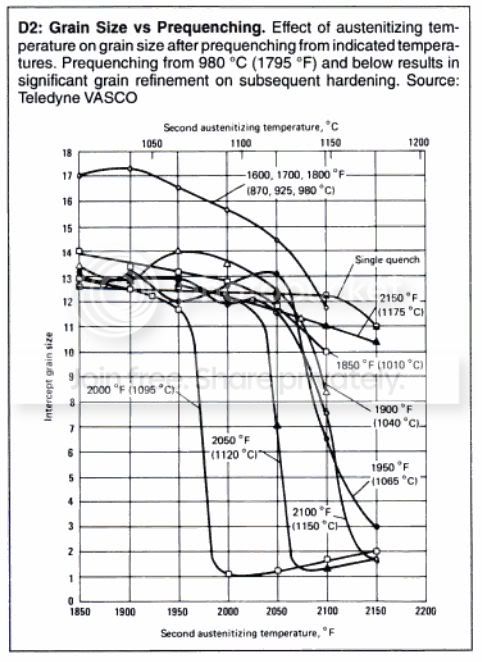
Right off the bat i know some of you will think that this is a bad idea, but is there a way to reduce the likelihood of cracking and warping d2 blades in an oil quench? from what i have read it seems as if an oil quench plus a liquid nitrogen treatment will get the steel to near full martinsite as well as reducing the grain of the steel, which if my understanding of heat treating is right, would produce an ideal blade. http://books.google.com/books?id=cY...0CDwQ6AEwAQ#v=onepage&q=d2 oil quench&f=false on pages 238-242 this is discussed, though no mention of what type of quenching oil is used is brought up and i am figuring that this type of research is aimed more for the tool and die makers using d2 rather than us knife-makers.
In another book http://books.google.com/books?id=bo...0CGMQ6AEwBg#v=onepage&q=d2 oil quench&f=false on pages 560 to 565 they compare different methods of heat treating d2 side by side and again it seems as if oil quenching and liquid nitrogen provide very desirable results.
So as knife-makers how could we reduce the negative effects of oil quenching in order to reap the benefits? or is this kind of quenching much like quenching 1095 in water which i know first hand is a 50/50 shot in the dark of success or failure.
-what would be the ideal oil
-i assume turco (spelling?) would be needed to be applied to the blade or could something like a thin layer of refractory cement be applied?
-are there any methods of reducing warping that could be used?
-What is the likely hood of failure by using an oil quench?
Thanks for reading and i hope somebody can provide some decent answers
In another book http://books.google.com/books?id=bo...0CGMQ6AEwBg#v=onepage&q=d2 oil quench&f=false on pages 560 to 565 they compare different methods of heat treating d2 side by side and again it seems as if oil quenching and liquid nitrogen provide very desirable results.
So as knife-makers how could we reduce the negative effects of oil quenching in order to reap the benefits? or is this kind of quenching much like quenching 1095 in water which i know first hand is a 50/50 shot in the dark of success or failure.
-what would be the ideal oil
-i assume turco (spelling?) would be needed to be applied to the blade or could something like a thin layer of refractory cement be applied?
-are there any methods of reducing warping that could be used?
-What is the likely hood of failure by using an oil quench?
Thanks for reading and i hope somebody can provide some decent answers