
-
The BladeForums.com 2024 Traditional Knife is available! Price is $250 ea (shipped within CONUS).
Order here: https://www.bladeforums.com/help/2024-traditional/
You are using an out of date browser. It may not display this or other websites correctly.
You should upgrade or use an alternative browser.
You should upgrade or use an alternative browser.
Oiling Slip Joints?
- Thread starter Beekman
- Start date


ISKski
Gold Member
- Joined
- Apr 11, 2011
- Messages
- 1,087
Oil is used to reduce the friction in the metal on metal action between the tang and the spring, thereby extending the life of the knife.
It also aides in avoiding corrosion in the pivot.
Occasionally I use some compressed air to blow out the dust and lint from the pivot. Then I drop a couple drops of "blade oil" that came with my beard trimmer into the pivot.
Once I do that the blade instantly becomes smoother and snappier. I usually remember to do that twice a month....maybe....
It also aides in avoiding corrosion in the pivot.
Occasionally I use some compressed air to blow out the dust and lint from the pivot. Then I drop a couple drops of "blade oil" that came with my beard trimmer into the pivot.
Once I do that the blade instantly becomes smoother and snappier. I usually remember to do that twice a month....maybe....
Last edited:

- Joined
- Jul 25, 2010
- Messages
- 7,432
To remove the dirt in my knives with the ultrasound cleaner my wife uses for her glasses - actually every dirt gets removed. I use to let the knife dry in sunlight and the oil the joints with simple mineral oil. It has no name but is sold in hardware stores to very low prices - works great.
In former times I used Ballistol on my knives, but I realised that it´s no good when brass is added to a material (like the liners) - as a weapon oil it´s made to remove brass rests from the barrel of a firearm. It will attack the material... I just wanted to say that.
When I plan not to use the knife in a longer term, I also add some mineral oil on a rag/towel and strop it on the blade(s) to get a thin oil film.
Never had real problems with rust... except some pitting on some of my blades, but that was my foolish fault and had nothing to do with the oil itself.
In former times I used Ballistol on my knives, but I realised that it´s no good when brass is added to a material (like the liners) - as a weapon oil it´s made to remove brass rests from the barrel of a firearm. It will attack the material... I just wanted to say that.
When I plan not to use the knife in a longer term, I also add some mineral oil on a rag/towel and strop it on the blade(s) to get a thin oil film.
Never had real problems with rust... except some pitting on some of my blades, but that was my foolish fault and had nothing to do with the oil itself.
Anything slippery will do, but I use gun oil a lot since the bottle has a fine applicator tip. I also like a wax lube called White Lightening. I even tried a little motor oil one time on the pivot of a somewhat stubborn sodbuster and that seemed to work really great. As far as bone handles, I would wipe with an oily cloth and call it good.

- Joined
- Oct 8, 2010
- Messages
- 8,340
Thanks guys ive been using veg oil because its food safe my texas jack is all gunked up now pocket lint n such. Im going to try mineral oil with needle dropper thanks again always great info here
Veg oil and olive oil can (and will) turn rancid and totally gunk up your knife (please do a web search if you use either of these, and you'll stop using them). Best to stick with mineral oil -- it is also food-safe and will not turn rancid. I speak from the experience of almost ruining two knives with olive oil!

JB in SC
Gold Member
- Joined
- May 19, 2001
- Messages
- 5,280
Andi,
Ballistol will supposedly remove trace amounts of copper and lead from barrels, but it's not aggressive (contains no ammonia).
I don't know how it reacts long term to brass liners (I'd be interested to know if anyone has experienced issues) but I would be surprised that the tiny amount normally applied would do any damage. It's mostly medicinal grade mineral oil with benzyl acetate, alkaline salts, some alcohols.
Ballistol will supposedly remove trace amounts of copper and lead from barrels, but it's not aggressive (contains no ammonia).
I don't know how it reacts long term to brass liners (I'd be interested to know if anyone has experienced issues) but I would be surprised that the tiny amount normally applied would do any damage. It's mostly medicinal grade mineral oil with benzyl acetate, alkaline salts, some alcohols.
Last edited:
I soak my old knives in Mineral oil for weeks at a time sometimes - be it whatever scales, I have never had any damage to any knife.
The reasoning in soaking these old knives is because they might be very stiff - etc and occasionally I take the knife out - work it-and plonk it back in again, and revived some great old knives through this method.
I then give it a good wash out using detergent and warm water-then air compressor air-gun out ALL moisture and lube the joints with a few drops of Mineral oil in the joints.
I haven't heard anything detrimental about the use of oil actually ON any scales - what have you heard?
I soaked a old TL-29 in mineral oil. It made the old wood scales swell and become loose.
- Joined
- Jul 25, 2010
- Messages
- 7,432
Andi,
Ballistol will supposedly remove trace amounts of copper and lead from barrels, but it's not aggressive (contains no ammonia).
I don't know how it reacts long term to brass liners (I'd be interested to know if anyone has experienced issues) but I would be surprised that the tiny amount normally applied would do any damage. It's mostly medicinal grade mineral oil with benzyl acetate, alkaline salts, some alcohols.
Thanks for correction, Jerry - I didn´t find the correct words

You are right, it´s not aggressive but it will corode brass liners over time. I use Ballistol for everything around the house, for being the best oil around - except my beloved Traditionals. I made a bad experience in the past on an Hartkopf knife with brass liners that got very bad while using Ballistol for over some time.

- Joined
- Apr 21, 2006
- Messages
- 5,613
I use different products for different knives with differing designs and tolerances. Some will get a grease rather than oil, some get dry teflon lubes like my modern Spyderco's. It all depends.
Anybody have an idea what grease is in the Case etc. traditionals when unpacked. Some of that stuff is cruddy looking like dirt from the buffer wheel is in it but it seems to work good and lasts decades sometimes.
It's a conundrum.
Anybody have an idea what grease is in the Case etc. traditionals when unpacked. Some of that stuff is cruddy looking like dirt from the buffer wheel is in it but it seems to work good and lasts decades sometimes.
It's a conundrum.


- Joined
- Apr 12, 2009
- Messages
- 13,653
I also like singer sewing machine oil but its hard to find.
It's likely just so-called 'light' (or also called 'white') mineral oil, less viscous than the 'heavy' grade sold as a laxative.
David
I too use mineral oil on my Case Texas Jack as it is my designated afternoon apple cutter. Recently I've also been using on my non-food cutting knives some Braun Shaver Oil that came with my Braun shaver. It seems to be even lighter in weight than the ubiquitous 3 in 1 oil. Anyone else use this?
- Joined
- Apr 12, 2009
- Messages
- 13,653
I too use mineral oil on my Case Texas Jack as it is my designated afternoon apple cutter. Recently I've also been using on my non-food cutting knives some Braun Shaver Oil that came with my Braun shaver. It seems to be even lighter in weight than the ubiquitous 3 in 1 oil. Anyone else use this?
That oil for the electric shaver is also likely the 'light' or 'white' mineral oil, as for sewing machines, electric hair clippers/trimmers, etc. Biggest clue for most of them is the complete lack (or nearly so) of color & odor, which is characteristic of mineral oil. Many industries and companies have figured out they can re-package it in small/tiny bottles and sell it at a bigger profit margin for 'specialized' uses. Same holds true for many so-called 'honing oils' for cutlery.

David
- Joined
- Aug 24, 2010
- Messages
- 1,447
I soak my old knives in Mineral oil for weeks at a time sometimes - be it whatever scales, I have never had any damage to any knife.
Here are knives that have evidence of oil soaking in unevenly.
On the left is a Russell I immersed in mineral oil, notice how there is a large area of darker color to half the handle. That portion of the bone became softer, and gouged easily when I used a buffing wheel on it.
Next is a "restored" Keen Kutter I got off ebay, notice the extra dark bone along the backspring edge, at the middle pin, and elsewhere
Next is a Boker with porous second cut stag handle, notice the dark spots in the middle of the handle where I put 3 drops of mineral oil that soaked into the pores

the "damage" caused by soaking in oil is that the oil changes the color of the bone unevenly. It tends to go in around the pins and under the edges of the scales, more than on other parts. Not all bone handles react the same way, as the density of the bone varies from knife to knife.
Even the two sides of the same knife react differently, for example, the Pile side on the Keen Kutter has much more oil staining than the Mark side


In the following photo, the Remington on the right shows just a very slight shadow where oil soaked in more than other parts of the bone, on the backspring side between the middle pin and the bolster. It left me with the impression that Remington bone is denser than the bone Russell used. The Charlow on the left showed very little change from oiling. Bone density varies a lot, and some cutleries use higher density bone than others. Gecs Primitive bone is so porous, that they stabilize the material by soaking in acrylic. After which oil will not penetrate at all.

In this next photo you can see that the Mark side of the Russell absorbed much less oil than the pile side, mostly only around the pins.
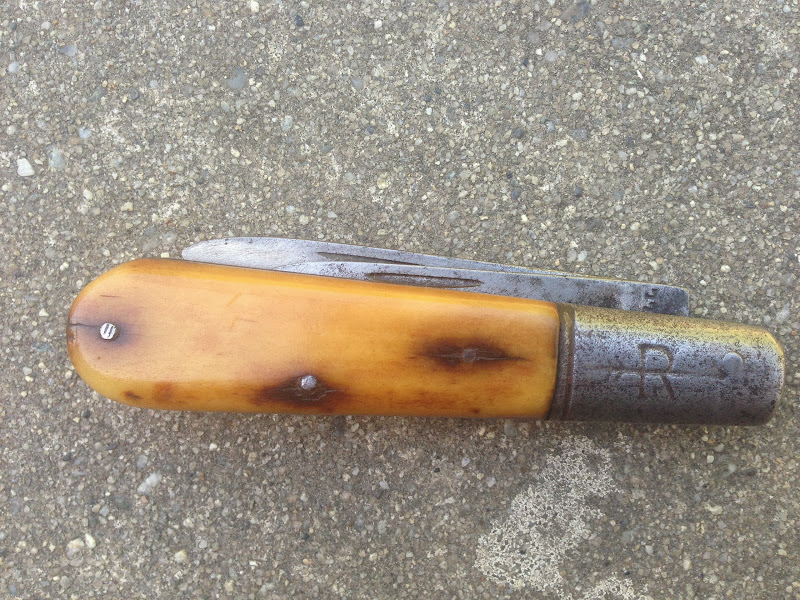
I do recommend using mineral oil for the pivot pin and blade of a carbon steel knife. I just no longer soak my handles with it.
Last edited:
Brian.Evans
Registered Member
- Joined
- Aug 20, 2011
- Messages
- 3,267
Knives and baseball gloves ............ Man, I can't smell that stuff without thinking of my childhood! :thumbup:
-- Mark
Me too. Remember sitting on the steps going from our kitchen to our family room watching dad use an old India stone with 3-in-1 oil to sharpen his Schrade sp3, then shaving hair from his arm. Fascinating to a young kid. Now, ball gloves and boots, really just leather in general, got neetsfoot oil.
I use mineral oil primarily, but sometimes use 3-in-1. Always brings me back though.
I dip a tooth pick in the mineral oil then touch it to the joints and work the blade. Maybe once a month, maybe every few weeks, just whenever it needs it.
As for brand of oil I use, it's whatever is on hand. I used to try to find the magic lubricant for my guns so I bought every new oil that came along. I have a large supply of exotic lubes around the house these days. I also have made a discovery: all of those oils work fine and none of them are truly any better than any of the others. If I had to recommend a brand for general lubrication, I would say Ballistol, Kano Microil, 3-In-1 and generic drug store mineral oil. Why those? They come in bigger bottles that last longer and cost less.