Ok, dumb Hamon question time

Joined
Nov 28, 1999
Messages
14,985
Probably been covered, but I'll throw it out there again. I have lots of 1095, W1, W2, 1084, etc... and, will be trying to do some knives with Hamons in the future. Question I have is, if I heat treat using my Evenheat oven and soak the blade at temp with the clay on for say, 5 mins, before quenching into the Parks 50, will the blade not get fully hard? In other words, how long does one have to soak a clay coated blade at temp, in order to obtain a Hamon? Reason I ask is this; I did this procedure on a 1084 blade recently(Satanite coated in the usual fashion, blade soaked for 5 mins at 1500, full quench in Parks 50), and so far, I see no evidence of a Hamon. Now, I haven't sanded this 1084 blade to a super fine grit yet, but I just thought that I would see a Hamon at 220 off the belt sander. No?
 
Last edited:
How the clay is done is pretty important. If the clay is too thick or comes too close to the edge it will prevent the edge from getting hard. The clay holds onto the heat longer and insulates the blade steel underneath from the cooling effects of the quenchant just long enough to prevent it from hardening. One of the ways of telling if it has been done right is to make sure the hamon has formed. At 220 with a uniform grind if you hold it at just the right angle you will probably be able to see it. If not you can do a quick etch to check. If there is still nothing you will probably want to re-heat treat.
 
Well, what jumps out at me is the steel type and temperature. 1084 will show a line with some activity... but I'd choose any of the other three you listed over 1084 if I was after a hamon.

And I'd lower the temperature to no more than 1450. The five minute soak should be fine.

This is all just what I've found with what works for me (most of the time), OMMV. ;) :)


Edited to add: Not to disagree with Allen, but I've found that if a hamon is going to be a good one, you can sweep over the blade with a 50X belt and see it so long as you angle the blade right under your light. It will be REALLY visible after tempering.
 
Danbo,

True 1084 should show a hamon if properly treated. Some 1084, esp Aldo's, has a bunch of Mn in it to increase hardenability and allow a slower oil. It's no longer a shallow-hardening steel= no hamon.

John

Edited to say Allen's comments point to "properly treated." Many variables here. Nick's point about seeing the hamon easily's a good one. If it's there, you should see it just by a quick grind after cleaning off the clay.
 
Last edited:
Danbo,

True 1084 should show a hamon if properly treated. Some 1084, esp Aldo's, has a bunch of Mn in it to increase hardenability and allow a slower oil. It's no longer a shallow-hardening steel= no hamon.

John

Edited to say Allen's comments point to "properly treated." Many variables here. Nick's point about seeing the hamon easily's a good one. If it's there, you should see it just by a quick grind after cleaning off the clay.

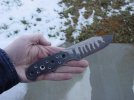
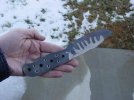
Probably should've been more specific. Yes, this was/is Aldo's 1084. Here's a couple pics of the blade before heat treat with the Satanite on. Not very thick, but it's there.

Now, don't get me wrong. I have no problems with the useability of this particular blade. I'm not going to redo the heat treat. I think it will perform just fine. Just trying to figure out how to get them fancy Hambone lines youz guyz are gettin. ;)


Nick, duly noted about the soak temp. :)
 

Attachments

  • 1084.jpg
    1084.jpg
    50.8 KB · Views: 144
  • 10842.jpg
    10842.jpg
    49.7 KB · Views: 152
Edited to say Allen's comments point to "properly treated." Many variables here. Nick's point about seeing the hamon easily's a good one. If it's there, you should see it just by a quick grind after cleaning off the clay.

Yep, there are a lot of variables. Sometimes, I end up doing it more than once as I can be pretty aggressive with the clay and the hamon can get too close to the edge. So, the advise about a quick grind and etch is quite good as it is a lot easier to re-heat treat before you get the blade thinned out to final thickness.
 
I did a blade out of Aldos steel at the ABS hammer in in Visalia last fall and the blade hardend all the way through. clay was satinite hardend in water.
 
Not that i have much room to say anything, But i used satanite to do my last one. Kept it at about 3/32 thick all the way around, quenched in oil at 140* using Kelly's 1080 and got a great hamon. Could see it great in the temper cycle. Want to try some W-2...
 
Based on my limited newbie experience with 1080, 1095 & W2 I think that your clay may actually be too thin... at least it looks that way from the photos. With 1095 & W2 I try to keep the clay fairly thin, but with 1080 (granted, not 1084) I apply a bit more clay (especially closer to the spine) to keep the blade from hardening all the way through (edited to add: especially important when using a faster quench like P50). I never get the same amount of activity with 1080 as I get with either 1095 or W2, but 1080 (and 1084 I imagine) can give you a hamon. As other have said, you should be able to see the hamon at 220 grit (or even lower) in the right light. I usually notice it under my fluorescents at about 120-grit.
 
Last edited:
Dan, drop Mr. White an e-mail and see if you can con him into sending you his hamon handout.. He did a hamon demo at the Southern Bladesmiths hammer-in last weekend and his method is about as easy to understand as any I have seen. He also has some polishing tricks that will let you get a nice looking blade without spending a week hand sanding it.:D As for the blade hardening, so what? You are looking for pretty, not flexy, right?
 
Are you sure that you are even getting your blade up to temp in your 5 minute soak? remember you have the extra mass of the clay to heat up. I give a blade at least 20 minutes, and that is without clay

_Page
 
1450 with a minute soak. Also your clay needs to come down lower towards the edge. I cover at least half the blade with the clay. The 1084 isn't going to produce as dramatic of a hamon as the other steels that were mentioned. Here's one I finished recently using 1084 from Aldo.

IMG_2959.JPG
 
Last edited:
1450 with a minute soak. Also your clay needs to come down lower towards the edge. I cover at least half the blade with the clay. The 1084 isn't going to produce as dramatic of a hamon as the other steels that were mentioned. Here's one I finished recently using 1084 from Aldo.

IMG_2959.JPG

Ray was that with clay or just difrential heating or both. I can get that hamon on just about any lower alloy steel by heating only the edge but any kind of soak time on steel with the amount of manganese that Aldo's 1084 has gives me a fully hardend blade.
 
Ray was that with clay or just difrential heating or both. I can get that hamon on just about any lower alloy steel by heating only the edge but any kind of soak time on steel with the amount of manganese that Aldo's 1084 has gives me a fully hardend blade.

Bill, That blade was done with my homemade clay mix, then quenched point first and totally submerged into horse grade mineral oil. I'd put the clay on without much wave action that's why it looks so straight. The only time I didn't get any hamon using Aldo's 1084 is if I did a few thermal cycles and then tried the clay. The whole blade would harden.
 
Bill, That blade was done with my homemade clay mix, then quenched point first and totally submerged into horse grade mineral oil. I'd put the clay on without much wave action that's why it looks so straight. The only time I didn't get any hamon using Aldo's 1084 is if I did a few thermal cycles and then tried the clay. The whole blade would harden.

that might partially explain it. I had thermal cycled the blade I did four times and the ground and quenched it.
 
Back
Top