Old as dirt Buffer help

Joined
Jun 17, 2006
Messages
578
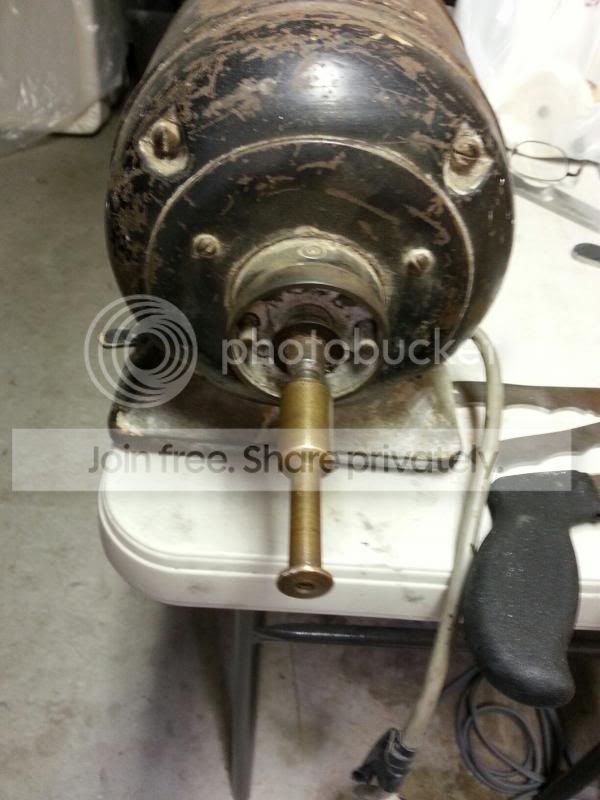
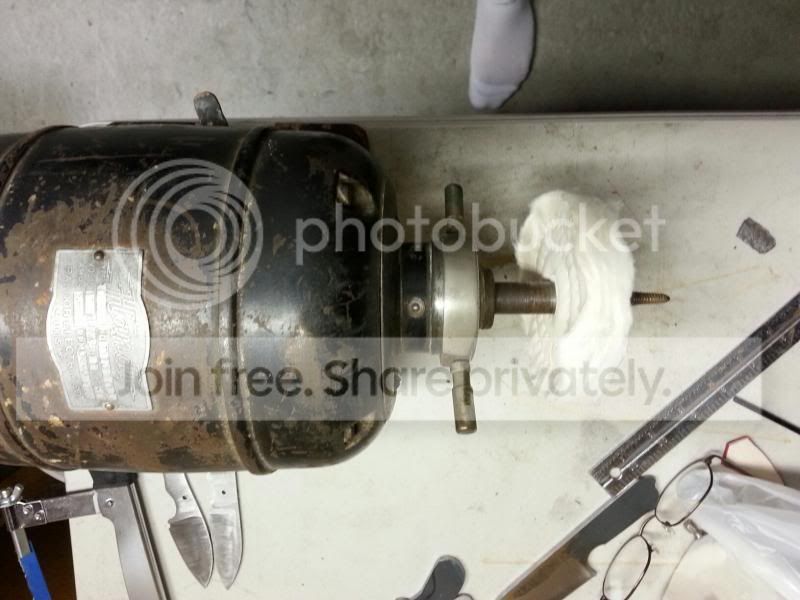
I just scored this old buffer and was wondering if it is missing stuff or broke, or both. lol the part with two handles sticking out turns around but doesn't tighten. and on the other side it has the brass part on the spindle. It still works thanks for any help


The part with two handles is likely used to press off stuck mandrels. It would have originally screwed in and out. It may be stripped. There would have been on on the other side too. it won't effect anything.
 
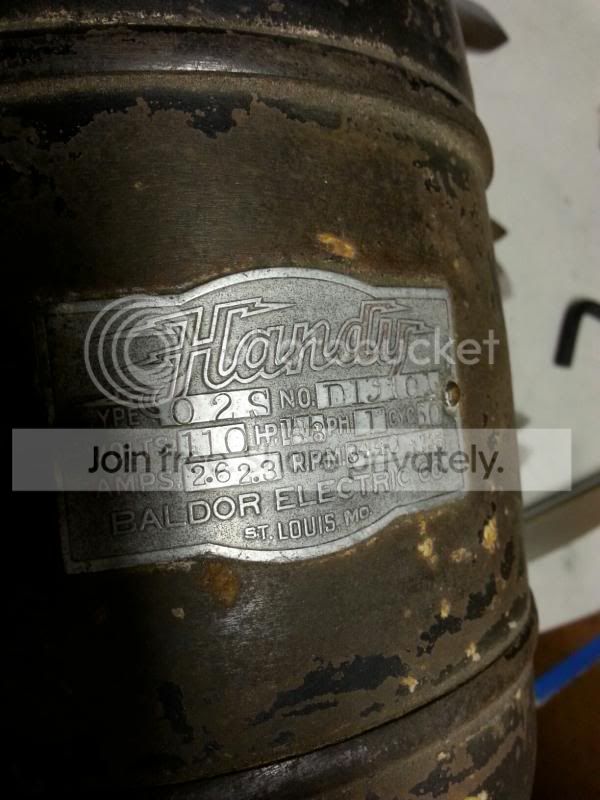
That is an old watchmaker's/jewelers bench motor/buffer.
The two handled piece is to press off the mandrels. There was one on the other side, which is missing. They were rarely used, and is on no need or concern for you. The odd looking piece on the other end runs the belt to the watchmakers lathe. It can be removed and another tapered spindle or buff mandrel put in its place. Make sure you put the proper "hand" spindle on (RH or LH).

Now, the bad news is that this is a very low power buffer made to polish very small things. It will not be totally useless for knife work, but is very limited. At 1/8HP it will only spin a 4" buff and will not polish steel blades and such. It will be OK for buffing wooden handles and small things like a brass guard.
Be cautious, as it is a high speed buffer...3440RPM. It will burn a wooden handle or toss a small object across the shop in a flash if you aren't careful.
 
Well sh#t. I was really hoping this would do the trick ! Guess I'll have to keep lookin. So should I be looking for a1/4 hp? Or more .. thx
 
...or toss a small object across the shop in a flash if you aren't careful.

Buffers are scary, dangerous and evil. I own one, I use it, and I'm terrified of it, which is why I'm still here. DON'T lose your focus with a buffer - it will take the sharp thing you're working on and put it somewhere other than in your hands instantly.
 
Buffers to have any real power to buff steel need to be 1/2HP minimum. Most commercial are 3/4 to 1HP. They will throw a 10-12" buff and can do a nice job on buffing a blade out........ BUT, they are super dangerous. I really, really want to express how a buffer is not a newbies toy! I buff every day at work...and things get away from me regularly. A whack on the fingers with a ring is annoying, a whack on the hand ...or in the abdomen.....can be much more tragic from a sharp knife. The buffer I use at work is called a Quatro, and looks like a neo-natal ICU tank.
http://search.yahoo.com/search;_ylt...p=quatro+buffing+machine&fr2=sb-top&fr=mcafee
My hands are inside a plexiglass compartment with rubber curtains keeping thrown objects inside. You can't do knives in such an enclosure, so you aren't protected at all when buffing out a blade. One of the reasons I do a machine finish on almost all my blades is that buffing is more danger than I am willing to do except on a special blade.

If I was to suggest a buffer for a non-professional, I would suggest a 3/4HP motor with extra long shafts. The shafts should be 1" diameter, and extend 8-10" past the motor housing on both sides. The motor should be a slow speed type. 1100RPM is best, 1750 the max. Two speed is really great....and VS superb. For a 3/4HP motor, us 10" buffing wheels. Use stitched muslin wheels on the left for coarse polish, and unstitched on the right for final fine polish. Avoid cross contamination of your buffs.
 
I hear a lot of experienced makers mention how dangerous buffers can be if they are not used properly (and I don't doubt it). I'm wondering if someone could do a quick lesson on the proper/safest way to use a buffer. If someone is setting up a new buffer, is there a preferred way of setting it up so it is more safe? I have a cheap HF buffer right now, but I'm hoping to get a mandrel style and run it off of a VFD. Thanks for any help.
 
im running a light duty low power buffer and ill stick with it since even with 6 inch buffs its frightning. i sand a grit or 2 higher then i think i will need before buffing jsut so i can shorten my tiem at that monster. my fun tiem was looking down and not seeing the razor i had jsut a sec ago in my hand then hearing it bounce off a trashcan on the other side of the shop

firt safty tip i can give is sharpening your knives is the last thing you do before taking it to a show or boxing up for shiping
 
I agree that it is the most dangerous tool in the shop. The best tip that I can give you is to buff only half of the width of the blade at a time in order to not expose the opposite edge to the buffing wheel. If you catch the opposite edge on the wheel it will try to take it out of your hands very quickly.

Gary
 
Wow, ok, I guess I'll just look into finishing blades on the belt grinder for now. thanks for the help as always dudes!
 
BTW they do make felt buffing belts and i do use them from time to time
and i lookded at my bench grinder and its only 1/6 HP 1700ish rpm and i woudl not want any more then that on the bench
 
Buffers are dangerous. So are torches and forges, bandsaws and grinders.
Polishing steel is part of being a real knifemaker. Learn to use buffers safely. Never present the buffing wheel a sharp edge to grab. Make sure you hold the work firmly. Polishing on hard felt wheels is less likely to cause accidents. Keep the work below the center of the wheel.
Putting a soft buff on a 3600 RPM machine, turning it on, and sticking a pointed piece of steel into the wheel with no experience is guaranteed to cause an accident. In my work, I must match factory finishes on all available types of cutlery, so I have lots of buffers. I even have a 3600 RPM 1HP model I use frequently.
If anyone wants tips on using a buffer, or has questions I will be happy to answer them.
 
Never have any string, wire, rope, lanyards or torn, ripped or loose clothing or hair anywhere near the buffer. I've been working in the plating/polishing industry for over 20 years and just reading this thread is making my hands sweat. We use monster 3 - 5 HP buffers that run about 3000 rpm, the wrong move on one of these machines can result in broken limbs.

I would definitely keep the max rpm to 1750 or less and use the tightest spiral sewn buffs that you can find, probably 3/8" spiral. The tighter, more dense the buff, the less likelihood of a catastrophic 'catching' event. That's just what I would do, I do not recommend anybody take this advice. /disclaimer off

 
Buffing is by far the dangerous step in knife finishing. When you do step over to the buffer do it when you are fully alert, not in any hurry and in a good mood, if not don't go there. Wear face and body protection, I wear a leather welding apron as an added layer of protection. Pay attention at all times where the blade is in comparison to the spinning raging wheel, and make sure you have a firm grip on your work. Don't push, use light easy pressure and add compound often. Pushing will lead to the wheel catching and throwing your work back at you, or at the least it will orange peel the finish. Use a different wheel for different buffing compounds and store each buffing wheel separate from the others to avoid contamination of the different buffing grits.
 
Back
Top