Old Cleaver: how'd they do that?

Phil705

Basic Member
Joined
Aug 23, 2007
Messages
364
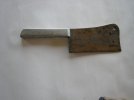
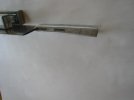
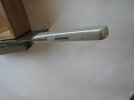
Attached are three pics of an old cleaver I inherited from my mother. It was probably from the 1920's, and it may have been home made, but I kind of doubt that. Note the interesting way the tang appears on the handle twice. The handle seems to be aluminum or pewter, not sure. My question is, does anyone know how/why the maker did it that way?

Phil Millam
Winthrop WA
 

Attachments

  • IMG_0940.jpg
    IMG_0940.jpg
    21.9 KB · Views: 218
  • IMG_0941.jpg
    IMG_0941.jpg
    19.2 KB · Views: 221
  • IMG_0942.jpg
    IMG_0942.jpg
    23.3 KB · Views: 299
OK, how did they pour the (looks like aluminum) handle without ruining the HT? There's no way to HT with the aluminum handle on it is there?? Maybe this was part of the HT?? I'm confused :D:D:confused:
 
Over the years it has been pretty common to have cast aluminum handles on knives. For example Gerber daggers were always done that way. I would guess that they clamp the business end of the blade in a heat sink (like big metal plates), put a mold around the tang and pour. They might actually have an over sized mold that acts as the heat sink. You could also immerse the blade in water, but it seems dangerous to have water around your mold. Rada knives are all made that way:
Blockknives9_131.jpg
 
Thanks to all who responded. Yes, it does look like it was poured, then ground.
 
I agree, poured and ground....maybe they didnt even care about softening the blade since it was a cleaver and not a fine slicer.
 
"Historicaly it was tin, not aluminum"

When in history? Most cast to tang knives during WWII were aluminum; Murphy Combat, Stone knuckle knife, etc. I have a few in brass, bronze and zinc ones in my collection, but dont know I've ever seen a WWII era grip made from cast tin.
 
Aluminum started to be used in great extent in the 1920s.... Historically tin ? perhaps he means pewter. Nickel silver was certainly used for handles as is the scalpel I have.
 
Back
Top