Old Rivals Part II (the British)

not2sharp

Platinum Member
Joined
Jun 29, 1999
Messages
20,854
You are a young well-to-do officer of the 19th Century. Your family has procurred a commission for you and you are off to serve the British Raj. When you show up in your dress, eh tartan, kilt... never mind.

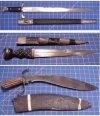
Your first assignment is to serve with the gurkhas in Nepal. Which of these knives are you going to take with you.....
 

Attachments

  • english knives (19th century).jpg
    english knives (19th century).jpg
    43 KB · Views: 174
With my kilt? The dirk, of course! That one, BTW, is no piper's effeminate butter knife, it is the Scottish version of an Arkansas Toothpick.

Come to think of it, it looks a bit old and dusty... would you care to trade for a nice shiney new version? heh

Stephen
 
it looks a bit old and dusty... would you care to trade for a nice shiney new version? heh

That was a Richardson example from Edinburgh c. 1823. He was registered as a surgical tool maker. Someone already grabbed it, but that is what you have to do to keep some semblence of order.

Please pass the knives to the left.

n2s
 
Ron Flook's book on British military knives shows some late 19th century khukuri styled knives made in Britain,apparently for officers headed for India.

Now,tell us more about that S-guard khuk at the bottom...

WoodOwl
 
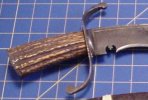
As with everything else khukuri related we have very little hard information. The S-guard khukuri was most likely made for a European. The handle is very much in the style common to hangers during the 18-19th centuries. This one is probably a one of a kind commissioned piece made during the 19th century.

There are two school of thoughs on these knives. Some were traditional kukuries that were taken home by returning Westerners which were then rehilted in the west, while others may have been purposely commissioned in India and Nepal and originally manufactured with the European style grip. I believe that this is one was originally manufactured as it is today. Although, the detail on the guard and metal work is first rate, there are no stamps,markings, or proof marks on the piece, and the piece seems to go together well.

n2s

Here is a closeup of the hilt.
 

Attachments

  • european khukuri (handle detail).jpg
    european khukuri (handle detail).jpg
    20.8 KB · Views: 126
Enjoyable topic. The type I'd like to lay down and rest my eyes contemplating.
 
I have given details on all but the top knife.

The top picture shows a 1887 Mark III english bayonet used on the Mark IV Martini-Henry rifle (cal. .450). This one is interesting in that it is marked with Nepal Arsenal Markings. This was one of the last of the great sword bayonets used by the British Army.

n2s
 
not2sharp great pictures.
Where do you find all of these blades!!!!!
 
Back
Top