Old Saber SFNOs vs. New Ones

Joined
Nov 11, 2003
Messages
6,787
I've noticed what may be two ways of distinguishing the old saber SFNOs from the new ones. The new ones have wider flats from the spine to the primary grind, and have more of a curve to the transition between the tang and the primary grind. I've checked this between the few I have around here (OK more than a few) and it seems to hold up. I had heard there are new blanks for the new ones, which is why the old ones could not be replicated, so it makes sense there are some consistent grind differences between old & new.

Now one could say the easiest way to tell is by checking the scales. But I'm not sure there aren't a few of the old style floating around with new style scales. It seems to me that some old-style SFNO blades were released after the original run with new style handles. These may have been made after the original run from extra blanks lying around the shop, after they transitioned to the new style slabs. The new style grind seems to begin with the LE and includes all other saber SFNOs after that run.
 
is the edge the same thickness with the primary grind starting lower? that's one of the things i really liked about the old saber SFNO. saber ground for toughness while not being too thick coming down to a perfect edge that wasn't too thick or too thin.
 
I only have two original sabres and one new LE so I don't know if my observations are universally applicable or not. But the new LE is fractionally taller in general, so that both the flat from the edge to the grind line and the flat of the sabre portion itself have more height compared to my original sabres.
 
Nah, there all the same. Your old one's are no longer special. I'll give you new price for your older ones just to help you out...since I'm a giver and all:p


J/K...I bet the plunge line is differant, but I don't have an old one to compare.
Have you checked the talon and lanyard hole size?
The old ones on an AD and Mr for instance are smaller was why I was asking if they were the same.
 
All of this provides me clues as to why I am NOT as in love with the LE as I have always been with sabre SFNO's. For me the LE just feels like a taller, chunkier knife. Even if the proportions were only marginally different, my hands/mind would know it even though my eyes might not because I spent a LOT of time looking at and holding that knife.
 
.............................................................

ttiwwop.gif


..............................................................
 
If memory serves, this Double Cut + Snakeskin Sabre SFNO was my first Busse Combat knife, purchased from BCS:

sfno-dc-snakeskin-1.jpg


I am not sure about its vintage, but here is another Sabre SFNO that I still own:

sfno-tan-tigerstripe-mag-1.jpg


I traded this one:

sfno-jungle-camo-green-1.jpg


These are 2009 Knob Creek Sabre SFNOs:

sfno-satin-orange-1.jpg


sfno-satin-redblack-1.jpg
 
According to Ken's pics, the flat above the grind line on the newer sabres does indeed extended farther below the spine than on the originals.

Ken...the muddy/TH is beautiful. If you ever decide to get rid of it, I'd like consideration.
 
One thing that I've noticed is the chamfer around the talon/lanyard holes. On the old ones there's a hexagonal shape to them while the new ones are rounded.

Super small difference, but one I find interesting. :)
 
Good eye there 360, I just checked that and see what you mean.

The new ones do seem to be about 1/8" taller in terms of blade tallness overall.
 
Yeah, thickness is exactly the same, about .24" fold the old and new sabers, according to my crude calipers
 
OK so in Ken's pics, notice the difference in the curve of the plunge line (i.e. the transition between tang and primary grind). In the the top three pics (the old style saber), the plunge line is straighter, in the bottom pics (the new style), the plunge line has more of a sweeping curve to it.
 
It seems they all differ a little, the new and old.

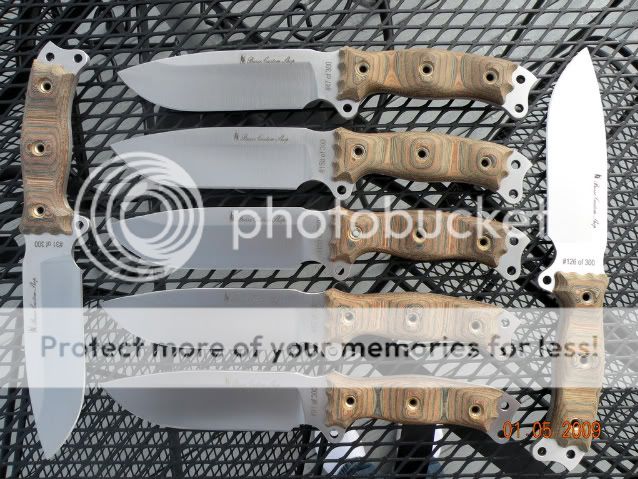
If you look at this pic of LE's you can see the one at the top has a smaller flat portion than say the third one down.

I noticed this when I got them and thought it was cool. Makes them even more unique.
DSCN0138.jpg
 
There was some variation in the tallness of the flats on the LE run, but I chalked it up to them being customs. Comparing production SFNOs, there seems to be more consistency in the grinds.
 
There was some variation in the tallness of the flats on the LE run, but I chalked it up to them being customs. Comparing production SFNOs, there seems to be more consistency in the grinds.

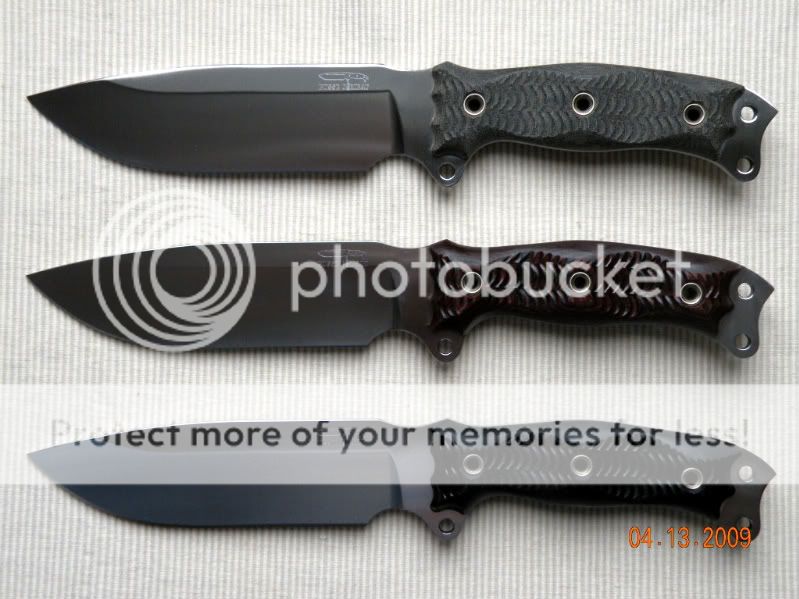
These three productions seem to have some variations.
Notice the middle and bottom ones.
DSCN0282.jpg


Whats the big deal anyway???:confused:
 
These three productions seem to have some variations.
Notice the middle and bottom ones.
DSCN0282.jpg


Whats the big deal anyway???:confused:

It's not a big deal at all, just a curiosity. When I heard they may be from new blanks, I started looking for the telltale signs. And, as Jason said, some may prefer the old style grind, even though the variations are slight. In your picture, all three are Knob Creek sabers, correct? Although there is some variation in the tallness of the flats, and I noticed that as well with mine, overall the new ones tend to have taller flats. You may also notice in your picture that the three are taller overall, when compared to the old ones, even when the flats vary. Another sign that can be seen in the three you posted is that all three have the curved plunge line. Upon closer examination, they probably have the smooth rounded talon holes as well.
 
Back
Top