
Old Time Tips and Tricks

Joined
Oct 6, 2008
Messages
4,076
My question is mainly from about a discussion over in W&SS about modding tomahawks/handles. runningboar says his grandpa soaked new axe handles in kerosene to "temper" them and it made them much stronger. He's a pretty no-BS guy.

Have any of you guys heard of this? What is the best "old school" way to finish a natural handle? What about scorching wood for appearance sake, does this cost you strength?

Or any other tricks like that you may know of. I'm thinking of stuff grandpa might have known that we forgot. (no, I don't need to know how to quench in panther oil under the light of the full moon :rolleyes: ) Stuff that we can show really works.

Thanks in advance, gentlemen!
 
I like to soak them in Sex Panther. :D

standard.jpg


In all honesty... I don't know. I was taught that soaking hammer/axe handles in Linseed oil makes them swell nice and tight and gives them some good protection. That's something that my family has been doing since at least as long ago as my great grandfather owning/operating the sawmill in the center of this town.
 
Perhaps it is some of sort of case hardening myth.

Or he was soaking it oil (as my Dad who was a logger always did - and may have actually worked at Nick's family mill in the 80s) and simply explained it incorrectly.
 
I don't know as a fact how it works, but a hickory Ramrod that has been soaked for a week in kerosene will bend nearly twice as far as one that has not been treated in the same manor.
Sense my normal forte is archery I tried soaking a test strip of hickory to see if it wood improve a hickory bow. The test strip did gain in flexibility and resistance to breakage, but was sluggish in springing back to its original form.
For Hawk/Axe handles and ramrods I use a kerosene soak. Not for my Bows though. The only finish I have tried after kerosene is a wipe down with wax.
 
Have heard of the Kerosean soak, never tried it. Anouther one I haven't tried, but may sometime in the future is salt water soak. Read an article about it in an archery magazine and it said that a year or two soak with yew or hickory, cant remember, improved performance of his bows. Seems he read something about a ship wreck and how much better the performance was and decided to try soaking his bow blanks in salt water. I may give that a try with a hawk handle when I get my shop built.

I have tried soaking the head of hawk handle in boiling tung oil, it worked for a while but the head is slightly loose now after being inside for a couple years.
 
Will, would that really take a year or two? Doesn't seem like a piece of wood that thin would take that long to get saturated... I want to take my hawk camping this spring, not in 2011 :D
 
I have soaked hickory ramrods in kerosene and it dose seam to improve the strength and durability of them.

Same here been doing it on all the rifles i have built for the past 10 years. also soak hawk handles it seems that when in a throwing comp. the handles hold up better when hit by another hawk.
 
Have heard of the Kerosene soak, never tried it. Anouther one I haven't tried, but may sometime in the future is salt water soak. Read an article about it in an archery magazine and it said that a year or two soak with yew or hickory, cant remember, improved performance of his bows. Seems he read something about a ship wreck and how much better the performance was and decided to try soaking his bow blanks in salt water. I may give that a try with a hawk handle when I get my shop built.

I have tried soaking the head of hawk handle in boiling tung oil, it worked for a while but the head is slightly loose now after being inside for a couple years.

There is something really wrong with the clam that a piece of hickory being soaked in water, ether salt or fresh will improve in performance. I have been making archery equipment for 30 years, so I'm still a new guy compared to some;) In my attempts to make a better bow I have I have studied other traditional wood working crafts and learned a few tricks. Old time Coopers (barrel makers) would take hickory saplings and soaked theme in water for a week. Salt was added to retard mold. That would make the growth rings start to separate and the wood could be split apart end to end. these strips were used to make the barrel bands buy connecting the ends of the strips in a loop and putting the loop over the barrel stave while wet and then letting it shrink up. Wood bands were eventually replaced with metal bands but there are people who still have the old skills. The same skill was used by a gent I met who made split hickory pack baskets. Hickory slats were soaked in water to let the growth rings start to slip then they were split and worked wet in to a basket. The basket was then allowed to dry to shape.
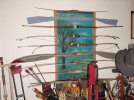
But as I said I'm still a beginner Boyer.
 

Attachments

  • P2230002.jpg
    P2230002.jpg
    71.5 KB · Views: 34
I believe that article was in Primitive Archer a couple of years ago. I read it as well, and thought it sounded kinda far fetched to me. Seems like the author was referencing the bows found in the Mary Rose shipwreck, which were yew, but he was trying his theory with hickory. I'm a bowyer, too, but with only about 3 years under my belt. I have a hard enough time keeping my hickory staves dry enough here in the south Florida humidity without soaking it in anything. Interestingly, I get all of my bow wood from my Dad's farm, about 30 miles from Will's place.

Todd
 
I sorta/kinda remember that article. I have every issue of Primitive archer. One of those articles that was well written by someone who didn't know what they were talking about. If I get up the gumption I'll look to see if I can find that article. The bow stave's found on the MaryRose were buried in silt for better than 400 years. I could imagine the panic in a curators eyes if you tried to string up an historical artifact.
 
Back
Top