"One armed man" exemption?

tyr_shadowblade

Gold Member
Joined
Jan 3, 2006
Messages
12,772
Federal Switchblade Act permits upper extremity amputees to possess and carry any switchblade knife with a blade 3" long or under.

It is my understanding that this federal exemption protects a one-armed man's right to possess a switchblade in all 50 states, even those that typically prohibit possession by non-LE or non-military.

Is this correct?

Thanks.

"The one-armed man"
 
I do think Texas has the one arm man exemption as well, but I can't find it right now.
 
tyr, I would have to say that it does NOT over ride any state laws. It allows a one arm mant to carrying interstate, and possess on Federal Lands and holdings. The states have been allowed to enforce their own far more restrictive weapons laws( the Second Amendment does not exist it seems since all those laws violate it), and I am not aware of any such exception spelled out in NJ, NY. PA at least. That all said, I would think all but a rookie would look the other way at this type of violation........
 
If you look at the wording first of WHERE the law applies, then you will understand WHERE the exceptions also apply:

Whoever, within any Territory or possession of the United States,
within Indian country (as defined in section 1151 of title 18), or
within the special maritime and territorial jurisdiction of the
United States (as defined in section 7 of title 18), manufactures,
sells, or possesses any switchblade knife, shall be fined not more
than $2,000 or imprisoned not more than five years, or both.


Section 1244. Exceptions

Sections 1242 and 1243 of this title shall not apply to -
(1) any common carrier or contract carrier, with respect to any
switchblade knife shipped, transported, or delivered for shipment
in interstate commerce in the ordinary course of business;
(2) the manufacture, sale, transportation, distribution,
possession, or introduction into interstate commerce, of
switchblade knives pursuant to contract with the Armed Forces;
(3) the Armed Forces or any member or employee thereof acting
in the performance of his duty; or
(4) the possession, and transportation upon his person, of any
switchblade knife with a blade three inches or less in length by
any individual who has only one arm.

As I stated above, I do believe almost all officers could understand your need and look the other way, BUT it would still be a violation.....
 
tyr, I would have to say that it does NOT over ride any state laws. It allows a one arm mant to carrying interstate, and possess on Federal Lands and holdings. The states have been allowed to enforce their own far more restrictive weapons laws( the Second Amendment does not exist it seems since all those laws violate it), and I am not aware of any such exception spelled out in NJ, NY. PA at least. That all said, I would think all but a rookie would look the other way at this type of violation........

Without doing any legal research, my first instinct is that tom is exactly right.
 
Here in NY it's actually legal to possess a switchblade if you have one arm and/or are engaged in hunting and fishing (or maybe it's if you have one arm AND you're hunting and fishing; I forget). It's a throwback to the days before one-hand folders.
 
If you look at the wording first of WHERE the law applies, then you will understand WHERE the exceptions also apply:

Whoever, within any Territory or possession of the United States,
within Indian country (as defined in section 1151 of title 18), or
within the special maritime and territorial jurisdiction of the
United States (as defined in section 7 of title 18)

Okay, my legalese not so good, but "any territory or possession of the US" includng "Indian country" and "special maritime and territorial jurisdiction" would initially appear to cover pretty much everywhere, as would not the states and commonwealths be considered territory and/or possession of the US? I do not think this applies only to military bases and parklands as interstate transport seems permitted. Has "territory" and "possession" been clearly defined?
 
Okay, my legalese not so good, but "any territory or possession of the US" includng "Indian country" and "special maritime and territorial jurisdiction" would initially appear to cover pretty much everywhere, as would not the states and commonwealths be considered territory and/or possession of the US? I do not think this applies only to military bases and parklands as interstate transport seems permitted. Has "territory" and "possession" been clearly defined?

My guess is that the states are not considered possessions of the United States. According to the theory underlying our federalist system, the states hold sovereignty, though they have ceded some of their sovereign powers to the government.

This also goes to the reason that the Federal government couldn't pass broad switchblade laws covering every state even if it wanted to. The powers that Article 8 grants to Congress don't really include anything that Congress could cite as authority for such a law. One of the things that Congress has tried (with varying degrees of success) is the Interstate Commerce Clause. That easily permits the Federal government to regulate interstate commerce in switchblades. It probably would not permit prohibition or allowance of possession of switchblades within a state, though.

There was a Supreme Court case decided a few years ago called United States v. Lopez, 514 U.S. 549 (1995). In it, the Court struck down a federal law that banned guns in schools. The Court said that the presence of guns on school property didn't sufficiently involve interstate commerce for Congress to have Constitutional authority to pass a law prohibiting it. Instead, the kind of "police power" that gives authority to a government to ban guns in school zones (or to ban switchblades, with exceptions for one-armed persons) still rests with the sovereign states.
 
There was a Supreme Court case decided a few years ago called United States v. Lopez, 514 U.S. 549 (1995). In it, the Court struck down a federal law that banned guns in schools. The Court said that the presence of guns on school property didn't sufficiently involve interstate commerce for Congress to have Constitutional authority to pass a law prohibiting it. Instead, the kind of "police power" that gives authority to a government to ban guns in school zones (or to ban switchblades, with exceptions for one-armed persons) still rests with the sovereign states.

The Gun-Free School Zones Act struck down in Lopez never mentioned any connection to regulating interstate commerce. In 1997, Congress enacted essentially the same law and included language with a bogus "nexus to interstate commerce." Federal courts have upheld the new law and SCOTUS has refused to grant a petition for a writ of certiorari to hear any appeal on the revised statute. Since FDR's court-packing threat of 1937, SCOTUS has allowed Congress to get away with legislating on almost any subject so long as they include a specious reference to regulating interstate commerce as a pretext to Constitutional authority. The original version of GCA-68 was also struck down by SCOTUS. Congress simply passed a slightly different version mentioning interstate commerce and the Nine Nazgul no longer had any objection to millions of Americans being denied their unalienable individual right to keep and bear arms. The Framers never imagined the Interstate Commerce Clause could be artfully misconstrued as it has been for decades to empower Congress to control virtually all aspects of Americans' lives, even to abrogate individual liberties expressly guaranteed in the Bill of Rights. The original intent behind the clause was to prevent states from taxing or otherwise interfering with interstate trade, not to provide Congress unbridled powers never delegated in Article I, Section 8.

The Constitution of the United States is not a convoluted treatise or a collection of arcane concepts that only a priesthood of the bench or the law schools can decipher. Its crucial terms, such as “free speech” or “due process,” already had historical meanings in English law before the American constitution was written by transplanted Englishmen. The much-vaunted “complexity” of constitutional law comes in most cases not from the Constitution itself but from clever attempts to evade the limits on government power set by the Constitution. The virtually unlimited judicial expansion of the concept of “interstate commerce” until it cancels out many of those limits and nullifies the Tenth Amendment is perhaps the classic example. — Thomas Sowell, The Quest for Cosmic Justice (1999)
 
I know for sure that Michigan has the exemption while Indiana doesn't. Indiana doesn't even have switchblade exemption for LEO, which technically means a cop carrying an auto in Indiana is breaking the law.
 
Last time I was in Gatlinburg TN every other tourist trap gift store was selling switch blades with no questions asked. And these were full size with up to 6 inch blades. What is up with that? It seems they are legal at least in that city.
 
The Gun-Free School Zones Act struck down in Lopez never mentioned any connection to regulating interstate commerce. In 1997, Congress enacted essentially the same law and included language with a bogus "nexus to interstate commerce." Federal courts have upheld the new law and SCOTUS has refused to grant a petition for a writ of certiorari to hear any appeal on the revised statute. Since FDR's court-packing threat of 1937, SCOTUS has allowed Congress to get away with legislating on almost any subject so long as they include a specious reference to regulating interstate commerce as a pretext to Constitutional authority. The original version of GCA-68 was also struck down by SCOTUS. Congress simply passed a slightly different version mentioning interstate commerce and the Nine Nazgul no longer had any objection to millions of Americans being denied their unalienable individual right to keep and bear arms. The Framers never imagined the Interstate Commerce Clause could be artfully misconstrued as it has been for decades to empower Congress to control virtually all aspects of Americans' lives, even to abrogate individual liberties expressly guaranteed in the Bill of Rights. The original intent behind the clause was to prevent states from taxing or otherwise interfering with interstate trade, not to provide Congress unbridled powers never delegated in Article I, Section 8.

Your legal-fu is strong. :thumbup:

Can I call you if the DPD bust me for carrying a 3" Microtech?

And can I sue for discrimination under the American Disability Act?

Seriously, a single-edged DA OTF was not designed as a "weapon" . . . it was designed as a safety knife. It is not a sturdy design. Do not understand why a 3.5" fixed blade is A-OK, but a 3" OTF is verbotten. Especially considering the loss of my dominant hand. Even most Spydercos are a bitch to open for me (Jot Singh Khalasa and waved Endura being exceptions), and I have a big scar on the inside of my thumb to prove it. Would really prefer to carry something other than a Sharpfinger or a LaGriffe around town. Sheath knives make people nervous in the city.
 
Last time I was in Gatlinburg TN every other tourist trap gift store was selling switch blades with no questions asked. And these were full size with up to 6 inch blades. What is up with that? It seems they are legal at least in that city.

The fact stores sell an item doesn't necessarily make possession of the item by lowly private citizens "legal" here in the Land of the Free. In late 1973, I bought a Bianchi aluminum baton for use in my employment as a security officer at a sugar refinery in Spreckels, CA. I bought the baton at Dick Bruhn's, a men's clothing store in Salinas, CA which also sold police uniforms and equipment. It was a year or two later while studying Criminal Law in college that I discovered it's a felony in California for a non-LEO to possess a billy club (and numerous other items). It was beyond my comprehension that merely possessing a billy club could be a crime, let alone a felony. The fact I purchased it from a reputable business would not be a legal defense in court. Judges just love to say, "Ignorance of the law is no excuse," even when they were completely unaware of a statute until the case reached them. Attempting to explain at trial why a law is unconstitutional (after the 1895 Sparf decision) is a surefire method to get yourself gagged and held in contempt of court.

Your legal-fu is strong. :thumbup:

If I had a twelve year-old child who didn't know more about the Constitution, American history and jurisprudence than every SCOTUS justice since 1913, I'd consider a retroactive abortion.

Can I call you if the DPD bust me for carrying a 3" Microtech?

Sure, if you can afford my billing rate. :) It's unlikely the DPD will be enforcing the Federal Switchblade Act, but rather Colorado and local anti-knife statutes.

Colorado Criminal Code Section 18-12-101 defines a "knife" as "any dagger, dirk, knife, or stiletto with a blade over 3-1/2 inches in length, or any other dangerous instrument capable of inflicting cutting, stabbing, or tearing wounds, but does not include a hunting or fishing knife carried for sports use." One can only wonder what Colorado legislators call a knife with a blade under 3.5" since, by their definition, it's not a knife. Section 18-12-102 decrees switchblade knives are "illegal weapons" (a phrase which would have confounded our Founding Fathers) and the mere possession by non-LEO/military personnel is a Class 1 misdemeanor (possession of a "dangerous weapon" is a Class 4 felony). I didn't find any exceptions for one-armed persons under Colorado law. Personally, I regard typical ignorant, amoral voters to be far more "dangerous" than any inanimate object but that's just me.

Colorado courts upheld the conviction of a person who possessed a screwdriver, holding that a screwdriver can be reasonably construed as a "knife" under Colorado law. See Miller v. District Court, 193 Colo. 404, 566 P.2d 1063 (1977).

And can I sue for discrimination under the American Disability Act?

You can sue anyone for anything; whether you prevail in court is a different matter. You want to use a blatantly unconstitutional federal law (Americans with Disabilities Act of 1990) to challenge an immoral state statute? Does that come under the Two Wrongs Make a Right theory of jurisprudence? :rolleyes: You could mention to DPD officers that you, like every other human being, have an unalienable individual right to keep and bear arms — any arms, anywhere, anytime — and remind them they swore an oath to adhere to the U.S. Constitution. While they're rolling on the ground laughing, you might be able to make a clean getaway. :)

Seriously, a single-edged DA OTF was not designed as a "weapon" . . . it was designed as a safety knife.

Lincoln High School in Sioux Falls, SD was locked down for an hour-and-a-half today while a herd of police ransacked the facility. What happened? Some students had been observed in the school parking lot with a "dangerous weapon" — a plastic toy pistol designed to shoot rubber-tipped plastic darts. The students are facing long suspensions and police/prosecutors are ardently searching for some criminal offense to charge them with. The fact the toy was never "designed" to be an actual weapon is of utterly no consequence in contemporary America. When I recited The Charge of the Light Brigade to my sixth grade classmates in 1963, I held a WWI-issue Springfield rifle as a prop. No one thought anything of it. Today, a SWAT team would be summoned and a student would be lucky to survive the encounter. :(

Do not understand why a 3.5" fixed blade is A-OK, but a 3" OTF is verbotten.

If you expect most legislators and the armed minions who enforce their edicts to exhibit common sense and a genuine regard for the Constitution then you may as well expect to encounter a Martian or an honest, competent attorney. When the Federal Switchblade Act was enacted in 1958, it was primarily a reaction by politicians pandering for votes to the use of switchblades by actors portraying "juvenile delinquents" with such knives in movies produced in the 1950s. At the time, the Departments of Justice and Commerce actually opposed such legislation. The members of Congress who sponsored the FSA publicly admitted the law wouldn't really do anything to deter violent crime but it was a "tool for law enforcement" (a phrase which never fails to infuriate me).

Sheath knives make people nervous in the city.

The next time I willingly render myself unarmed and helpless rather than make cognitively- and/or ethically-impaired people "nervous" will be the first.

 
Well for the let me get back in here and say that states are not in the defined location that the federal law applies to. They are STATES, and are therefore different than the places noted by the law. The courts have held that federal lease holds fall under the the listed definitions. so courts, IRS offices, etc have the ban in place.
Finally, State laws rule in all but those stated locations for possession, and THERE IS NO one arm exception in NY ! Yes there is a Police/peace officer, and hunting/fishing/trapping exception, but NO one arm man exception in NY ( NYS PL 265.20) please feel free to check.....
 
Cutting off an arm so you can carry a swtchblade is a huge sacrifice. Are you sure it's worth it? :eek:
 
Colorado Criminal Code Section 18-12-101 defines a "knife" as "any dagger, dirk, knife, or stiletto with a blade over 3-1/2 inches in length, or any other dangerous instrument capable of inflicting cutting, stabbing, or tearing wounds, but does not include a hunting or fishing knife carried for sports use." One can only wonder what Colorado legislators call a knife with a blade under 3.5" since, by their definition, it's not a knife.

The *funny* thing is, even though CO law specifically permits double-edged knives under 3.5", DPD does not. No official municipal ban on double-edge, but what the po-lice do is measure the entire cutting edge as "blade length." So, if you have a 2" dagger in Denver, police will arrest you for possessing a knife .5" over "legal length." :thumbdn:

AbnInfantry said:
The next time I willingly render myself unarmed and helpless rather than make cognitively- and/or ethically-impaired people "nervous" will be the first.

Yeah, I usually keep it concealed under my shirt.
 
The *funny* thing is, even though CO law specifically permits double-edged knives under 3.5", DPD does not. No official municipal ban on double-edge, but what the po-lice do is measure the entire cutting edge as "blade length." So, if you have a 2" dagger in Denver, police will arrest you for possessing a knife .5" over "legal length." :thumbdn:

It requires no great shift in ethics for LEOs willing to enforce immoral and overtly unconstitutional anti-gun/knife statutes to also deliberately "misinterpret" a law for their own purposes. Have any stalwart folks in Denver seriously challenged this egregious misconduct in court, particularly at the appellate level?

In South Dakota, the sole state anti-knife law is a ban on possession of "ballistic" knives (not that any such knife was ever used in a crime in SD or more than a single legislator knew such knives existed before proposing the ban). There is no state, county or local statute prohibiting private citizens from carrying a knife into a Sioux Falls public library and many other municipal properties. The duplicitous mayor of Sioux Falls, however, issued an executive order forbidding non-LEOs from bringing many knives into such buildings. Whether a knife is "allowed" or not is entirely at the arbitrary whim of the police. The SD Attorney General and city attorney both declared the mayor's order is illegal and no one may be prosecuted for violating it. Who do you think SFPD officers obey ... the law or the mayor? :rolleyes:

In the 1980s, police in Seward, AK arrested a man for being a "felon in possession of a firearm" (the fact the USA was founded by armed felons matters not a whit to most contemporary Americans). The "firearm" was a BB gun which does not remotely constitute a firearm under either Alaska or Federal statutes. That fact didn't keep the defendant from being arrested, prosecuted and convicted of a felony. It took the AK Court of Appeals to explain to LEOs, prosecutors and a superior court judge what any reasonably bright child knows ... a BB gun is not a firearm.
 
I do think Texas has the one arm man exemption as well, but I can't find it right now.
If you look at the wording first of WHERE the law applies, then you will understand WHERE the exceptions also apply:

Whoever, within any Territory or possession of the United States,
within Indian country (as defined in section 1151 of title 18), or
within the special maritime and territorial jurisdiction of the
United States (as defined in section 7 of title 18), manufactures,
sells, or possesses any switchblade knife, shall be fined not more
than $2,000 or imprisoned not more than five years, or both.


Section 1244. Exceptions

Sections 1242 and 1243 of this title shall not apply to -
(1) any common carrier or contract carrier, with respect to any
switchblade knife shipped, transported, or delivered for shipment
in interstate commerce in the ordinary course of business;
(2) the manufacture, sale, transportation, distribution,
possession, or introduction into interstate commerce, of
switchblade knives pursuant to contract with the Armed Forces;
(3) the Armed Forces or any member or employee thereof acting
in the performance of his duty; or
(4) the possession, and transportation upon his person, of any
switchblade knife with a blade three inches or less in length by
any individual who has only one arm.

As I stated above, I do believe almost all officers could understand your need and look the other way, BUT it would still be a violation.....
I have cerebral palsy that effects my right side, I can’t I can’t ball a fist or rotate my wrist, how would that exception apply to me? Even though I live in California?
 
I have cerebral palsy that effects my right side, I can’t I can’t ball a fist or rotate my wrist, how would that exception apply to me? Even though I live in California?
Was honestly denied my ability to join the service due to epilepsy, but there are no laws about an epileptic being in law enforcement
 
I have cerebral palsy that effects my right side, I can’t I can’t ball a fist or rotate my wrist, how would that exception apply to me? Even though I live in California?

If you're asking about California state law, there is no exception in the law that allows disabled persons to carry "switchblades" (legally defined in California as having a blade 2" or longer). There are countless manual folding knives that can be easily opened with one hand that are legal to carry in California. And of course anyone in California can carry a switchblade with a blade under 2" long.

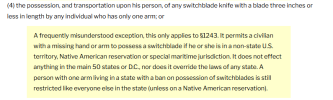
As far as the original topic of this thread (exceptions in the Federal Switchblade Act for persons with one arm), I agree with Tom. And so does Kniferights.org.

The screenshot below is from the Kniferights.org website, and their interpretation of the Federal Switchblade Act, specifically the "one armed" exemption. The screenshot also addresses state laws. The statute is on top, the Kniferights interpretation is underneath (appears pink on my computer, but appears yellow on my phone).

And before someone tells me, yes, I know this thread is from 2009.

Screenshot 2025-02-26 122411.png
 
Last edited:
Back
Top