
-
The BladeForums.com 2024 Traditional Knife is available! Price is $250 ea (shipped within CONUS).
Order here: https://www.bladeforums.com/help/2024-traditional/
You are using an out of date browser. It may not display this or other websites correctly.
You should upgrade or use an alternative browser.
You should upgrade or use an alternative browser.
One Side Of Knife Handle Is Carbon Fiber
- Thread starter Razor
- Start date


Ajack60
Platinum Member
- Joined
- Apr 21, 2013
- Messages
- 8,546
The carbon fiber doesn't flex as much as you'd think it would. I haven't had any issues with mine. If you think about it, carbon fiber is used in different applications that are subject to more stress than a knife. That's what sold me on the stuff.


- Joined
- Nov 20, 2005
- Messages
- 19,385
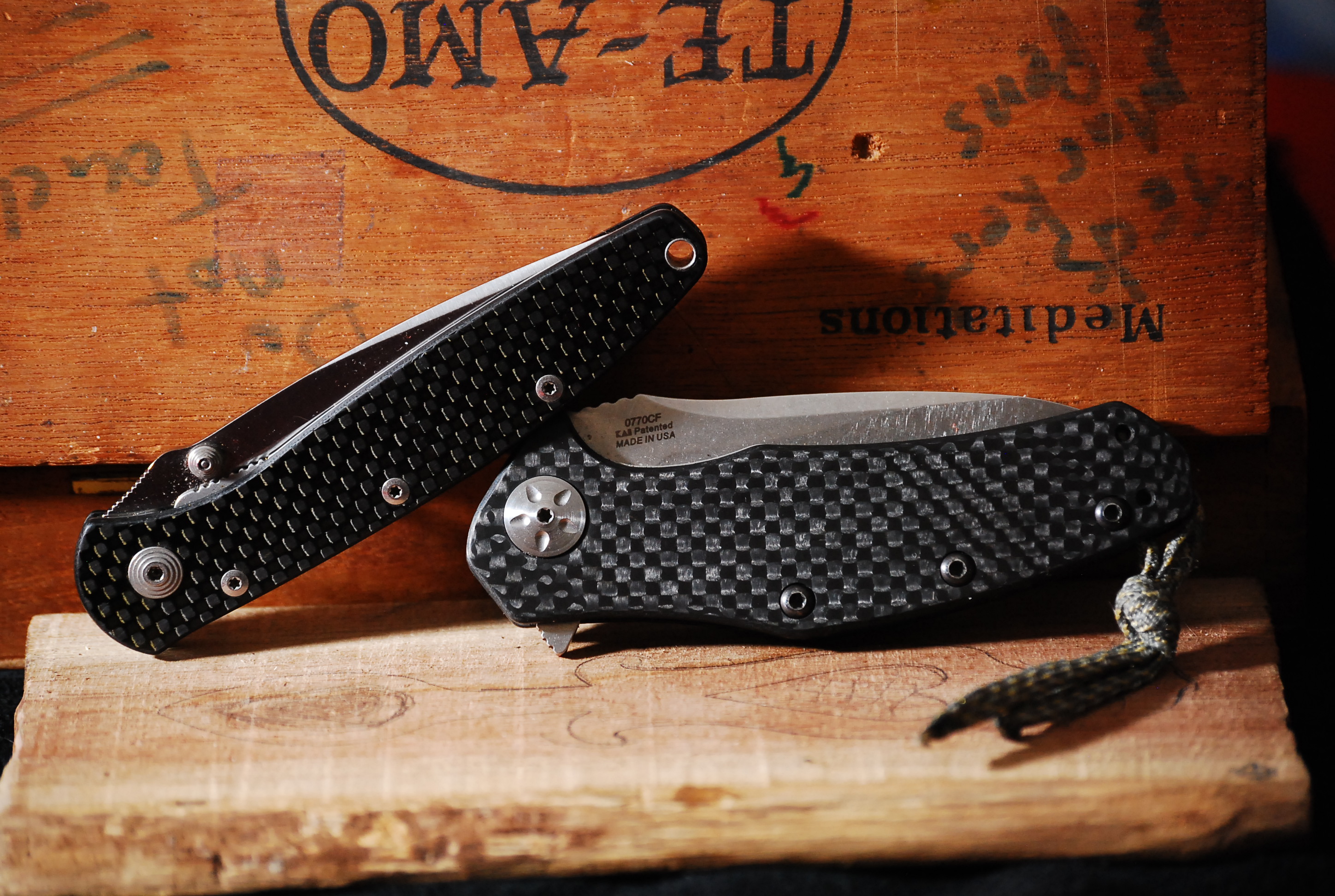
Funny. I generally don't want a knife with only one side being carbon fiber. Make it both sides like the ZT 0770CF. 
Pretty tough stuff.
Pretty tough stuff.

- Joined
- Nov 15, 2006
- Messages
- 420
It all depends on the quality of the carbon fiber.
I have a friend in the auto business who works with CF; they do the carbon work on the $1.5 million Aston Martin One-77 supercar. He says there's a distinction between "structural" CF and what he calls "cosmetic" CF. The structural stuff is not only stronger/stiffer/lighter than steel, but also impact resistant. Strong and resilient enough to build things like racecar suspension components, crash structures, and even wheel centers.
For example, you can get structural CF wheels for the 2017 Ford GT supercar. Not just the wheel centers (like on some old Gr.B rally cars), but the barrels and rims, too:

Think about what the axial and radial loads must be on those skinny little spokes! Insane.
The unlined CF scales on my Dozier Little Workhorse have zero flex. Bob says he uses the same supplier that Lockheed Martin uses for the F-22 Raptor. I don't know where CRK sources theirs, but the the CF scale on my old KnifeArt Sebenza also seemed incredibly stiff and strong: you could lay into it with both hands and it wouldn't flex even a tiny bit. I don't think either knife would be any stronger if the scales were lined with steel or titanium.
But your typical, low-cost CF sheet isn't meant to survive that kind of load. Besides, a lot of so-called "CF" isn't even really CF. You'll see thin veneers of CF bonded to substrates such as G10, fiberglass, or aluminum honeycomb. That's going to look nice, but won't necessarily have the same strength as steel or titanium.
I have a friend in the auto business who works with CF; they do the carbon work on the $1.5 million Aston Martin One-77 supercar. He says there's a distinction between "structural" CF and what he calls "cosmetic" CF. The structural stuff is not only stronger/stiffer/lighter than steel, but also impact resistant. Strong and resilient enough to build things like racecar suspension components, crash structures, and even wheel centers.
For example, you can get structural CF wheels for the 2017 Ford GT supercar. Not just the wheel centers (like on some old Gr.B rally cars), but the barrels and rims, too:
Think about what the axial and radial loads must be on those skinny little spokes! Insane.
The unlined CF scales on my Dozier Little Workhorse have zero flex. Bob says he uses the same supplier that Lockheed Martin uses for the F-22 Raptor. I don't know where CRK sources theirs, but the the CF scale on my old KnifeArt Sebenza also seemed incredibly stiff and strong: you could lay into it with both hands and it wouldn't flex even a tiny bit. I don't think either knife would be any stronger if the scales were lined with steel or titanium.
But your typical, low-cost CF sheet isn't meant to survive that kind of load. Besides, a lot of so-called "CF" isn't even really CF. You'll see thin veneers of CF bonded to substrates such as G10, fiberglass, or aluminum honeycomb. That's going to look nice, but won't necessarily have the same strength as steel or titanium.

- Joined
- Nov 15, 2006
- Messages
- 420
As another data point, CF has been used to build bass guitar necks for over 30 years now. I've got a Vigier Passion II from the early '80s with CF neck, and it's still rock stable


Consider the enormous tension on the neck once all those strings are tuned to pitch. Hundreds of pounds of load.
Consider the enormous tension on the neck once all those strings are tuned to pitch. Hundreds of pounds of load.
Exactly. You wouldn't be able to hold onto it.I would think your hand would break way before the CF does.
To be fair, body panels don't need to be strong. They just need to be light and stiff. The suspension components and chassis, however, is a different matter.If it is strong enough for body panels on an F1 car, they should be strong enough for your knife.

- Joined
- Feb 3, 2001
- Messages
- 32,359
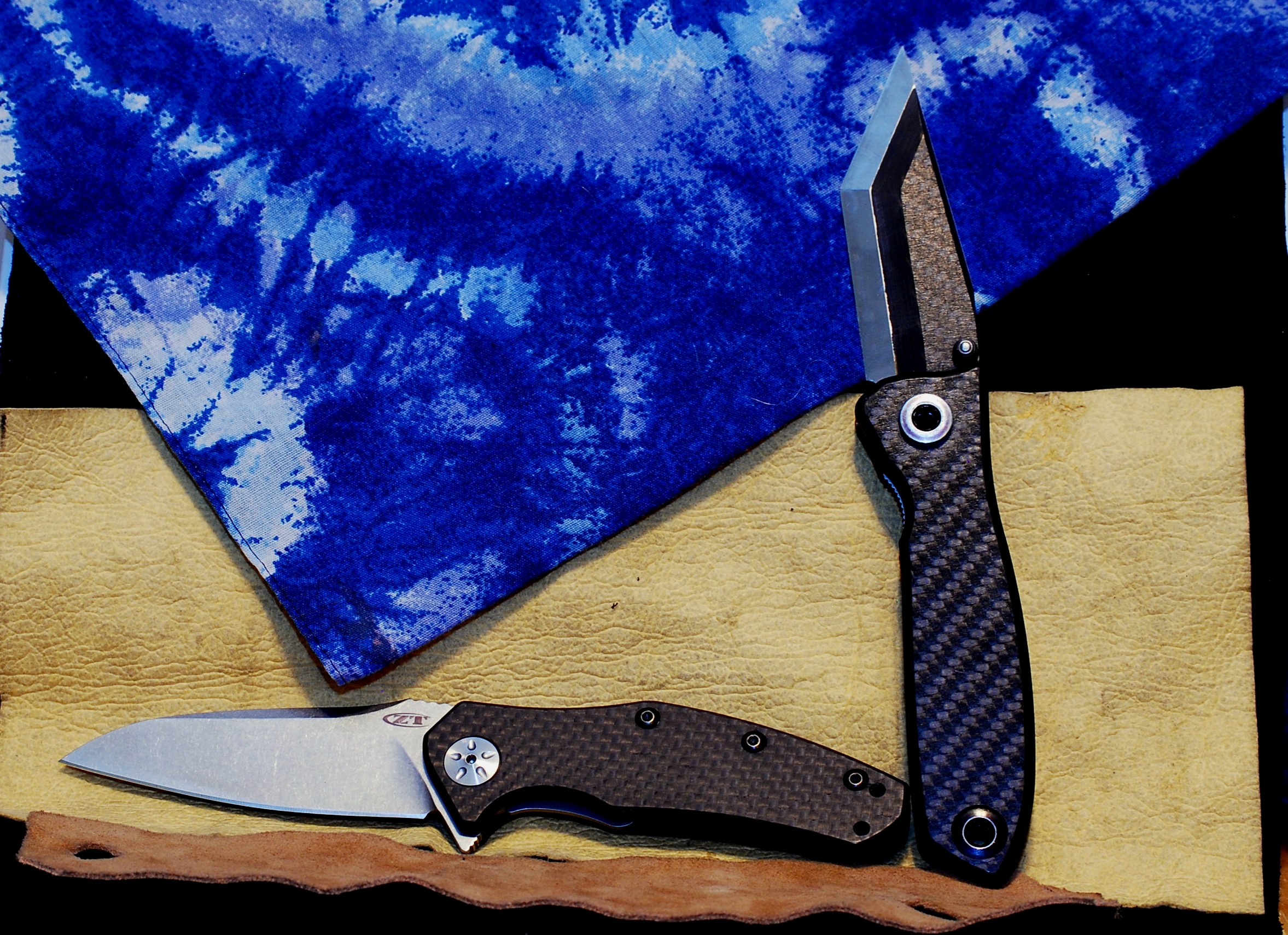
I have a couple of few all CF knives and they don't flex at all. I have a Warren Thomas Beretta Avenger, All CF with a laminated VG10 and CF blade, a Gerber SL3.25CF and the ZT 077CF to name a few and all as stiff as steel or aluminum, I can't flex it. I'd recommend CF for one side or both, That's assuming you use it like a knife.

NJBillK
Custom Leather and Fixed Blade modifications.
- Joined
- Mar 27, 2014
- Messages
- 9,594
Nice bass's but I do have to say that at the level of competition that these cars operate at, the panels have to be more than just light and stiff.Consider the enormous tension on the neck once all those strings are tuned to pitch. Hundreds of pounds of load.
------
To be fair, body panels don't need to be strong. They just need to be light and stiff. The suspension components and chassis, however, is a different matter.
Each piece is designed to work in concert with the rest of the car to put out the most utilitarian and highest performing System available. Even Indy cars are sitting around 5500 lbs. of downward pressure when in "city" or "touring" dress, and they don't have power steering, and are heavier than F1 car. The Indy cars are the "Less Technical" top of the line cars. Even the chassis on modern Indy cars is full carbon fiber.
The front wings (think of the parts in front of the tires), have no significant outward support. They are mostly attached from the interior of the blade. I wouldn't be surprised to learn that a front wing takes over 2,000 lbs of down force on a regular basis.
I am sorry, but to compare strings on a bass (even a 12 string) to the abuse that an F1 wing takes is absurd... You don't want to crank those strings too tight and break tuner do you?
- Joined
- Nov 15, 2006
- Messages
- 420
If it is strong enough for body panels on an F1 car...
Not trying to be a dick here, but you said "body panels" and now you're talking about wings and wing supports. There isn't a huge amount of force acting on the bodywork. Wings (and especially wing supports) are a totally different ballgame.The front wings ... I wouldn't be surprised to learn that a front wing takes over 2,000 lbs of down force on a regular basis ... the abuse that an F1 wing takes is absurd...
I race touring cars, so I'm not going to pretend I'm an expert on modern formula car aerodynamics! An F1 car will weigh about 1500 lbs and generate between 3 and 4g of downforce. Up to a quarter of that is at the front. So, you're right about that. There's probably somewhere around 1000-1200 pounds (guesstimate) acting on the two wing supports.
My point was that the kind of structural CF used for something like a wing support is stronger than you'd ever need for a knife. Guys like Dozier make a point to use "the good stuff" (for whatever that's worth). But regular sheets of CF you buy from the hobby shop aren't necessarily going to have the same properties.

nightman
Gold Member
- Joined
- May 17, 2010
- Messages
- 492


- Joined
- Mar 3, 2006
- Messages
- 703
Carbon fiber is also used to make masts and spars for sailboats which must endure heavy stress.
Examples: http://www.offshorespars.com/masts/carbon-fiber-masts/
https://www.hallspars.com/v/vspfiles/hall_masts_cruising.html
Examples: http://www.offshorespars.com/masts/carbon-fiber-masts/
https://www.hallspars.com/v/vspfiles/hall_masts_cruising.html

- Joined
- Jan 4, 2016
- Messages
- 5,666
Back to the OP question (racing parts, space ships, and hockey sticks aside...)
There is a generally known and accepted issue on the CRK CF models that the blade tends to favor the CF scale over time. It is very slight, but it happens. Someone somewhere probably can explain why it happens. I cannot. My CRK CF exhibits this and I don't particularly care about it. Some folks would be bothered by it. I am not sure if other knife brands have this tendency.
There is a generally known and accepted issue on the CRK CF models that the blade tends to favor the CF scale over time. It is very slight, but it happens. Someone somewhere probably can explain why it happens. I cannot. My CRK CF exhibits this and I don't particularly care about it. Some folks would be bothered by it. I am not sure if other knife brands have this tendency.

- Joined
- Jun 9, 2011
- Messages
- 32,770
good post. maybe im reading your last sentences incorrectly, but g10 with or without a carbon fiber top layer is quite strong. stronger than what a knife scale would need to be.It all depends on the quality of the carbon fiber.
I have a friend in the auto business who works with CF; they do the carbon work on the $1.5 million Aston Martin One-77 supercar. He says there's a distinction between "structural" CF and what he calls "cosmetic" CF. The structural stuff is not only stronger/stiffer/lighter than steel, but also impact resistant. Strong and resilient enough to build things like racecar suspension components, crash structures, and even wheel centers.
For example, you can get structural CF wheels for the 2017 Ford GT supercar. Not just the wheel centers (like on some old Gr.B rally cars), but the barrels and rims, too:
Think about what the axial and radial loads must be on those skinny little spokes! Insane.
The unlined CF scales on my Dozier Little Workhorse have zero flex. Bob says he uses the same supplier that Lockheed Martin uses for the F-22 Raptor. I don't know where CRK sources theirs, but the the CF scale on my old KnifeArt Sebenza also seemed incredibly stiff and strong: you could lay into it with both hands and it wouldn't flex even a tiny bit. I don't think either knife would be any stronger if the scales were lined with steel or titanium.
But your typical, low-cost CF sheet isn't meant to survive that kind of load. Besides, a lot of so-called "CF" isn't even really CF. You'll see thin veneers of CF bonded to substrates such as G10, fiberglass, or aluminum honeycomb. That's going to look nice, but won't necessarily have the same strength as steel or titanium.


- Joined
- Feb 18, 2015
- Messages
- 3,024
CF will be more than strong enough for a handle slab