

- Joined
- Nov 25, 2007
- Messages
- 340
Good Afternoon,
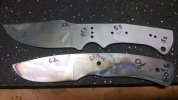
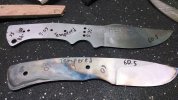
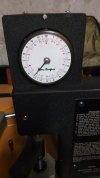
I treated these two this morning and am a bit confused as to why the clip point hunter has such a wide range of readings. the rear of the tang is a lot softer than the blade. Both blades were heated at the same time in double seamed foil, spine down, tang towards door.
Austenizing- The recipe ramped for about 2.5 hours to 1880 and first blade soaked for 15 minutes. I added ten minutes for second blade to get back up to temp so second blade (clip point) soaked for 25. My kiln is 110v so I cannot have it ramp any faster.
Tempering- 2 hours at 225. Kiln was still too hot from first heat cycle and went all the way to 297 before it slowly dropped back down to 225. Was still at 237 60 minutes into the temper.
Quench- two 1/4" aluminum plates (all I have right now, I know I need thicker) on top of 10lb steel weight to help ventilate heat. Another 10 lb weight on top of upper alum plate. Small fan on hi blowing on whole operation. Blades remained in foil for plate quench
Other variables- I used a soft freezer pack to cool the plates back down between quenches which left water on the plates would this have any affect? The clip point sizzled and spat.
Thanks in advance
I treated these two this morning and am a bit confused
as to why the clip point hunter has such a wide range of readings. the rear of the tang is a lot softer than the blade. Both blades were heated at the same time in double seamed foil, spine down, tang towards door. Austenizing- The recipe ramped for about 2.5 hours to 1880 and first blade soaked for 15 minutes. I added ten minutes for second blade to get back up to temp so second blade (clip point) soaked for 25. My kiln is 110v so I cannot have it ramp any faster.
Tempering- 2 hours at 225. Kiln was still too hot from first heat cycle and went all the way to 297 before it slowly dropped back down to 225. Was still at 237 60 minutes into the temper.
Quench- two 1/4" aluminum plates (all I have right now, I know I need thicker) on top of 10lb steel weight to help ventilate heat. Another 10 lb weight on top of upper alum plate. Small fan on hi blowing on whole operation. Blades remained in foil for plate quench
Other variables- I used a soft freezer pack to cool the plates back down between quenches which left water on the plates would this have any affect? The clip point sizzled and spat.
Thanks in advance

