- Joined
- Feb 28, 2002
- Messages
- 13,348
If Stuart had been seeking a challenge, I'd say he found one. I certainly admire his determination and committment to see it through.
"I don't know if I mentioned it but I have refinished this blade about 6 times including the once I went back to the grinder with the 120x belt to re-establish the geometry of the kissaki area.
That last set of photos showing the counter polishing starting at 1200x ultimately didn't work out as I could never get the scratches out. I don't know if steel "grain" is like wood grain but counterpolishing with even 2000x paper looked like I dragged it across gravel. I even used some 3M TriMite paper that was supposedly 3 microns or equivalent to 4000x and it still looked like the cat was sharpening her claws on it.
So... I went back and took the whole blade up to the 2000x grit in the horizontal polish and then began working the counter polish after the etch with the loose abrasives and some traditional Japanese nugui polishing compounds.
This is a picture of the Jitekko. It is powdered magnetite that is mixed with clove oil to perform what is called a Sashikomi style of polish. This is as opposed to the Hadori style.
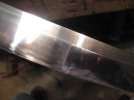
What is shown here is from tonight. I was still troubled with the kissaki polish as a previous Jitekko application had a stray coarse piece scratched the blade and in polishing the scratches I was left with an uneven finish. So, I used nail polish as a resist and re etched the blade with lemon juice and then took the oxides off with the 1200x loose abrasive/oil mix. Then this step, the Sashikomi polish. This is the first blade I've used it on and I really like how it seemed to not only whiten the hamon details and refine the crispness but also highlighted a colour difference in the hardened and unhardened portions of the blade. The mix is made and then it is placed onto a piece of nuguigami polishing paper with the finger so the oil mix seeps through but filters the mix. This is then dabbed onto the blade and then mix is worked in with oumewata which is a super soft cotton like material.
I then follow this up with a finer polish of Tsunokou/oil mix and then with the Uchiko ball and finally a light coat of clove oil.
Ultimately I think traditional stones would be the way to properly approach this geometry in the future but it was a learning experience for sure."


Roger
"I don't know if I mentioned it but I have refinished this blade about 6 times including the once I went back to the grinder with the 120x belt to re-establish the geometry of the kissaki area.
That last set of photos showing the counter polishing starting at 1200x ultimately didn't work out as I could never get the scratches out. I don't know if steel "grain" is like wood grain but counterpolishing with even 2000x paper looked like I dragged it across gravel. I even used some 3M TriMite paper that was supposedly 3 microns or equivalent to 4000x and it still looked like the cat was sharpening her claws on it.
So... I went back and took the whole blade up to the 2000x grit in the horizontal polish and then began working the counter polish after the etch with the loose abrasives and some traditional Japanese nugui polishing compounds.
This is a picture of the Jitekko. It is powdered magnetite that is mixed with clove oil to perform what is called a Sashikomi style of polish. This is as opposed to the Hadori style.
What is shown here is from tonight. I was still troubled with the kissaki polish as a previous Jitekko application had a stray coarse piece scratched the blade and in polishing the scratches I was left with an uneven finish. So, I used nail polish as a resist and re etched the blade with lemon juice and then took the oxides off with the 1200x loose abrasive/oil mix. Then this step, the Sashikomi polish. This is the first blade I've used it on and I really like how it seemed to not only whiten the hamon details and refine the crispness but also highlighted a colour difference in the hardened and unhardened portions of the blade. The mix is made and then it is placed onto a piece of nuguigami polishing paper with the finger so the oil mix seeps through but filters the mix. This is then dabbed onto the blade and then mix is worked in with oumewata which is a super soft cotton like material.
I then follow this up with a finer polish of Tsunokou/oil mix and then with the Uchiko ball and finally a light coat of clove oil.
Ultimately I think traditional stones would be the way to properly approach this geometry in the future but it was a learning experience for sure."
Roger