ostrich. head. sand.

Joined
May 19, 2005
Messages
12,709
What does it say when I don't live in hurricane country, but I'm more paranoid about it than are the people who live there? Check this out:

Convinced that tough tactics are needed, officials in hurricane-prone states are trumpeting dire warnings about the storm season that starts on Thursday, preaching self-reliance and prodding the public to prepare early and well.

...

But the main strategy, it seems, is to scare the multitudes of people who emergency officials say remain blase even after last year's record-breaking storm season.

...

But will it work? Emergency management officials groaned this month at a poll by Mason-Dixon Polling and Research Inc., which found that of 1,100 adults along the Atlantic and Gulf Coasts, 83 percent had taken no steps to fortify their homes this year, 68 percent had no hurricane survival kits and 60 percent had no family disaster plan.

"I can't rightfully say I see any increased sense of people getting ready," said Larry Gispert, emergency management director in Hillsborough County, Fla., home to Tampa. "It's like a psychological issue 'If I don't think about bad things, bad things won't happen.' "

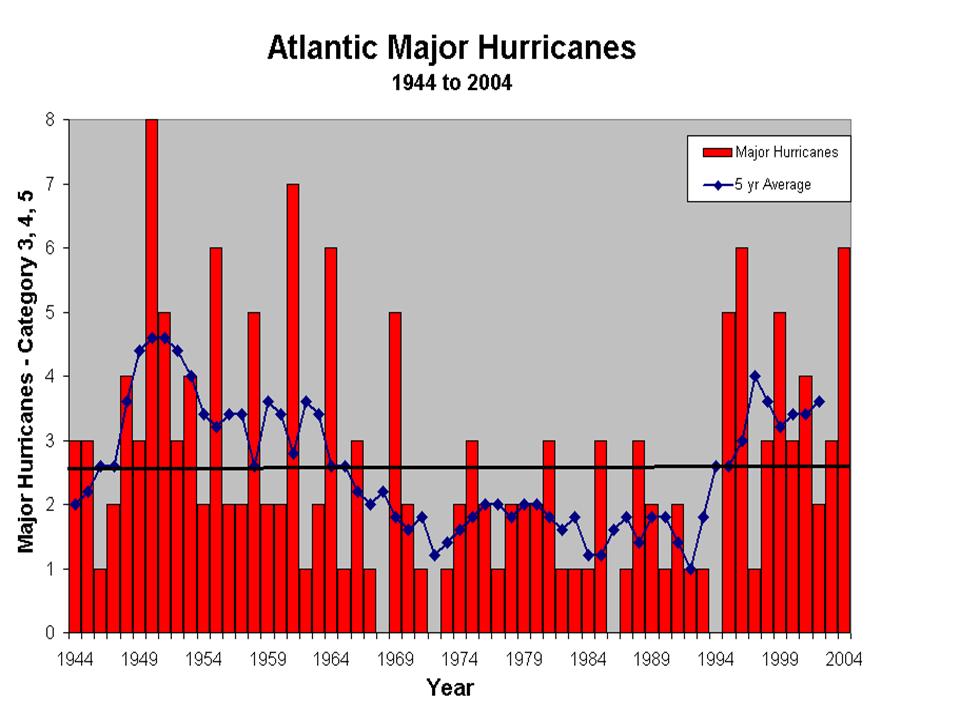
The people firmly against the notion of global warming, or against the idea of doing anything about it anyway, continue to claim that the rate of hurricane occurrences is up only due to a naturally occurring cycles. But the reality of it is that two things have increased:

  1. The number of tropical depressions forming in the Atlantic
  2. The temperature of the water.

Without global warming we'd be seeing a lot more tropical storms, but not necessarily more hurricanes. Because of global warming and that ever-so-important water temperature, we'll be seeing a lot more of those depressions turn into hurricanes, and big ones too.

The immediate answer is to buy investment property in Arizona because once those retired Florida people get battered a few more times they're all going to bail to the south west. Of course, global warming is also going to cause massive amounts of drought, punctuated by horrible floods, all throughout the western United States, so don't get too comfortable in those desert regions.

Warm. It's looking like a really warm summer. Me, I keep working on my bug-out-bag.
 
Tobacco kills 100,000's a year in the U.S. alone -- but people smoke.
15% of our drivers here do not wear seat belts.

The "thinking" seems to be, "It won't happen to me."

If it happens, and you survive, "It surely won't happen to me again."

I guess Cliff is right about natural selection. The various governments can only do so much to get in the way.

Let's move 'em all to San Francisco. ;)
 
I moved from Arkansas to "paridise" in July of 1995. Gulf Breeze, Florida is located on a narrow peninsula between Pensacola Bay and the Intercoastal Waterway, just a stone's throw from Santa Rosa Island. I was in an area of Gulf Breeze proper called "The Point", and my house was two blocks from the Bay on the North, and two blocks from the Waterway on the South.

On August 3rd 1995, Hurricane Erin had 85 knot winds (Category 2) when it hit. Landfall occurred near Pensacola, Florida during the late morning. The most significant structural damage for the final landfall occurred on Pensacola Beach, Navarre Beach, around Mary Esther and in northeast Pensacola. More than 2,000 homes were damaged there and crop losses were reported. Some beach erosion was reported west of Navarre Beach. Farther inland, about 100 homes were damaged in Alabama. Widespread tree, power line and crop damage extended inland. We survived fine because we were prepared.

On October 4th 1995, Hurricane Opal was a Category 3 hurricane when it made landfall. I was dead center. Sustained winds of 115 mph, with gusts to 140 mph, Panama City Beach Pier recorded peak tidal surge of 8.3 feet above mean tide, with wave run-up to 18.1 feet. Hurricane Opal destroyed more coastal structures in Florida than all other coastal storms over the past 20 years combined. While my neighbors had yachts in their yards, and 200 year old live oaks were down everywhere, we came through fine because we were prepared. Five days without utilities, three before we could get ice and supplies by walking (climbing through storm debris) to the center of town six blocks away.

Interestingly, natives of the area fared worse. We had food, water, camp stoves and lanterns, everything we needed to last a week or more.

http://www.city-data.com/city/Gulf-Breeze-Florida.html

Codger
 
There are an astounding number of people who still, somehow, even after hurricane Katrina, believe that their local, state, or federal governments are going to rescue them, should something catastrophic occur. They seem oblivious to there being any need to prepare themselves for their own survival. That, to me, seems the best explanation for those states, in hurricane zones, trying to scare their residents into getting prepared.

---------------------

Hurricanes are a tough natural disaster because we have the technology to track their progress from their beginnings, as tropical storms, until they reach landfall, but, we cannot predict where a hurricane will strike land, no matter how far we track it. This leads to a situation where the people in hundreds or thousands of coastal towns and cities are warned about an approaching hurricane and that it may hit them. The problem is that, while potentially tens of millions of people are warned about the approaching hurricane, usually only hundreds or thousands of people will eventually be adversely effected by that hurricane.

That tens of millions of Americans might be warned about an approaching hurricane, yet, only hundreds and perhaps thousands of Americans will eventually be badly effected by that hurricane, it can, unfortunately, lead to a large amount of complacency. There are probably millions of Americans that live in coastal areas that have heard the hurricane warnings a hundred times, but, they haven't actually ever experienced any hurricane damage.

Do those folks that have listened to the hurricane warnings a hundred times before, and nothing catastrophic has ever happened to either them, their families, or their house, listen to/take heed of the hurricane warnings as seriously as those individuals who have recently experienced the wrath of a hurricane...? I sincerely doubt it.

---------------------------

I bet that those folks in New Orleans who turned-down offers of a ride out of town, before Katrina hit, will be lining up for the first evacuation bus heading out of town, the next time. If those that had been offered rides out of low-lying portions of New Orleans had been asked if they had an axe in their attics, I bet that implication might've helped many folks to accept a ride out....

GeoThorn
 
Tobacco is an addictive habit forming drug . It is harder to kick than heroin .
I don,t think an addiction can be compared to not preparing oneself for a natural disaster .
 
Kevin the grey said:
Tobacco is an addictive habit forming drug . It is harder to kick than heroin .
I don,t think an addiction can be compared to not preparing oneself for a natural disaster .

Point taken. Failure to regard a risk as relevant to your own situation is not a chemical addiction, although the failure to recognize the enhanced risk of horrible death certainly is a factor is continuance of smoking for some (not the ones dying in the Hospital and having smokes smuggled in to them).

Tobacco is not generally regarded as harder to kick than heroin, but, as a "legal" addictive drug, it is certainly a far more serious public health problem than all of the "scheduled" drugs combined, plus alcohol.

(I'd like to see a study comparing "kicking" overeating to "kicking" smoking. We are born with an oral satiety center crying out "Feed me!!)
 
I don,t want to digress from the thread . This is a subject close to my heart . I am not saying tobacco is a plague though it does plague our health system .
It wasn,t a scientific study but many heroin users who have quit heroin could not shake the tobacco drug . It was made evident by them that they considered cigarretes much harder to quit than heroin . Perhaps not a scientific analysis . Just a grass roots level survey .

To get back on track it sounds to me that telling people to be self reliant as far as hurricane survivability is concerned is double talk for : you are on your own: a la New Orleans .
I have found that people that will prepare for something don,t need to be told to be prepared . The opposite side to that coin is you can wack a dead mule over the head with a frying pan . He isn,t going to do what you want him to do .
 
Kevin the grey said:
I have found that people that will prepare for something don,t need to be told to be prepared . The opposite side to that coin is you can wack a dead mule over the head with a frying pan . He isn,t going to do what you want him to do .

Just how do you prepare for the complete distruction of your entire state? Evacuation is not an option; you have neither enough time, nor the means to do so; and, there isn't enough truck capacity in the entire country to haul it. Is the government prepared to reinburse me for the business expense of providing each employee with 45-60 days of paid hurricane leave, so that all can prepare or evacuate upon the publication of a hurricane watch? The right solution is to put in place the kind of building code that would make a catagory V hurricane harmless - and that goes doubly so for key pieces of infrastructure like the highway system and the power grid. That these politicians should merely wash their hands of the entire mess; a mess which they themselves have created; should be enough to lynch the lot of them.

n2s
 
bulgron said:
The people firmly against the notion of global warming, or against the idea of doing anything about it anyway, continue to claim that the rate of hurricane occurrences is up only due to a naturally occurring cycles. But the reality of it is that two things have increased:

  1. The number of tropical depressions forming in the Atlantic


  1. mh05.jpg

    http://www.aoml.noaa.gov/hrd/tcfaq/E11.html

    bulgron said:
    [*]The temperature of the water.

+1 degree on average
 
I cannot agree more that something has to be done . The gouvernment saying they are washing their hands of their responsibility or providing the minimum to who crys the loudest is no way to run a railroad . Self reliance is one thing . Paying taxes is another . Being self reliant is good and necessary . It seems to me that the more you rely on yourself the farther the gouvernment wii distance themselves from you . Thats all well and good except you still get your tax bill every year .
 
Anyone wanna bet this thread gets booted to the Political Arena by nightfall? ;)

What sort of message is being sent if the U.S. government tells Americans, literally, that it's every "man for himself" (hopefully after 'women and children first'....) for the next major natural [and maybe terrorist-caused...?] disaster...? That sounds like an abdication of U.S. government responsibility, to the country itself, in my opinion.

After the next natural/man-made disaster, are we all supposed to just pull together and pick up the pieces, or is the U.S. government going to be over-seeing it and leading it...?

Didn't hurricane Katrina already show us what a natural disaster looks like without/with too-slow U.S. government intervention...?

GeoThorn
 
Given that government -- relevant government -- is not running a surplus, vote to very significantly raise your taxes to provide the funding for building necessary infrastructure and vote in politicians who will increase the cost of buildings by requiring them to be built to resist 200 mph winds and Category 5 storm surge. We know the technology is there. In 1994, I saw a church in Des Plaines that had been run over by a Class 5 tornado. It suffered only cosmetic damage. (The rectory building next door was simply gone - just a cinderblock-lined hole in the ground -- the basement. Even the grass was gone.)

I elect not to live there - or in the quake and volcanic zones out west. I noticed that those risks existed.
 
I agree that to move into an area that has elevated risks may not be the best choice . People live where they live for a reason . It may not be apparent to others and thats just the way things are . We all do things that are inexplicable to others . People live on coastlines , drought prone regions , earthquake central and a host of other less than desireable areas for a ton of very good reasons .
It can be economic , family oriented or just the end of the line for some folks . I don,t think it is up to anyone else to judge if those reasons are valid .
I myself am looking for the least expensive , lowest taxed piece of property I can find . I am sure there will be some drawbacks and that it will not be the most desireable of properties .The good side is that what is not desireable to your average yuppy country squire is proabably a lot closer to paradise for me . Am I foolish for wanting to move there or is it because I have no choice that is apparent to me ?
 
Kevin, I understand what you are saying, and I don't disagree with it. But I know one thing: I did not make the choice for the folks who build on California hillsides or below sea-level in NOLA. But I help pay for the consequences of those choices in my insurance premiums and federal taxes.

I also subsidize those who live in other disaster-prone areas. And I am not complaining about that -- thus far.

It does seem strange that those who made those choices say I am not doing enough to protect them from the consequences of their choices. Or shall we pretend that government creates wealth?
 
It does seem strange that those who made those choices say I am not doing enough to protect them from the consequences of their choices. Or shall we pretend that government creates wealth?

Most of us are not structural or geo technicians. When we buy a home we assure ourselves that it meets our needs, that it is legally transferred and defined, and that it passes inspection (including code compliance). The presumption is that if it meets code it should be safe. I doubt most sellers would appreciate it if I start digging exploratory trenches, or hacking into the structure to do a stress analysis. Nor are we in a position to walk over and test the engineered maximum wind load designed into the local utilities.

We depend on local and state government to put appropriate standards in place, and to follow up to ensure compliance with that code. To the extent that there is a crisis it is a problem largely created by government. If they no longer want the responsibility then they should no longer be in the licensing, fines, and inspection business. If it is to be every man for himself, then it is time to have mass public sector layoffs.

n2s
 
NTS, where local govenrment doesn't draft and enforce resonable building codes (Recall Anrew knocking down houses where the walls were made of 2x2's and the roof attachment was by gravity alone?), hang the creeps. You want me to help pay for corruption in Florida? LA? Sure. Why not. I am already.

But some places are just obviously risky. Before 1968, there were areas where no one built homes because they were not insurable. Federal flood insurance (now $billions in the red) started in 1968. Thousands and thousands of structures were then built in high-risk areas on coasts and rivers. I have seen houses built five feet above sea-level on the Gulf coast. I'll bet some are even lower. That's not much margin, however good the view/weather generally might be. There WILL be waves. Should the codes require West Wall Steel and Concrete bunkers? Will there be federal subsidies to build structures that will withstand the inevitable tests?

And no amount of finger-pointing will stop NOLA from sinking. It's built on saturated mud. Meanwhile, the flood-control levees along the river are destroying the swamp that protects NOLA from the sea.

I simply suggest that there ought to be thought given to the price paid to allow folks to live in high-risk areas - paid by folks who decide to avoid those risks.
 
I think we are starting to mix apples and oranges here . There seems to be an issue with paying for other peoples mistakes . I think that if we keep bouncing from one issue to another such as from poor location choice to government responsibility and then to corruption that little will be made any clearer than when we started . I enjoyed this thread . It seems to be unraveling a bit . I,m gonna move on to survival issues as opposed to taking issue with how others survive .
 
I am of the opinion that my survival is a matter of my own personal responsibility, not that of government, and I live my life that way. Government is not my mommy or daddy. In today's society, individual survival is actually less assured because the prevailing thought is that government is there to protect me from my own poor decisions. Well, Katrina showed us what happens when too many people think this way. If you want to build a house of straw on a spit of sand jutting into the gulf a few feet above sea level, or a house of twigs on a steep eroded hillside in California, or the rim of a volcano in Washington, more power to you. Just don't blame me, or the government when your property comes to ruin or you don't survive. Nature is not a respector of persons or governments. And in the long run, no matter how you seek to isolate yourself from nature, we do live in the dynamic natural world.
 
Back
Top