Overall grinding strategery questions

Joined
Sep 16, 2002
Messages
1,577
I have gotten to the point after making a few knives that I have some questions about the overall strategy and approach to grinding/finishing a knife (stock removal, full tang.) Up till now, my 'strategy' has been pretty much like this:

-profile blade
-grind bevels (with fingers and toes crossed.) As soon as it looks halfway decent STOP and immediately switch to files/sandpaper so as to not screw things up
-spend countless hours by hand finishing the bevels and fixing any mistakes the power tools made
-sand the flats and bevels to the same grit/scratch pattern
-HT
-etc.

Now that I feel like I'm on the road to grinding halfway decent bevels, it brings up a couple of questions. I'd appreciate any tips anyone is willing to throw my way on any of this.

-When grinding a full height flat grind (all the way to the spine), how high should I grind with any particular grit belt to get all the way up but not into the spine? My first couple I ground way too high and created a step in the spine...the last couple I stopped too short and didn't make it all the way up. Is this just a feel or experience sort of thing, or is there a good system to get me there? Also, do you sand the flats before finishing the grind (as taking down the flats of either precision ground or rolled can remove differing amounts of material and seems to complicate the matter further...at least in my feeble mind.)

-I'm currently sanding my flats with a palm sander and/or by hand. Is it possible to do the flats on the belt/platen (and keep things flat), or is a disk the only other practical way aside from my current methods?

Thanks in advance!
 
Okay, I'm still a newbie but I'll answer some as best I can.

- I grind 50/60 grit (depending on which I buy) about 3/4 of the way then I switch to 80 grit and do 95% (well, in a perfect world anyhow). Then 220, 400, 400 cork, 600 cork, hand sand starting at 220 grit, then 400, then 600, then final scratch coat back at 400. this ensures you will seen any scratches left at the previous steps. It's kind of overkill but I've gotten OCD like that. Change angles with you hand sanding to really show the previous level of sanding.

- Yes. Disk I've heard is better, don't have one, never done it. You will get better at keeping the flats flat on the grinder. You will burn your fingers lots, but you will get better :D
 
Thanks, Erik. I've seen pics of your knives...if you're a newbie, I don't know what to call myself. Maybe I should just give up!

Anyway, so it seems people do do their flats on the belt. I don't ever remember reading anything about this, only sanding by hand on a flat surface plate or on a disk. Do you do this on the platen? Large contact wheel? Small contact wheel?

Thanks also for sharing your approach on the full height flat grind, I'll give that a shot on my next one to see how it comes out. I've got 60x and 120x belts, so perhaps I'll go a little higher than you on the 60 since I don't have any 80x.

When do you do your flats, does it affect the height of your grind much? I've had the top grind line move around on me after first grinding the bevels to say 400x and hand sanding them, and then afterwards sanding off mill scale (5160) on the flats and bringing them up to match the bevels. I'm wondering if I need to stop after the 60x belt on the bevels and clean up the flats, then finish grinding the bevels with 120x, 240x, etc. Or I suppose, you could do them together at each grit stage, especially if you're doing the flats on the belt as opposed to by hand separately.
 
I do it on a platen with a ceramic liner. The glass makes a big difference from a straight metal one. I have seen a few use a leather face on the platen too, but that will form a very slight convex grind, which honestly can be a good thing for strength. I used to use 120 after the 80 and figured out it really didn't gain me anything, but if you're jumping 60 to 120, then that should work fine. Definitely try to bring the grind a little higher in that instance I'd say. As far as the flats go, I use precision ground mostly, but when I use scaled stock, I do the flats first thing using the magnet to hold them then work the grinds. Also, if you screw up and take the grind too high, just hit the flats a little and you'll fix it quick. It won't take much to take that little divot step out, so check it frequently. Too much and you'll offset your centerline. You can cheat a little and you won't be able to tell without using a caliper :D
 
What kind of grinder do you have? Erik makes a good point about flattening on the platen, but I have a hell of a time on the Coote with the slack area above the platen. On a KMG, or similar grinder, you have a place to put your top hand. I've started to use the 8" wheel on my 4x36 combo (though i really need to make a REAL disc grinder) and it's been a big improvement on getting the flats flatter. Just my 2 cents from a real newbie... not Some wannabe newbie like Erik :D Seriously man... you should be proud to call yourself a Knifemaker, you make awesome stuff!
 
I usually got to within 1/4 inch of the spine with 80 grit and then go to 120 and 220.

I do a minimal amount of work prior to HT, there will be plenty of sanding afterwards. I will start and finish with a 220 after HT and then hand sand.

I was going the same way as Tec and using 400 and 600 belts and then sanding with 220, it made not sense to me and was frustrating. I am very carefull to make sure I remove all previous scratches with the 220. I start hand sanding with 220 (cross direction of the belt) and when all the scratches go the same direction I got to 320 on up until I get bored. This really does not take long, I just did a dagger in 440c with 4 bevels in about 1/2 hour to 320.

The flats are done before the bevel, I sand flat on the platen with up to 220 and then hand sand with the stiff backing board. This way I dont mess with anything once the blade is done.

A couple words of advice on flat grinding, I found it usefull to forget all the talk about making the plunge and grinding with alot of pressure. I approach the belt really carefully, you must be flat and you must be in the right spot. Take a little longer and you will have less machine errors which result in deep groves that need to be removed.

Use good belts, it really helps since you dont have to press real hard, save them and burn them up when you get better. I use the norton trizac and get at least 5-8 good flat grinds before I use them for shaping for about $7 thats not bad.
 
Thanks guys, I've been using a Craftsman 2x42 with ceramic liner mostly, but I'm just getting my new KMG setup. It has a steel platen, and I thought it would try it as is before bothering with another ceramic liner (I'm not sure it's necessary on this machine...on the Sears it was absolutely essential.)

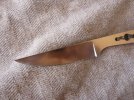
Here's the last one I did and I got close to the top, but it was really more by chance I think than anything else. This (as I recall) was at 600x, post HT grinding.
 

Attachments

  • P1000275.JPG
    P1000275.JPG
    69.9 KB · Views: 104
just go slow and take your time, dont rush while grinding no good comes from speed in grinding. Start on the slower speeds if your grinder has them. when you feel more comfortable speed up a bit.

Practice on paint sticks (the ones you stir paint with, hardware has them cheap)
 
Patrick, thanks for your input (I think we were posting at the same time.) I have been doing my flats last, and mostly by hand but lately by palm sander trying to speed things up a bit. I did this 1) because I didn't know any different and 2) because why waste the effort if I screwed up the grinding and why sand a bunch of material that will be gone as soon as the bevels are ground in anyway. I think I need to reevaluate this approach and try something different, and I think I need to suck it up and try doing the flats on the platen as well.

I decided recently that I'm not doing any hand sanding on my next blade prior to HT. I'm using simple steels and forge HT'ing, and it seems with all the cleanup I have to do anyway that it's just a bunch of wasted effort and time. My plan on my next one is to do say 90% of the grinding pre HT, then finish it up post HT and only then hand sand. If this works (and I don't know why it wouldn't), my pre HT hand sanding days will be forever over...at least I hope!

Thanks guys!
 
My grinding strategy:

1: Start the profile (5 min)
2: rough on the mill to get a straight even edge and remove the bulk of the metal (15 min)
3: grind starting with 120, then 240, then 400. Occasionally 600 or 800 grit (15 min)
4: finish profile (5 min)
5: tumble to remove scratches and smooth edges
6: HT
7: grind (again) the ones I want really thin - otherwise tumble to remove HT color, then scotchbrite on the grinder

The resulting "user finish":

feb09_1.jpg
 
A trick you can do to get the height on a full height flat grind correct, is to not profile the back of the blade until your bevels are set. Dont shape the blade at all beyond getting the edge shape established on your piece of steel. Once the bevels are set, you can profile the back of the blade down to match your grind height, and shape the rest of the knife. You have more oportunities to fix things this way, even though you might end up with a knife that is either narrower or wider than you envisioned when you started. Still, you have a better chance of ending up with something to complete and be happy with, rather than scrapping a piece of steel. Heck, I have ended up with a blade shape that I actually liked more than my original drawing. Do this a few times and you will learn to trust your grinder further into the process, and cut way down on the frustration level. Once you have a few more grinds knocked out, you will feel more comfortable doing things the conventional way. Also, the value of varible speed on your future KMG can not be overstated here.
By the way, you really dont have far to go. The blade pictured looks fantastic!
 
Last edited:
Pre HT I grind to a edge of about 0.060" and then plan to take it to 0.040 after HT. I only go to 220 on the belt sander and no hand sanding. I have my electric kiln set up so I am now getting a tumbler and hoping that will cut sanding.

I start my sanding with a angle grinder air tool, you can get sanding inserts to which I glue paper with rubber cement, this is very fast and works wells. You cant use it to correct divots because the surface will not be flat but to get to the 220 grit takes a couple of minutes.

If you can get a good surface with the 220 after HT the sanding is pretty quick. Use a backing board with a leather spacer to start, this will save the paper. Then go to a stiff backing board.
 
Nathan, techna, and Patrick, thank you for the additional input. That's an interesting idea of not completing profiling along the spine until the grind is set; I may have to play with that option as well.

I'm having less than 100% success with the palm sander, and I really WANT it to work for me (on both flats and bevels to speed up hand sanding, which has become a bit of a drag lately.) I should probably make another post to get some input as to why it's not working properly for me.

Thanks all!
 
I take the edge down to my scribed lines, then hog away 80% of the mateiral needing to be ground off with a 60 grit Blaze belt.

Pre-HT I then only take it to 200 grit and leave about a dime's thickness on the blade. No hand sanding other than cleaning up plunges, if necessary.

Post HT I start at 120 and go to 400, but anyone who has hand sanded a 400 grit belt finish knows that its not a 400 grit finish, so I go back to 200 with my hand sanding. I "scrub" both directions through 400 grit, then only a single direction until i'm at my target final grit.

For grinding the actual flats, I do everything based on shadows between the edge and belt. Think about what youre trying to achieve. If you first take the edges down to your scribed lines at a 45 degree angle, in order to grind your flats, you need to move that grindline up to the spine without taking any more meat off the edge. This means you need to have a gap between then edge and the belt. Start grinding, moving that grind line up, gauging your progress by watching the "shadow" or gap between the cutting edge and the belt. When that gap closes, the belt is approaching the edge. If your grind isnt high enough, that gap will need to be "opened" by putting more pressure towards the spine, thus raising the grind at the same time. When I say "gap" or "shadow" I am talking about a tiny thin gap. I have a very bright light over my shoulder that helps this.

A good way to practice getting the feel for this is to take a bar of scrap steel and hold it flat up to the belt. If you held it this way and pressed with even pressure, you'd cut evenly into the bar and notch out a perfect rectangle. Now "twist" that bar as you press it into the platen so the pressure is more towards the top or bottom. Grind for a few seconds and take the bar off...youll see how the "twist" pressure needs to be even left to right so that youre grinding up the blade but doing so in an even way. New guys commonly have a deep grind about 2" from the plunge as a result of uneven pressure.

Moving a grindline up and across a blade is a combination of putting the right pressure on the blade so the right area is being ground (moving line up towards spine vs keeping grindline even and grinding down into edge) while at the same time maintaining even left-right pressure
 
Well said david, the real key is the shadow between the belt and edge.

The problem with you palm sander may be your paper, good paper works well anywhere. But in reality if you have the blade sanded to 200 - 400 on your belts your dont need power tools to sand. I do use the air grinder but usually when I am doing several blades at one time. Focus on being really carefull on the last couple of passes on your belts and move the blade to a slight angle to see if you have removed the deeper scratches. Sand at a angle other than your belt scratches and remove all the previous and it should go more quickly.

I also have made some sticks and tools to hold the paper, nothing fancy, just helps the grip.
 
Another tip is that you can gauge how evenly you are pressing the bar into a belt by observing the sparks coming off the blade. Even pressure often results in a nice, even 2" strip of sparks. If you start seeing more sparks on the right or left, you are torquing the blade into the belt, which will cause wavy grinds. I somehow find the spot where I can view the edge-to-belt while at the same time watching the sparks with my peripheral vision.
 
For grinding the actual flats, I do everything based on shadows between the edge and belt. Think about what youre trying to achieve. If you first take the edges down to your scribed lines at a 45 degree angle, in order to grind your flats, you need to move that grindline up to the spine without taking any more meat off the edge. This means you need to have a gap between then edge and the belt. Start grinding, moving that grind line up, gauging your progress by watching the "shadow" or gap between the cutting edge and the belt. When that gap closes, the belt is approaching the edge. If your grind isnt high enough, that gap will need to be "opened" by putting more pressure towards the spine, thus raising the grind at the same time. When I say "gap" or "shadow" I am talking about a tiny thin gap. I have a very bright light over my shoulder that helps this.

Thanks for your input, David. I may be using the wrong terms...by 'flats' I mean ricasso and tang, but it sounds to me like your describing grinding the bevels above. I'm currently doing my 'flats' (ricasso/tang) by hand or on the palm sander, but I was wondering if guys did them on a belt/platen; I hadn't really ever read about any way other than the methods I'm using or a disc grinder.
Well said david, the real key is the shadow between the belt and edge.

The problem with you palm sander may be your paper, good paper works well anywhere. But in reality if you have the blade sanded to 200 - 400 on your belts your dont need power tools to sand. I do use the air grinder but usually when I am doing several blades at one time. Focus on being really carefull on the last couple of passes on your belts and move the blade to a slight angle to see if you have removed the deeper scratches. Sand at a angle other than your belt scratches and remove all the previous and it should go more quickly.

I also have made some sticks and tools to hold the paper, nothing fancy, just helps the grip.

I spent about 2 hours this morning messing around with another blade of O-1 that has been heat treated. I carefully ground it up to 600x on the grinder after HT (it had been hand sanded to 320x before HT so I know anything coarser than that was gone). I started at 400x...no good. Went to 320x....still taking forever. Back to 220x, mostly by hand but also some time on the palm sander, and after all that I still don't have all the scratches out of one side. The previous blade I finished of O-1 also gave me fits.

What is a good brand/type of sandpaper? I haven't graduated to buying anything from any knifemaking suppliers. I'm using GatorGrit wet/dry SiC from ACE hardware. Is my paper crap? Is hardened O-1 really hard to sand? Does my methodology stink?

Thanks guys!
 
I used to use Klingspor sheets from Pop's but now I use Norton Black Ice and like it a lot more. You can also (as suggested to me by Del Ealy) cut a belt in pieces. They last forever (a LOT longer than a sheet). However, I found I like the way sheets wrap around my sanding block a lot more.
 
I have gator grip and I like it. Maybe you should detail your sanding process. I have to say if you are going back to 200 to remove scratches they were still there and not removed previously.

Let me say I feel your pain, couple of years ago I went through the same thing and I was trying to do mirror finish.

I could not hold the blade steady enough to use anything finer than 220 on the belt grinder, I made more sanding for myself using the finer belts. Maybe now I can but I only use the fine grits on the flats.

1. The last grind has..must.. without doubt be at a different angle. 90 45 30 does not matter , you will see the coarse scratches.

2. Remove all the coarse scratches, I worry about the palm sander I would try by hand and get something that works.

3. Use a litte water with a couple of drops of soap for lubricant, it really helps.

4. Use one spot on the paper 1-2 minutes at most, you should feel when its not cutting

5. start at the tip and work 1" back, when all the scratches are removed go to the next inch.

Seems simple but it can be frustrating.
 
Back
Top