Para detent, lock bar, pivot adjustment

Joined
Oct 25, 2009
Messages
485
Just got a user para in a trade and was wondering if some issues are normal.

1. There is very in handle detent to speak of, to the point where I would never carry the knife tip up even if it were possible.

2. The compression lock feels rather feeble. This is the first example of the lock I've ever handled and it definitely doesn't have the authoritative snap as lock backs and liner locks. Do compression locks wear like liner locks do? Mine moves over about 75-80%. There is a tiny bit of blade play vertically and horizontally.

3. The pivot isn't adjustable because it's not pinned on the other side. Why would they do this? Am I supposed to buy two sets of torx screws :confused: The blade is centered - I just want to tighten the pivot for some more detention.
 
I had one that the comp lock would not engage at all. I sent it back to W&R, waiting on it.
Do you have a pic of the lock issue at all?
As for the 3rd item, The side that does NOT have the clip is the side that can be adjusted. If I remember correctly, the other side that has the clip is keyed (so to speak). Hope that made sense.
 
Turning the pivot screw from either side results in the other side also turning.

As for the lock, I wouldn't call it an issue. But I am wondering if the weak detent and slight blade play may be due to a well worn compression lock.
 
I think it is beyond well worn. Blade play usually doesn't show up until the lock is worn past self-adjustment. That can happen rather quickly with a lot of inertial openings and/or spine whacking. I've rebuilt a Yojimbo that was in that condition, and unless you are very comfortable with sheet metal work and precision machining, I don't recommend it. I suggest you contact Warranty and Repair and see what they say about the possibility of it still being covered.

Yes, you need two Torx drivers to tighten the pivot. They aren't that expensive. I probably have at least half a dozen laying here on my desk.
 
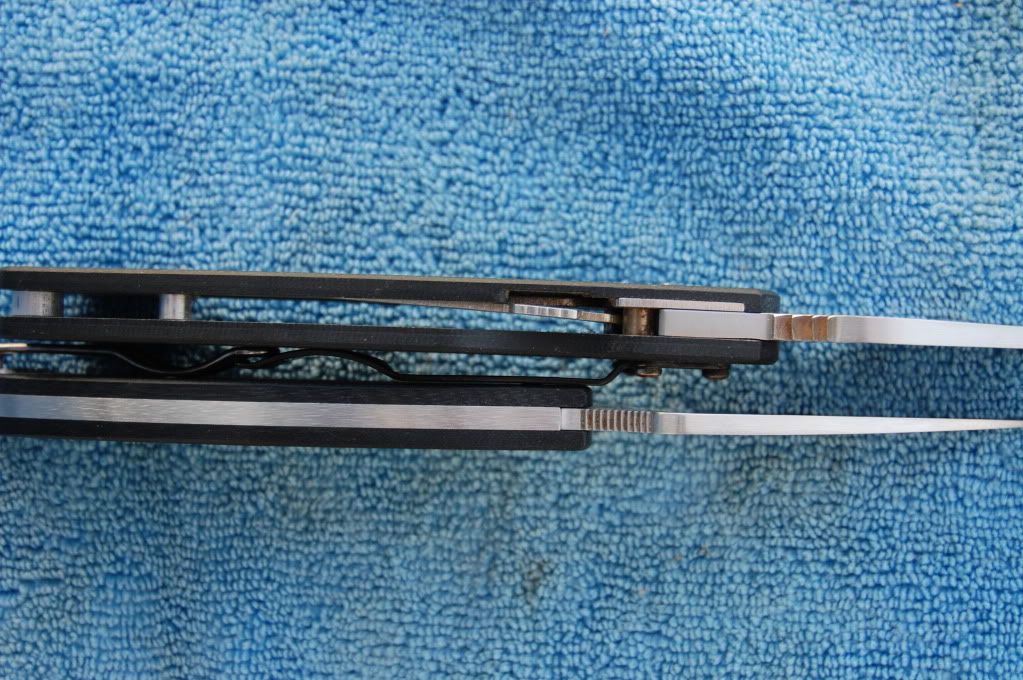
Interesting, does anyone have a picture of the para's engaged lock viewed from above?

About the pivot...and here I was thinking that 30 pc set of drivers I bought would be enough for any knife I'd ever come across. :rolleyes:

Well now I'm just more excited for the Para II hahah
 
Here's a shot I had laying around the harddrive.

DSC_0088-1.jpg
 
Thanks yablanowitz. The lock bar on my example does indeed move over about 2mm more than the one pictured.

Edit: Btw, is that photo of a new para? I ask because there appears to be some rust on the stop pin and liner.
 
Last edited:
My liner lock Barong has virtually no detectable detent. I saw a comment from another user that he called Spyderco and had someone handpick the one with be best dedent for him, so this may be a known issue with the Barong.
I'm reluctant to carry that tip up too.

My compression lock Superhawk is somewhat better. There is at least a noticeable detent, though I wouldn't mind it being a bit stronger.
 
Last edited:
Thanks yablanowitz. The lock bar on my example does indeed move over about 2mm more than the one pictured.

Edit: Btw, is that photo of a new para? I ask because there appears to be some rust on the stop pin and liner.

No, that one is far from new. It has been used hard and put away wet more than once. My work knives lead hard lives.
 
1.In my experience the detent on the Para "feels" weak, as in, it's very easy and smooth to open, compared to a ball detent, but still pretty secure. It should take a fair amount of force to fling it open without touching the blade.

Now that I'm thinking about it, I wonder why they don't use a ball detent on the comp locks, it doesn't seem like it would be impossible.

2. Yes, the compression lock lacks the great snap, thwack, or clack of a good liner, frame, or back lock. This doesn't mean it's a feeble lock though, the knife will self-destruct before the compression lock fails.

In my experience, a tiny bit of up-down "flex" is a bit normal for some Paras. this is caused by a slight gap between the lock bar and the stop pin, which is probably necessary, or else the lock bar would drag on the stop pin. it is somewhat inherent to the design, although a large amount is not.

3.this is kind of strange... both my paras have had a flat spot on the pivot pin that matches the liners to keep the female part of the pivot pin from spinning...
 
I pulled out a Superhawk because it is the only example of a compression lock that I have.

On that knife it does have a detent and holds the blade in quite well. It also makes the same light 'thwack' that a liner lock makes. Hopefully someone else will verify that the para does not have a detent. It is possible the little ball bearing came out.

You could try rotating the stop pin to see if that takes out some of the play and prevents the lock from moving so far.
 
Hopefully someone else will verify that the para does not have a detent.

the Para does not have a traditional ball bearing detent as seen on frame and liner locks. there is a notch cut in the blade tang that the whole compression "liner" nests in, acting as a detent.

You could try rotating the stop pin to see if that takes out some of the play and prevents the lock from moving so far.

I'm not sure on this one, but I don't believe the para has an eccentric stop pin either. At least I never had any luck adjusting mine.
 
The stop pin is not eccentric, but a lot of inertial openings will peen a flat spot on the pin where the blade strikes it as well as peening a groove in the stop face of the blade. If that is the problem, turning the stop pin a little will move the peened flat away from the groove, reducing the clearance a little. Those hard openings can also peen the screw holes in the liners where the stop pin is secured, causing the pin to move toward the butt of the handle, which is more difficult to repair.
 
3.this is kind of strange... both my paras have had a flat spot on the pivot pin that matches the liners to keep the female part of the pivot pin from spinning...

I'm not sure I understand what you mean by this. Are you saying the non-clip side of the pivot pin will spin a certain amount before hitting up against something on the liner that will stop it and allow the user to adjust the other side accordingly?

Right now I think being able to tighten the pivot will improve both handle retention and fix the majority of the bladeplay.

By inertial openings do you mean spydie-drop and similar methods? I would be disappointed with the design of the compression lock if simple repeated thumb flick-opening of the blade would wear it down that easily.
 
Here's another shot of the compression lock for comparison. I don't use this knife very often - If I had to guess how many times it's been opened and closed I'd say 300-450 (ball park guess :o)

P1270036.jpg
 
Inertial openings are those where the blade is put into motion and stops only when an outside force acts on it, or it slams into the stop pin. Scientifically speaking inertia is the energy stored that tends to resist a change in acceleration. The heavier the blade, and/or the harder it is set into motion the more inertia is has stored that is imparted when the blade comes to rest. Generally this creates a bit of wear on things when it comes to knives. Many choose to do this, but hopefully they understand that they are creating additional wear and tear.

I have carried my para for a few months, then I got a Military. Love them both, but if I knew nothing regarding the design and workings of the pivots, I would tend to assume the para is pretty frail. In reality I think the para may have a slightly stronger lock than the military (assuming you compare perfect examples of each), but the action of the para is so much lighter and offers so little feedback that it is easy to assume that it is flimsy.

The same can be said for the detent when closed. I never thought my para was lacking. However when I got the mil, I marveled at the difference.

img58293.jpg
 
Last edited:
I'm not sure I understand what you mean by this. Are you saying the non-clip side of the pivot pin will spin a certain amount before hitting up against something on the liner that will stop it and allow the user to adjust the other side accordingly?

Right now I think being able to tighten the pivot will improve both handle retention and fix the majority of the bladeplay.

By inertial openings do you mean spydie-drop and similar methods? I would be disappointed with the design of the compression lock if simple repeated thumb flick-opening of the blade would wear it down that easily.

The female side of the pivot pin, the one that goes through the knife, has a flat spot. If you were looking down on it, it would not be a full circle, it be as if you sliced part of it off. The liners are cut the same way so that the pin will not rotate, allowing the pivot to be loosened or tightened with one bit, onto the male side of the screw.

Odds are that your threads are stripped
 
Knives are like snowflakes--no two are alike.

My D2 Para has the strongest closed detent out of all my liner locks, compression locks and Axis locks. Much stronger than my orange Millie's. Go figure.:confused:

Also, I do not need two torx bits (one on each side) to tighten the pivot. Just the one on the lock side (non-clip side) is all mine needs for adjustment. Go figure.:confused:

Not done yet. Its compression lock is also fairly loud and positive sounding and feeling when it engages. In all fairness, I will admit that it wasn't like that out of the box. Only after I took it apart for cleaning and lubing and put it back together did the lock situate itself that way.
 
Knives are like snowflakes--no two are alike.

My D2 Para has the strongest closed detent out of all my liner locks, compression locks and Axis locks. Much stronger than my orange Millie's. Go figure.:confused:

Also, I do not need two torx bits (one on each side) to tighten the pivot. Just the one on the lock side (non-clip side) is all mine needs for adjustment. Go figure.:confused:

True that, but I think this one may just be well worn. Still makes a great user though, despite the little flaws. And I have to say this para is the smoothest knife I've ever handled. Better than axis locks even.

I'll be holding out for the Para II and the Superleaf
 
My early Para has a very weak detent. So weak that even the slightest flick will cause the blade to drop down and the tip to be exposed. Not sure if the design is poor or if the early examples were simply not up to typical Spyderco standards.
 
Back
Top