
-
The BladeForums.com 2024 Traditional Knife is available! Price is $250 ea (shipped within CONUS).
Order here: https://www.bladeforums.com/help/2024-traditional/
You are using an out of date browser. It may not display this or other websites correctly.
You should upgrade or use an alternative browser.
You should upgrade or use an alternative browser.
Paring Knife Design
- Thread starter Chasen30
- Start date


- Joined
- Jul 7, 2013
- Messages
- 2,614
The belly of the handle is way to big. If you get rid of that feature altogether I think it would look better.

Without some dimensions it's hard to really judge. If you look at a lot of paring knives the handles are often pretty slender. I think this is mainly to support the peeling position (edge facing you). Say it's a 3" paring knife, 3/4" wide blade... that handle is what, 1" wide? Way too big, IMHO.
I'm skeptical that the curvature/angle of the handle relative to the blade suits a paring knife. It looks more like an EDC blade.
I'm skeptical that the curvature/angle of the handle relative to the blade suits a paring knife. It looks more like an EDC blade.
Thanks for the feedback. The dimensions are a 3" blade. 0.75" at the Ricasso, 4" handle. So the curve for purchase isn't necessary? Oh and the handle is 0.75" curve is deceptive. With the first pic I was thinking about comfort of grip but the edge facing you position didn't occur to me.
- Joined
- Jul 7, 2013
- Messages
- 2,614
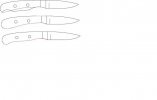
You want to avoid sharp angles on your handle. They can be uncomfortable when using the knife for any amount of time. Here are a couple of other ideas. Drawing in MS paint is quite limiting. Try using a pencil and paper.

- Joined
- Dec 6, 2004
- Messages
- 6,212
slender handle some thing to keep your fingers from riding up onto the blade plunge not in the way of the edge
handle shape that keeps it from rolling around in your grip (hands get slippery when pealing alot of soft fruit and veg.
handle shape that keeps it from rolling around in your grip (hands get slippery when pealing alot of soft fruit and veg.

- Joined
- Nov 28, 2014
- Messages
- 1,864
I vote for the middle one. Simple is nice.You want to avoid sharp angles on your handle. They can be uncomfortable when using the knife for any amount of time. Here are a couple of other ideas. Drawing in MS paint is quite limiting. Try using a pencil and paper.
View attachment 530379
The best thing is always to use a variety of paring knives for the tasks they're made for, then ask working cooks what their favorite paring knife looks like and how they hold it.
I personally like to have the cutting edge a little "behind" the handle- the blade is narrower than the handle and the spine makes a fairly continuous line from handle to point. This makes peeling much easier than a cutting edge that sticks out, the way a skinner or chopping knife would.
I personally like to have the cutting edge a little "behind" the handle- the blade is narrower than the handle and the spine makes a fairly continuous line from handle to point. This makes peeling much easier than a cutting edge that sticks out, the way a skinner or chopping knife would.
Thank you everyone for your feedback. After some consideration I'm thinking of finalizing the design with this:
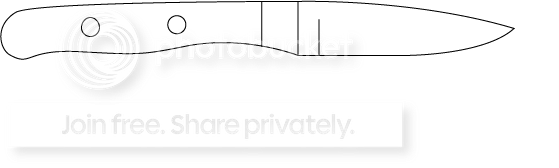
It is simple and contains some basic features of a functional knife. I realize I could labor over this for ages, but at some point I have to start working steel. Any major flaws with this before I go to it? Anything that screams, "That's a noob mistake!"

It is simple and contains some basic features of a functional knife. I realize I could labor over this for ages, but at some point I have to start working steel. Any major flaws with this before I go to it? Anything that screams, "That's a noob mistake!"