paring knife handle flaws

Joined
Jan 18, 2010
Messages
217
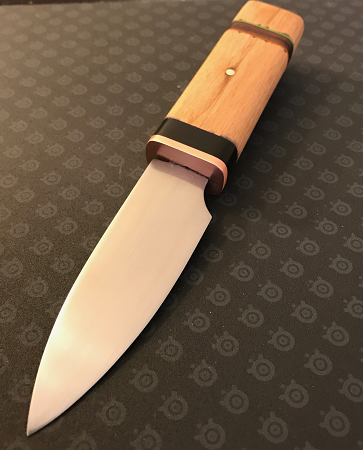
I'm making a paring knife (blade currently @HT w/JT). This handle is Alder (thanks again Mburks, this is what I had left from your piece!), ironwood, G10, buffalo horn, and copper. I realize i probably over-did it w/the materials...but it was so fun. i sanded to 220g on the belt grinder. hand sanded up to 600g, and applied 3 coats of tung oil. the bottom section and top section have internal brass pings+epoxy.

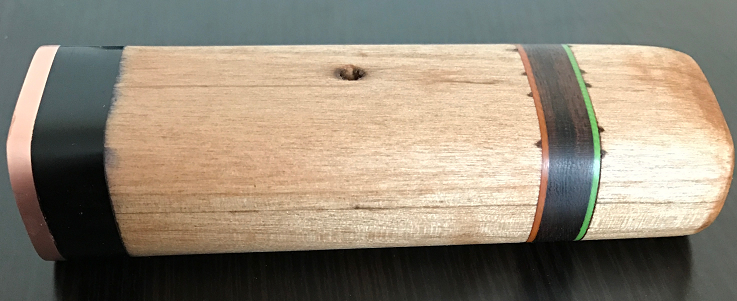
i created flaws in 2 areas:

1. between the G10 and the alder wood. these flaws are smooth to the touch, but they look like voids i probably created on the sander.
2. between the horn and the alder wood. it looks like horn dust may have smeared into the small openings in the alder wood.

so BF...thoughts on how i created these flaws, and suggestions on how to avoid it in the future? thanks again.
MCiW6rO.png
 
For the alder and horn you just sand from alder to the horn, don't sand the other way and it should prevent that.
 
I've finished a couple alder guitars with tung oil, it's a nice look.

To keep sanding dust out of wood pores the wood needs to be sealed before fine sanding. Everyone here swears by super glue, I've used that with mixed results. I am currently trying a couple with urethane sanding sealer.

Hopefully some people with more experience will chime in but I'm thinking now that you have sealed it with tung oil, you should be able to sand past the flaws. Just sand with 600 or 800 grit until you feel like your getting past where the tung oil penetrated, apply tung oil again , rinse lather repeat until you get past it.

The tung oil should seal it so you don't get more dust trapped in pores.

I always rubbed the,last coat of tung oil with 0000 steel wool, regardless of what grit you sanded the wood to, maybe even 2 or 3 coats with steel wool in between.

The one thing I don't like about tung oil is the process time building up a good finish. I always waited a couple days in between rubbing and applying a new coat, so finishing a guitar could take a couplesealed.

Edit to add, the post above is good advice too, and glad you got some use out of the alder.
 
The other side of the block is fine right? My guess is the wood chipped when you cut it. It helps to have something solid under the piece you are cutting/drilling to prevent tearout. I agree with MBurks , you should be able to sand the flaws out .
 
Agree with spalted, may be tear out from when you cut the wood. One other way to prevent the filling as shown would be to seel the alder before sanding. After sealing, blow out all pores and apply a thing coat of epoxy, filling all holes and pores, the sand as needed.
 
i sanded pretty deep and those flaws didn't disappear. i'm not going to bother posting a pic because its pretty much identical to the one above -- except the handle is thinner. in the future what type of a saw would be best to use for this? i used a hacksaw...it was the only thing i had...but now i realize i had the wrong tool for the job.
 
Your blade should be delivered today. I use a fine tooth bandsaw but I allways sand it back to finished dimensions.
 
Always cut the wood longer than needed and sand back to a 80 to 120 grit flat surface ( I like 80 grit). Do that on all mating surfaces before glue-up. This will give perfectly crisp and strong glue lines.
 
I can sand until the cows come home and those flaws aren't coming out. I'm chalking it up to a learning opportunity. Here's my finished work. Thanks again BF for all of the help.

wdZNO6p.png
 
What grit sandpaper did you use to try and sand the tearout with ?
 
What grit sandpaper did you use to try and sand the tearout with ?

I went back to my grinder w/a 60 grit belt. the handle is significantly slimmer now (not a bad thing necessarily as it was probably too thick). looking back, i think i did a number on the alder when i cut it w/a hacksaw while it was in a vise.
 
How easy was finish sanding on the blade?

Super easy. No little circles and that charcoal residue came off quickly by hand w/220grit (and i use pretty crappy sand paper). I updated your thread where you described your process, but its worth thanking you again in this thread for your help and the D2/15n20.
 
Back
Top