patina

Definitely not a stupid question.

Applying a patina to a blade can give you a bit more control in terms of pattern and coverage than you might get if you left it to develop naturally. So, there is a certain aesthetic purpose to it.

But the primary reason to apply one is to provide protection against rust.

Also, it's just fun. Especially when you attempt to explain yourself afterwards. "What did I get up to this evening? Oh, not much. Just sat around, rubbing mustard and vinegar on knives ..."

All the best,

- Mike
 
I do it for rust protection. My favorite is Dijon Mustard.

It creates a pretty cool effect, but it's more function than form to me.
IMG_0321.jpg
 
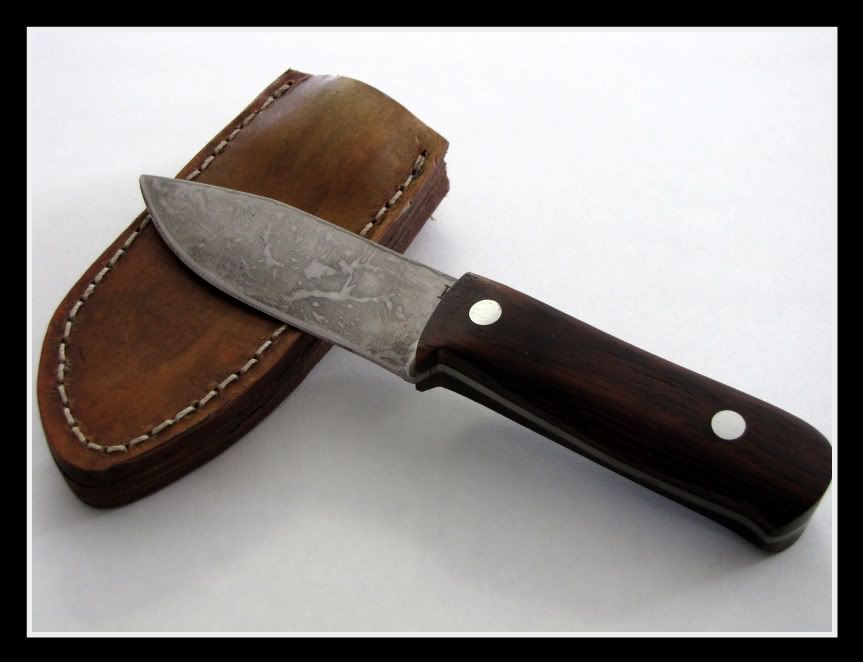
I found after making a few of my own knives, they love to rust when they are fresh. I tried keeping a few of my O1 knives at a 400 grit finish, but they would rust just sitting in my drawer with all of my other carbon steel knives that don't rust. I use hot vinegar to put a very deep blue on the blades. I've used chemicals, but they always seem to stink for forever. I do it to prevent rust, but it is also fun and looks good.
 
okay...then my next questions are: what is the process of doing it with either vinegar or mustard? i really like the look of the blade with the mustard patina. i have a knife in O1 on it's way and would like to protect it from rust. thanks for the help guys!
 
Here's my vinegar method...

1. Clean the blade with rubbing alcohol. You want it to be as dry and free of lubricants as possible. From here on out, don't touch the blade with your fingers or you'll get a permanent fingerprint on the blade.
2. Put the knife, tip-down, in an empty glass or something weighted so it doesn't tip over. You want the blade to have as little contact with the container as possible so that the vinegar can cover the blade's surface uniformly.
3. Add enough vinegar (I use white distilled vinegar) to cover the entire blade.
4. Wait. You'll see bubbles start to appear within a few minutes. After about an hour, I remove the knife, wipe the blade down with a dry cotton towel, and put it back in the water.
5. Repeat step 4 until the blade has been soaked in the vinegar for about 5 hours, then remove it. The last time you remove it, don't wipe it off yet.
6. Let it sit for another hour in the air, then wipe it off as dry as possible.
7. Make sure you apply some sort of very light lubricant on it to protect anything you missed since the un-patina'd portion is now highly susceptible to rust spots.

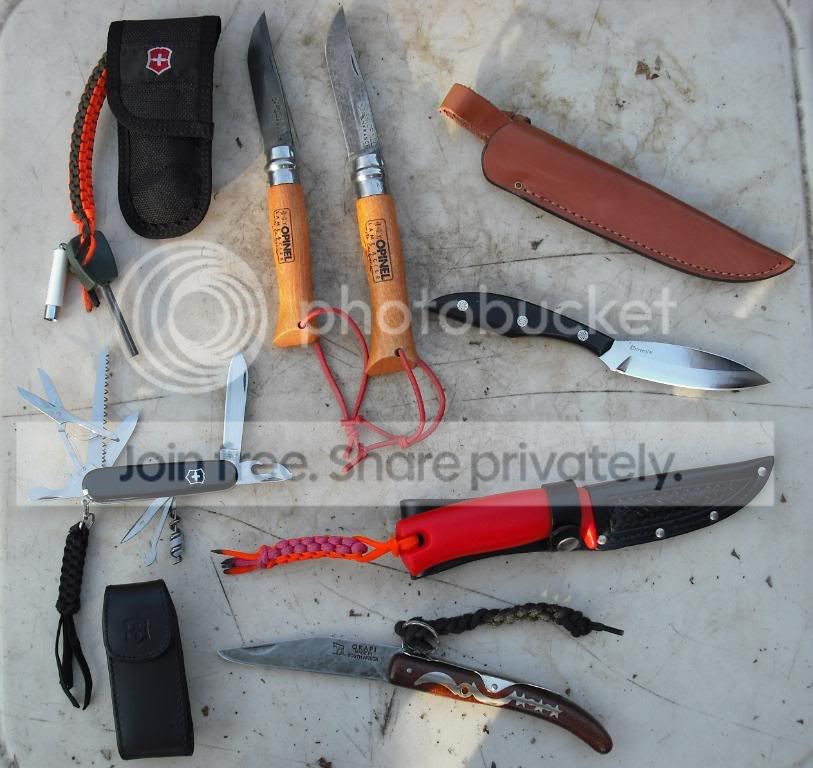
Using this method, I turned my shiny Opinels and Okapi into these...
003-9.jpg


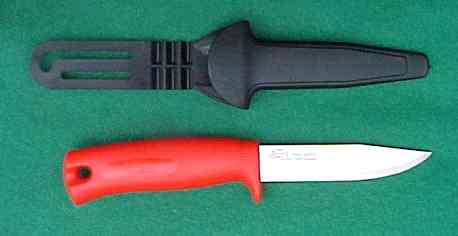
and my Mora from this...
740.jpg

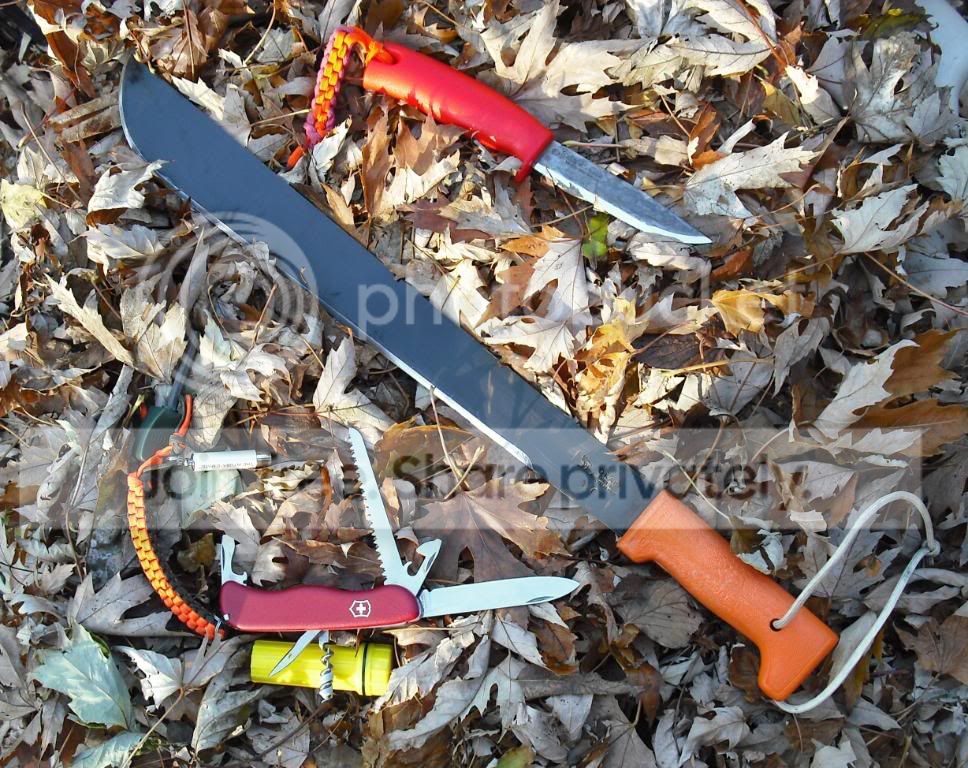
into this (the very top knife)...
001-7.jpg
 
Experimentation is key, but I recently arrived at a process that works for me.

First, no matter what method you use, you have to make sure that the blade is totally clean, and free of oils or streaks. I use a bit of acetone, followed by a rinse with water, then dry it using a lint-free cloth.

For the first step, I use a cotton swab and dab a light coating of French's mustard on both sides of the blade. The goal here is to apply a light and thin coat - the patina forms where the drying mustard forms a translucent layer between the air and the steel, and not where the mustard is deep and yellow. Leave this to sit for a while to dry (10-15 min. should do).

At this point, you can either clean off the mustard or clean it off, apply another coat and keep going.

Alternatively, you can use a cotton swab dipped in vinegar to dab the mustard off the blade, leaving a thin mustard-vinegar coating. Then allow this to dry, and repeat. This helps to get rid of blotches and streaks, which tend to form around blobs of mustard if they are left to dry.

After a few applications of mustard / vinegar, rinse the blade off, dry it, and let the patina finish forming on its own.

This seems to work for me.

Before:

IMG_2469.jpg


After:

IMG_2471.jpg


All the best,

- Mike
 
I used dijon mustard on a stripped D2 RAT3 to make Strider-type tiger stripes.

It worked pretty well, but I hated the look after a minute, sanded it back to shiny and left it at that for the time being.

Just have fun with condiments! Dab some stuff on a clean blade, let it sit and wipe it off. Repeat as needed.
 
I've heard it's better to warm both the acid (vinegar or something) and the blade.

I've always done it with nitric acid, dip blade into the acid of room temperature
for half a minute or so. But for the current EDC I used blueing processing
of tools (like drill bits). I asked a professional person to do it.
But tools blueing didn't last long when I used knife for fruit, fish, meat, or vegetables.
Today, it looks like this.
2008.07.25.R0016123.JPG


These kind of layer does not protect blade perfectly and the colour or pattern of
surface will change as you use it.
 
I warm a vinegar and Birchwood Casey Cold Blue solution (50/50 - learned it here in BF). Then I wash the blade in HOT water with dishsoap and a sponge. Rinse in HOT (did I say HOT?) water and dry with a towel. Now go immediately to the vinegar/cold blue solution.

You can also go to a mustard rub while the blade is still hot, then immediately dip in the solution and let soak. After soaking, clean the blade (takes all the mustard off), then let soak in the solution again without the mustard.

This EnZo was treated with mustard then dipped in the vinegar/cold blue solution before flattening the scandi grind. It didn;t mustard up very well... I should've used dijon ((( :D )))
P226-04.jpg


These two Moras were washed and rinsed under HOT! tap water, dried, then soaked in apple vinegar (just because that's all my wife would give me :) ).
MoraPatinas-02.jpg
 
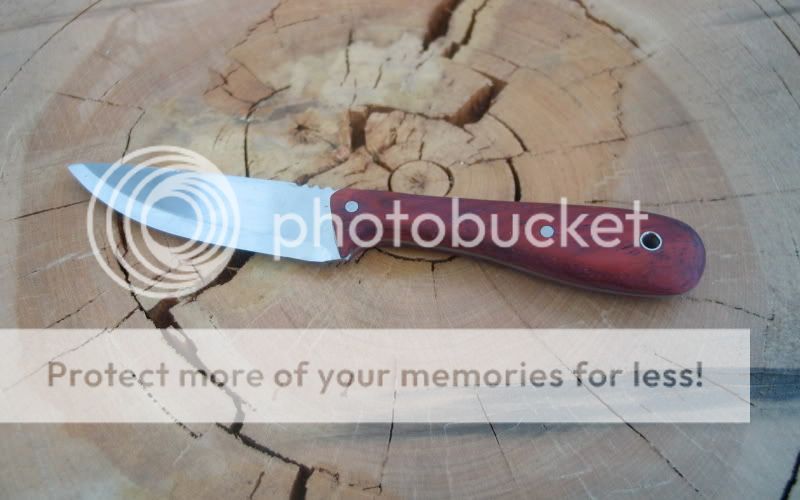
here is a knife i made last year. i put yellow mustard on the right side in rows then let it dry for a few hours. once it was dry i put some on the left side and let it dry. then i soaked the blade in vinegar and agitating the blade when bubbles formed. once the mustard had soaked off i ended up with a neat looking patina on the right. i need to redo the left side one of these days.
attachment.php
 
Pepsi works too. It's probably the carbonic acid...Just clean the knife really well, stand it up in a glass full of pepsi, and let go for about an hour. don't wipe it off after removing it from the pepsi. after it dries you can wipe of any stickiness that may remain. I tried Dr. Pepper yesterday, and it didn't work as well...

Oh yeah, don't let anyone accidentally drink the Pepsi when you're done with it! It WILL taste like carbon. :o:D
 
I find just cutting meats, vegetables and fruits give my carbon steel blades a nice patina.

This one is a BRK&T Canadian Camp Knife in A2.

cc010wb3.jpg


"If you're not living on the edge, …you're taking up too much space."

Big Mike
 
The way I see it the patina is going to form anyway but letting it do so on its own is patchy. To do it yourself in advance at least allows it to be more evenly distributed so its much better looking.

STR
 
Do you fully emerse a knife with a full and exposed tang in order to give the patina to all of the exposed steel? I have a knife in A2 and the micarta is attached with brass, will it be affected also? I think maybe I should try this on an old Mora first. :D I like how it looks on the ones Stretch did. Nice even coating. :thumbup:

I used gun blue on a hatchet a whiloe back but it seemed to dull the edge. Has anyone also experienced that also? Gave it a great look but wasn't very durable. It seemed to come off easily when I used it but maybe thats normal?
 
Back
Top