
Pattern definition question

weo

Joined
Sep 21, 2014
Messages
3,115
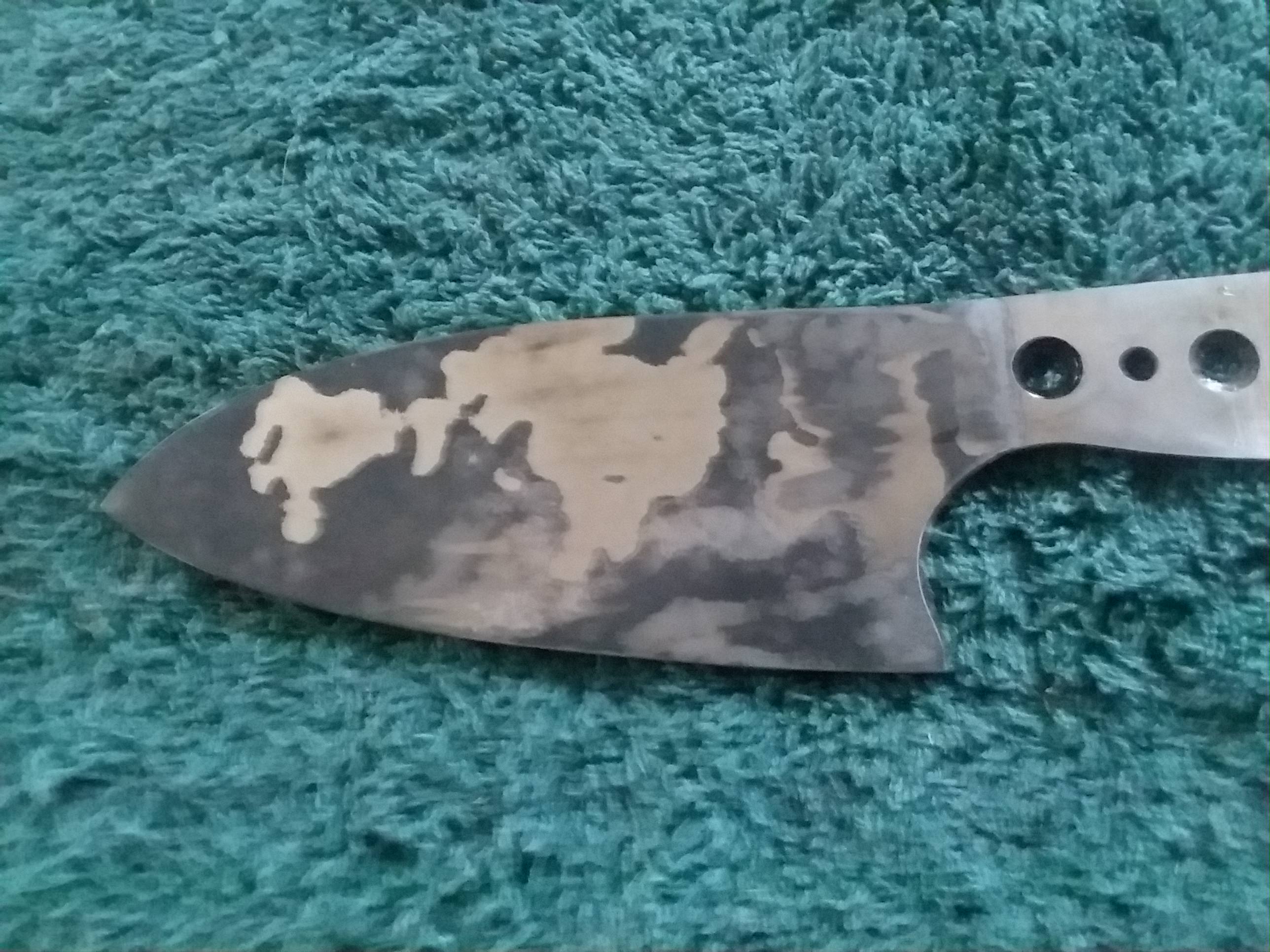
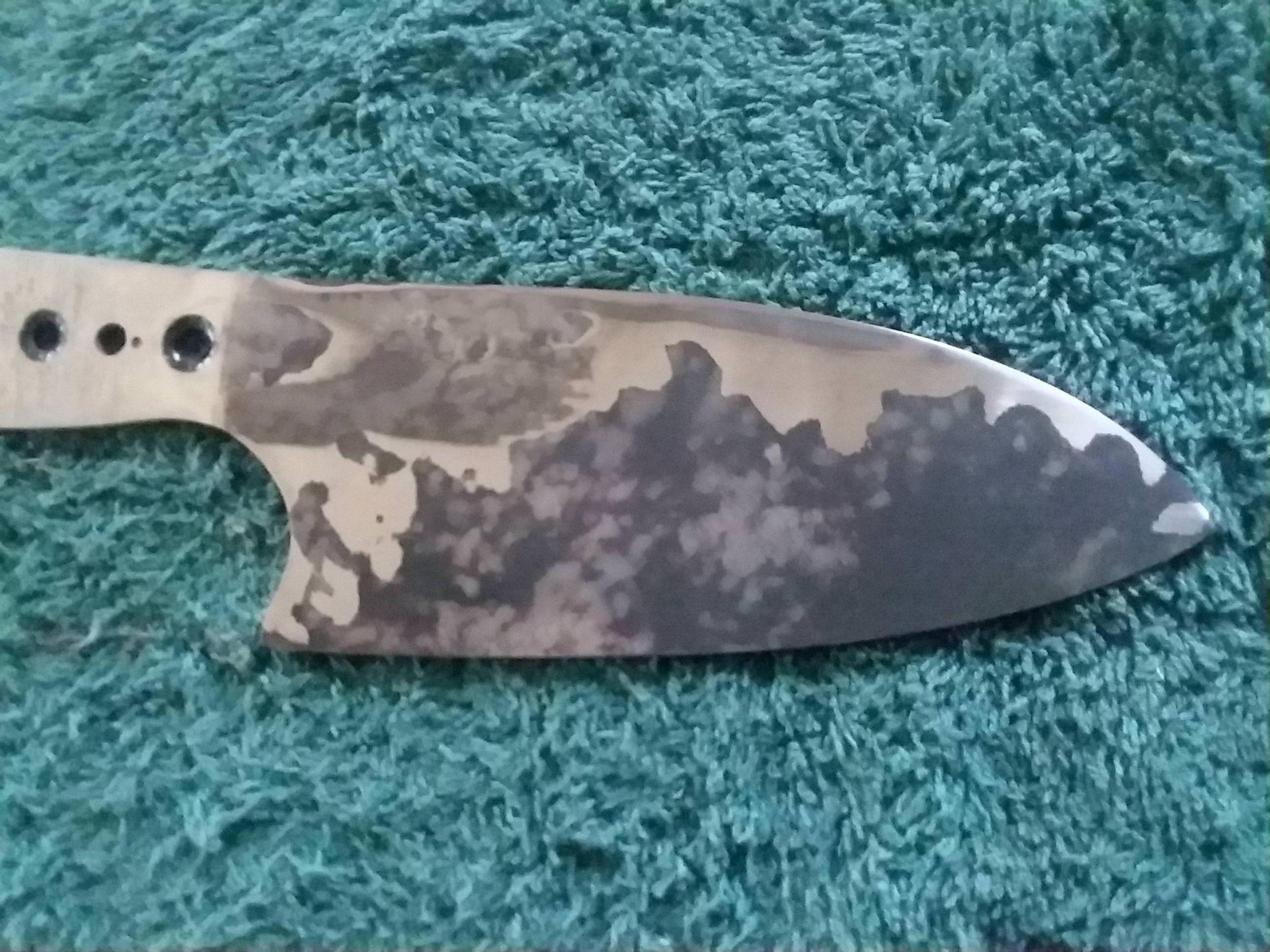
Hello all. I etched a blade in coffee (my preferred technique) last night and am unhappy with the results and hope someone can give me ideas on what happened so I can avoid it in the future.
rV3mBX8.jpg

0dCpuXr.jpg


The pattern is not as defined as I've had in the past. Is it just a result of forging? Is it a heat treat issue? Another reason?

Thanks.

as always
peace and love
billyO
 
You etched in only coffee? I've been starting with ferric to get some dimensional contrast, then coffee to color. Or is that not damascus and you're talking about coffee patina?
 
You didn't say what steel it is and any of the details, but that looks like a blade with lots of decarb still on it.
 
Looks like it could also be sanmai to me. I was also curious about the pattern. Did you put nail polish or something on it before etching or is it damascus/sanmai/decarb?

You etched in only coffee? I've been starting with ferric to get some dimensional contrast, then coffee to color. Or is that not damascus and you're talking about coffee patina?

Yeah I heard it was something the Europeans started. I never gave it much thought until I spoke with someone at a show, I believe it was Bill Behnke(SP?), who had a couple of fantastic damascus folders and one was beautiful cross cut mammoth with real dark damascus. I asked him how he etched it and he said coffee. I had never heard of it before and I asked if he used coffee and something else and he said he uses an entire can of instant coffee in like a half gallon of water and leaves it in overnight. I'm guessing on the amount of water because I don't remember but I do recall it wasn't much. Whatever he did it looked great.

-Clint

Edit:

I didn't think I snapped a photo of it, but I did.

IMG_0132 by Clint, on Flickr
 
You etched in only coffee? I've been starting with ferric to get some dimensional contrast, then coffee to color. Or is that not damascus and you're talking about coffee patina?

On my last few knives, I do a quick derricks chloride etched on my Damascus patterns like you mentioned, but on my Damascus mail patterns, I'm doing just an overnight or 24 hrs coffee etch (no dimensionalcontrast needed)

You didn't say what steel it is and any of the details, but that looks like a blade with lots of decarb still on it.
I wrote a lot more than what posted....here's what didn't show up.
I'm wondering if it's just the nature of being hand forged or if it's possibly a heat treat issue.

It's 3 layers, O1/15N20 quenched in 130deg canola oil, tempered 2x2hrs at 400 deg.
It's finish ground (so shouldn't be decarb) except for the final edge. Was planning on putting on the scales today, but like I said, I don't like how the pattern turned out.

Here's a link to another one, basically the brother to this one... https://www.bladeforums.com/threads/another-san-mai-finishing-question.1539853/#post-17691165

Thanks
~billyO
 
Hello all. I had another thought, is this possibly a fault in my forge welding? Flux inclusions perhaps (but it shouldn't be after grinding and hand sanding....)

Any thoughts would be appreciated so I can try to avoid this in the future.
Thanks
~billyO
 
Black is O1 white is 15N20 ? It's 3 layers ,maybe it is just a result of forging , maybe you hit to hard with hammer :)
 
Hello again, all. Well, here's how it turned out. I'm not unhappy with it, but still wonder about the grey areas. I tried etching after 1500g, then 2000g, then again after 5000g, and this is how it turned out after each 4-ish hour etch. Any thoughts?
PHaORb9.jpg

2Sv016o.jpg


Any ideas/suggestions/critiques are welcome.

as always
peace and love
billyO
 
I think it's carbon migration. You've got 3 layers there? Basically you're seeing what happens with thin, flat ground san mai blades. The O1's higher carbon is diffusing into the nickel layers and they are etching darker because of it. You really see that as a pronounced affect particularly when much welding heat or soak time has been involved, with thin layers.

Then again... I don't use 15n20 as cladding, so IDK if that's precisely what will happen with it. That is what happens with 410 stainless, though.

The edges of your 15n20 areas there are the actual weld zones, which are often robbed of carbon as separate surfaces before welding. So perhaps that's how you could see those gray islands with bright edges.

But there are problems with that theory, too. Steel is weird to think about sometimes...
 
Last edited:
Back
Top