pattern welding AND stainless san mai questions

Ive found if the conditions are right (temp, atmosphere and pressure) 16 layers 1/8" thick welds just as easily as 2 layers 1" thick weld :) (so long as you bring up to heat a bit gently to stop the outer layers bowing to much!!)

A bigger billet has more thermal mass, so is easier to weld, but I do 90% of my welding straight under a power hammer (only resort to a hand hammer for tricksy multibar work and suchlike)

Just have a play with it, remember the golden rule is billet soak time (before you weld, and cook it for a few mins at a full welding heat after you have set your welds). The only real obstical to success is not trying it!

I allways thought stainless welding would be a sob, but managed a twist pattern in 304&316 within 2 hours of actually trying it, as opposed to the months I put off trying it worrying I couldnt do it!!
 
John... I really appreciate the encouragement. Jumping into things might not be for everybody because too much initial failure can really turn you off of things... but if you are stubborn bastard, well then...

The thermal mass seems like a good point when I look back over my progression through figuring out san mai. My first attempt was only 1/4" thick total which completely failed. Although I'm now absolutely sure that I wasn't even close to welding temps at that time...

Also.. I just found an old thread in which Ed Caffery welded up some stainless san mai and it seems like he went with the same method I used for wire welding my wrought iron/nickel/15n20... just don't get too good at it and leave little pin holes.
 
better to have regrets for things you have tried, than regrets of not trying.... :rolleyes:

really, its just a process, no magic. If you fail (sorry, have 'sub optimal results') assess which of the variables might have caused it (temp, pressure or atmosphere, or combinations of!), and adjust it for your next go. Its how I taught myself to weld. After a few tries, so long as you learn from you previous goes youll nail it.

Its fun when you know it will stick good and you can really get into the patterns!
 
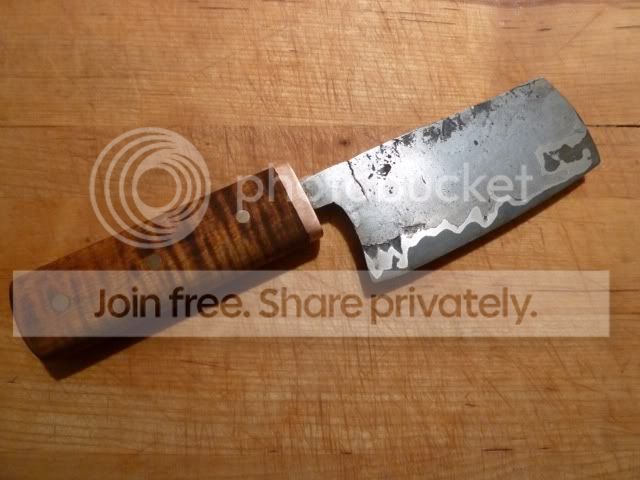
Here is one of my first 'sub optimal results' with wi/nickel/15n20. I had huge areas of delam in the billet between the wrought and the nickel (the nickel welded perfectly to the 15n20) and lots of huge inclusions in wrought. This is what I was able to salvage from the drawn-out billet. It managed to stay together throughout the heat treat. I think the delams were due to a combination of extremely unrefined slaggy wrought and insufficient soak at temp. The weld I did right after this had no delams but too many inclusions in the wrought. If I continue to use this wrought I'm gonna have to do some refining. Sure etches well though!

This knife isn't done yet... Needs more polishing and handle sanding... I may not even finish it..... That crack in the wrought at the spine is just a little too gnarly.


a8af712c.jpg
 
Last edited:
If you have wrought with lots of inclusions it is best to save that for fittings as that is what we like to see in fittings. Get some cleaner wrought to do the san mai with. Also wrought needs a higher temp to weld, if you had a thermocouple you could bump the heat up 50 degrees and soak a bit longer. To my eye I look for a bright yellow.

I find most people I help with making damascus in my shop always want to pull the billet early, so now for those people I tell when you think it is ready walk away and come back in 5-10 minutes depending on billets size. This has cured a lot of failed billets that would have failed to weld because they would have hit the billet too soon.
 
Very good advice....hard to do sometimes though! :)

Hey Scott....post a pic of one that came out more like you wanted. I would like to see one if you don't mind....

Brad
 
If you forge with a normal sized hammer then maybe start with something like 1" x 1" x 5" or so..If your alreay welding then damascus wont be a big jump. Like someone said above I had been blacksmithing for a long time before I tried to make damascus..
To me damascus is about the easiest welding to do, espically in a gas forge. I learned to do regular blacksmiths welds in a coal forge. Compared to that setting a stack of high carbon steel in a gas forge and just waiting for it to come up to heat is overly simple.
With a little bit of practice it will be for you too. Just make sure its clean, fluxed and comes up to heat all the way thru. Then pull it out and tap it together. Forge it out, cut it in half stack it and start over..Just takes longer with a hand hammer.
 
I do all of my damascus with a hand hammer, by the time you have a decent layer count you are at 25% yield, and that's before cutting losses for pattern reveal

-Page
 
I think Butch had the best advice with the proposal of using shim stock for the carbon steel damascus. It will give you that high layer count much faster.

The stainless San Mai needs to be dry welded with no pin holes. Soak it longer than what you think it needs. I soak mine for 20 minutes on a 1 1/4 x 4 x 5/8 billet.
 
Back
Top