Peening a tang?

Joined
Jan 27, 2008
Messages
2,010
As the title says, I'm about to peen the tang on a rather small dagger. I haven't done this before and I'm a bit leery of doing this on such a small, thin-tipped blade.

The dagger is forged 1084 with hammered copper, ebony and cholla cactus that will be filled with black epoxy then textured. The butt end will have a thin piece of ebony against the cholla then capped with a second piece of hammered copper. The tang is approx 1/8" thick. I still need to shorten the cholla by about 1/2 inch. Total length will be approx 5 1/2 inches. As shown in the photo below, I am planning on peening the exposed rectangular tang onto the copper plate that has been drilled and filed to fit the tang. Pinning through the cholla and tang is not an option as I'm sure you can see. The tang will be annealed.

I really don't want to damage this blade as it was a LOT of work and I'm quite pleased with how it turned out. Any suggestions on how to do this safely and effectively.... or, suggestions on other methods of securing the whole bit would be greatly appreciated.

Thank you,

Peter


Clamp the blade in a vise between copper jaw liners. Clamp tight. Peen the annealed tang as needed.

You can make the process easier by first epoxying the handle up in a clamp, just like a hidden tang. Then, after all the shaping and adjustments are done, slip on the copper washer, trim the tang 1/8" above it, and peen as above.
 
Clamp the blade in a vise between copper jaw liners.

Stacy - Thank you. I was planning on cutting a deep, blade-shaped notch in a piece of cross grained hardwood. Sometimes the simplest methods just escape me.

-Peter
 
On my most recent knife I used a 2x4 with a slit cut in it for the blade then dropped that in the vise and peened slowly. Worked pretty good.
 
You can make the process easier by first epoxying the handle up in a clamp, just like a hidden tang. Then, after all the shaping and adjustments are done, slip on the copper washer, trim the tang 1/8" above it, and peen as above.

So you mean peen after the epoxy has hardened? I've never peened a tang but have read elsewhere (Bo Bgerman) recommendations to peen before the epoxy hardens.
 
On a hidden tang knife I once attached a handle by drilling a hole in the tang that was covered half way by the handle. I then tapered a stainless steel pin and inserted it into the hole to act as a wedge. After I epoxied everything together I trimmed the wedge. I then drilled and tapped the but cap with a bottom tap. Two stainless steel bolts with the heads ground down, not off, to give it some grip is inserted into the handle. You also have to make a notch to receive the tang and wedge. The but piece is more decorative than structural. It looks like you might need a thicker but cap though.
 
William - That's actually one of the designs I drew up for this knife(if I understand you correctly). I decided against it because I wanted a clean, smooth butt(wow, that didn't sound right), without the tang protruding. This little thing is supposed to be held in thumb, fore and middle finger, with the ring finger bracing from behind the butt end. That design would have made that a bit uncomfortable.

Pullrich - I have one of Bo's books and have read that as well. The way I do cholla handles is to tightly wrap the piece with tape, then pour epoxy into the cactus' center void from the butt end when it is fitted to tang, then clamp and let cure. The epoxy will always settle into the natural voids leaving a small gap that will need to be filled prior to fitting/epoxying the butt plate assembly in place. So, in this case the epoxy will be cured when I do the peening.

Thanks all.

Peter
 
Just give up, Blue... your handle is all riddled with termite holes, anyway.:p
 
Peter, Everything would be hidden. You wouldn't see the tang. Your handle is held on by epoxy and the wedge. The but piece is attached to the handle, not the tang. You would need to make a thicker pommel. Smooth as a baby's butt.
 
If you have an assembly where the peened butt is what holds a simple one piece handle on, then peening while the epoxy is wet works well.

If you have a handle with complex segments that need to be aligned, it may be easier to glue it up on the tang, and put the knife in a handle clamping jig. That will make a good solid handle with all the parts straight. Then peening the tang end becomes a simple task.

Either one will work, but the cured epoxy method will eliminate errors that may occur when trying to line up everything at one time.
 
Is there any chance of breaking the allready cured epoxy bond during the peening process? How could that be avoided? Would a couple of errant hammer blows be enough to break the epoxy bond?
 
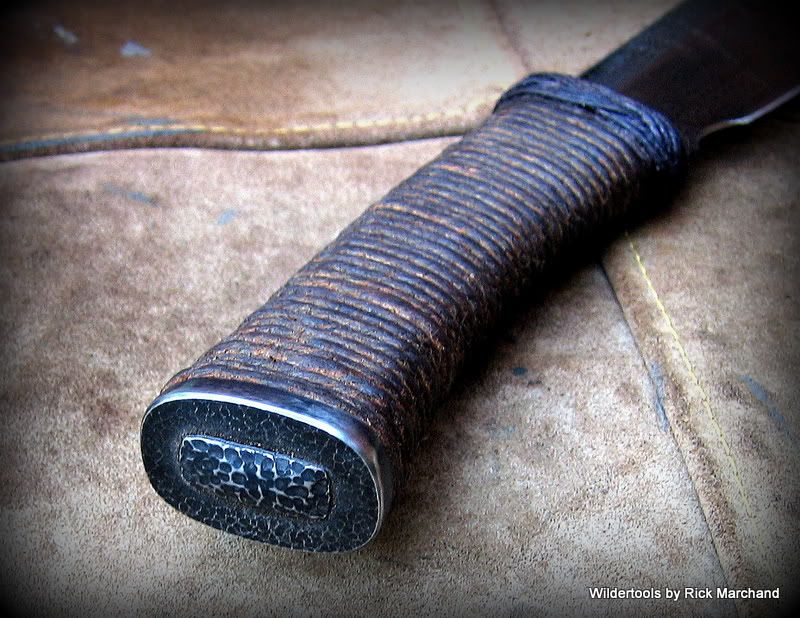
Just to be sure I peen everything! I PEEN YOU!

IMG_0120-1.jpg
 
Rick - That is exactly what I'm going for on my little dagger. In fact the image in my head, I believe, came from seeing that knife.

Thanks,
Peened Peter

Woodworker - You bring up a question I've been pondering as well. This will be the first time I've attempted a peened tang, and I may be taking a bit of a chance by doing it on this type of construction. You'll all see the results probably tomorrow.
 
Bigblue17, when I was working on the bolsters of my second knife, after the JB Weld under the bolsters had cured I tried to peen the pins a little more. Of course I broke the JB Weld bond to the tang.
 
Back
Top