Peening and Soldering guards?

Joined
Feb 16, 2014
Messages
152
I have looked around here and on youtube and can't find a consensus on this. I am making a guard as seen in the picture here and it is a full tang design:
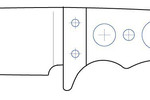
i-HXXfQK5-L.jpg

It is a CPM 154 blade and 416 guard. My intention is to make it a one piece guard with a slit in the back as opposed to the two piece bolsters I have peened/epoxied before. I really like the look of the soldered parts and have everything I need to give it a go. Just wondering if I need to peen pins to hold it securely or if the solder is all I need? It will have black Micarta scales.
 
Depending on how you fit the guard, one pin may be enough. In my opinion, a single properly peened pin is going to provide much better long term durability than soldering alone.

Bob
 
As Bob said above depending how you fit the guard. Maybe do a tight cutout in the
blade to fit the guard in kind of a cross configuration, do one pin above it and solder.
In other words the guard would fit the blade, but the blade would also be fitted to the
guard.
Ken.
 
Thanks guys, sounds like since I like the look of solder but want it to be strong I will pin and solder. Great idea about the one pin!
 
The strongest solder is made from a 0.003 " gap and flows best also.
 
I was thinking I will fit the guard, drill pin holes in tang and guard, heat treat tang and guard, put pins in place for positioning but not peen, solder guard, then peen pins. This make sense? Assuming I don't want to peen the pins before solder since it wouldn't leave much space for the solder to flow into?
 
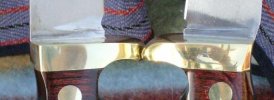
Here you can see the difference. I put a slight taper for the hole before peening.


3knives5.jpg


Both were pinned before soldering. The one on the left was peened and the one on the right wasn't.
 
Maybe I'm missing something but, I don't see any point in leaving any kind of gap for soldering. Best practice, as far as I know, is to fit the guard as tight as possible to the blade, peen the pin tightly and then use solder to fill in any tiny gaps and provide extra sealing against moisture infiltration. The solder is not meant to be a fastening system, it is a sealer.

Bob
 
I agree with all of Bob's comments and suggestions. I slide the guard into a very closely shaped slot on the tang, and then I peen the single pin before soldering.
 
Also agree with all Bob has said. A lot of makers have switched to JB Weld to seal their joints. Be sure to shape your guard to near finished before you peen your pin, they spread better if you chamfer the ends.

After peening the pin, peen the bottom back edge of the guard down into the slot in blade. This will shunt the face of the guard forward hard up against the front face of the slot and close up any gap at the back.

Next peen the tops of the guard over onto the spine of the blade for a seamless join. You will deform the guard material in all directions doing this and you will have to clean it up. The back face of the guard can be cleaned up with a file. Best way is to hold the file in your vice and run the back faces of the guard along the vice. This will accurately remove the deformed metal at the top and bottom and keep everything flat. Having a safe edge against the tang is also best.

Be careful not to go over board when you peen the top of the guard as any material you move towards the tip in near impossible to remove. Your guard needs only be half a mm proud of the tang before peening.

Hope your project works out well.
 
Also agree with all Bob has said. A lot of makers have switched to JB Weld to seal their joints. Be sure to shape your guard to near finished before you peen your pin, they spread better if you chamfer the ends.

After peening the pin, peen the bottom back edge of the guard down into the slot in blade. This will shunt the face of the guard forward hard up against the front face of the slot and close up any gap at the back.

Next peen the tops of the guard over onto the spine of the blade for a seamless join. You will deform the guard material in all directions doing this and you will have to clean it up. The back face of the guard can be cleaned up with a file. Best way is to hold the file in your vice and run the back faces of the guard along the vice. This will accurately remove the deformed metal at the top and bottom and keep everything flat. Having a safe edge against the tang is also best.

Be careful not to go over board when you peen the top of the guard as any material you move towards the tip in near impossible to remove. Your guard needs only be half a mm proud of the tang before peening.

Hope your project works out well.

Interesting technique! The whole reason I was going to use solder this time was to have that "seamless" look of the guard and tang. It seems your technique eliminates the need for the solder? When I did my last peened bolster I had a slight line between the tang and bolsters (I applied epoxy to seal before peening). I guess your approach is to apply the same idea as the pins- if two materials are forced in contact they will sand to a seamless part. This will work as well for my two piece peened bolsters as well right? Peen the edges around the tang a bit then file off. Thanks!
 
great thread... i have never "successfully" soldered a guard. i tried it 3 times and gave up until i can find someone who's really good at it to show me. this lead me to developing a similar technique to bob. I make as tight a fit as i can, epoxy or jb weld the guard in place then peen the 1/8" rod into a single hole with a chamfered opening on both sides. I then Peen it till the rod has spread wide and filled the entire hole... this allows the rod/pin to spread out and swell into the opening and leaves an almost seamless fit when sanded. as of yet, i haven't had one turn out bad this way and am liking the results.
 
Back
Top