
performance tests

Joined
Jun 11, 2006
Messages
8,651
i have been kicking around the idea of developing a set of non destructive tests for knive to test for performance. what i have come up with so far is this.

blade geomatery test. tests blade shape and grind in relation to thick.

sharpness test. a repeatable test to test just the sharpness.

flex test. test to see how much force it takes to flex a blade a preset distance.

what else should be tested for.
 
Ya need a hand-blister test. Call it an ergonomics test or comfort test.

Do something arduous for a length of time and see how your hand feels at the end. I don't know, clear a fencerow or split 150 chicken bone joints, something like that.

Blister = fail, no blister = pass :D
 
Jarod, I would applaud your testing as long as it is well thought out and for the right reasons; you can test in any way you like and be happy but if anybody else is going to care about your results it needs to mean something. Believe me the knife business already has enough meaningless tests for little more than shameless P.R.

I would immediately suggest defining exactly what you are measuring by your flex tests, or not bothering with it. It is a paradox that there are so many "flex" testing their knives to measure things that "flexing" has nothing to do with. So here just be aware that heat treatment or alloying will have no effect on flexing whatsoever despite the number of tragically misguided people who believe it does. If you are going to "flex” pay very close attention to the cross sectional geometry and thickness of the blade so that you can measure its properties via its modulus of elasticity. You may be able to find the best cross section geometry for rigidity in your knives and actually come up with something useful from flex testing.

The test for sharpness that you suggest is good and often attempted and it would be great if you could find a nice standardized method, but the aware that if you actually come up with a good accurate test you will never get everybody on board as there will always be those who will out of hand reject your test especially if it has the potential to contradict theirs.

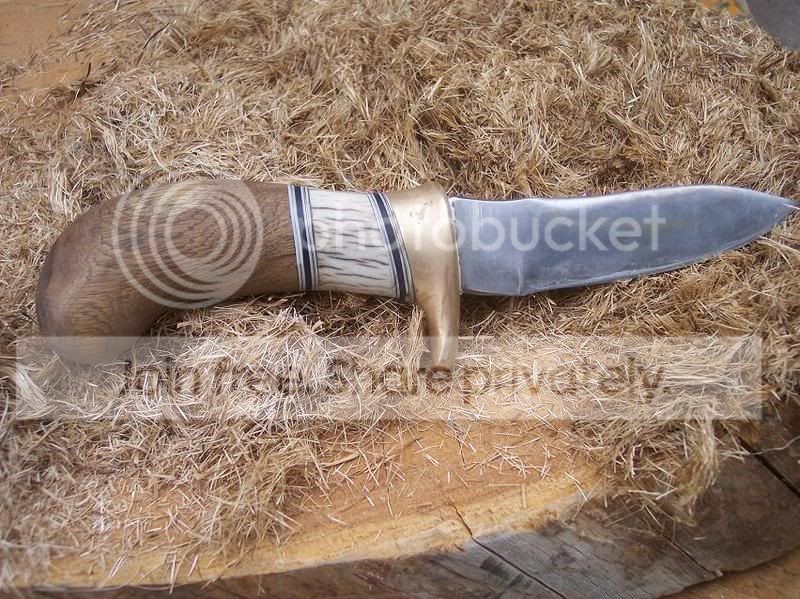
I would strongly suggest tests for the part that is most often forgotten in testing- the handle. This is the human interface and is the major contributor to whether a knife "feels" right and is a proper hand tool. All the blade tests that are done are fine by themselves only if the blade will be mounted in a machine and never be used by people. But if we want to determine if this thing will function as a hand tool for humans we should be testing the most critical interface in that regard. Not just how comfortable it is the moment you pick up the knife but how will it feel after using it for an hour. How does the shape and angle of the handle affect cutting ability? How strong is the handle and the handle design? This is very often overlooked. I see some handle designs that are very popular these days that have some serious weak points.

There was an article written many years ago in KI that stirred some controversy which involved field testing of camp knives made by mastersmiths, it was perhaps the first time this was really done. The results were quite surprising, even in the stuff that made it to print. I am to understand quite a bit didn't make it to print when handles outright failed that were made by smiths with ratings that put them at the top of their field!:confused: A more recent repeat of that field test in another publication once again stirred even more controversy because the author dared to point out what he felt were disappointments in.... you guessed it, handles. Instead of getting angry at the messenger I think we makers should take this as a sign that we obsess too much over blade performance that we forget about the handle. This will not fix itself by killing the messenger. Jarod, I would strongly encourage you to find tests for handles.

Regardless I do applaud your ambition as you are taking on a tall order if it is to be done right. Tests without tight controls, total consistency and repeatability are meaningless and even harmful since they are very prone to influencing or interpreting in the direction that makes you feel best or allows your work to look good. I have said it many times before and it bears repeating- Testing done for the purpose of making your knives look good is not testing, that is called advertising, or marketing gimmicks.
 
Although you probably won't get to do it on all your knives,... Don't forget keeping some for "long term" field testing.

The quick "short term" in shop test are a good idea on all blades, but they do have their limitations.
 
My testing was somewhat subjective and not something you could use in PR soapboxing.
I made knives and wore them as everyday carry knives. I used and abused them in all of the dumb ways we tell people not to use their knives, modified the handles until they felt natural, stayed put in my hand while I was using them, and didn't blister, any time I had a blade chip or break I tried to adjust my process to eliminate that problem. when I had a knife I was comfortable using for a year, and it survived all sorts of abuse with nothing more than occaisional sharpening I figured I had a salable knife and started making some to sell.
Here's a hint in addition to Kevin's advice, if it is going to be a using knife, really look at your sheath design. I found that the way a lot of folks and knife companies do sheaths is not comfortable or safe for daily wear.

-Page
 
One thing I forgot to mention that goes along with the "long term field testing" is, "comparison testing".

You need to acquire knives by other people that were made for similar purposes to compare your knives to. This is vitally important if you wish to beat or compete with the big boys. I am fortunate to have been in this business long enough, and have been able to trade for and acquire hundreds of different knives, antique knives, modern factory knives and modern custom knives by some of the top names in the industry,… just for this very purpose.

It’s a great way to learn.
 
Knives should not chip out, edge flex them to prove them worthy. (I use a valve from a Chevy small block)

Knives should cut, test them cutting.

elkhuntertested33per.jpg

Chop some wood, make some fuzzy sticks for fire starting , whittle some brass, copper or aluminum see if it will still shave arm hair.

Just my $0.02 cents worth, but my test kit consist of:

Ferric Chloride, Radio Shack $5. or so (test for HT effect)

Chevy small block valve $Free , just a trip to most any engine builder or scrap yard. (edge flex test, blade should not chip or stay flexed or curled,,,, it should 'flex' back 8 - 10 flexes should prove worthy)

Block of Aluminum , brass and copper, $spare change at any scrap yard (whittling mouse bites out of a softer metal should give you a wonderful idea if you 'nailed' the HT,,,, if it keeps a nice edge and still cuts paper)

2X4" less then $4.00 any Home Depot or lumber yard,,,, scraps are free at any job site. (if your chopping knotts out of a pine 2X4 , and chopping them in 2 readily, and maintaining blade , handle/hand integrity, your there!)

Length of rope, $0.48 cents a foot at any Home Depot (For years I thought my Buck knives were top shelf, and still tip my hat to Buck! , my rope cutting test has to beat my Buck knives by a margin)
 
In terms of "performance", If you have a variety of knives to choose from for a given task, the one that you reach for and use the most, IS,... "the favored knife“, regardless of anything else! Although this is completely subjective, individual and personal. You also have to figure that there are others who share your preferences and tastes. It's really that simple. :)
 
one of my ideas that im very excyted about testing is my take on a push cut. but the problem with cutting rope is that how do we keep the test controled so it provides us with useable data. the push cut test, tests how well the knife cuts through rope taking into account the shape of the blades cross section. what im thinking is to replace the rope with a liquid like water oil. clamp the knife to a force gage and pump the liquid through a tube and pore onto the edge of the knife. then messur the force.
 
Back
Top