Physics explanation for fire?

Joined
Jan 21, 2008
Messages
3,346
ok, i was outside the other day staring at the campfire, passing the time when i started to wonder what fire was. Being a physics stundent and since i had been out of school for a few days, my mind was ready to do some thinking. the best explanation i came up with is:

fire is an in-efficient transformation of heat, and, because it is so inefficient, heat energy is lost in the transfer and turned into light energy. similar to how if you shoot a rifle(ws&s content) at a brick wall. if the shot is made in pitch black condidtions, you will see light come from the point of impact (thats what i am told at least).

but this explanation dosnt seem complete to me. are their any other physics students or some physics professors that could explain this to me? and kgd, i dont think is is explained in the second law of thermodynamics, or is it?

this definatly lives up to the "off topic" prefix.
 
that article has alot of good info, although it deals more in the realm of chemistry. it also dosent go into detail about the light.

Chemical reaction resulting in converion of one form of energy to another or as my Oldman used to say, "It's F.M."
 
I found this explanation:

Fire is a chemical reaction that releases light and heat. The display usually marks the meeting of a combustible material and oxygen, although other chemicals can spark flames as well. These flames occur when small particles of the combustible material are heated to the point of incandescence and shot upward.

Given a steady supply of fuel, this exothermic reaction will continue unabated. But fires consume combustibles greedily, hence the need to frequently feed your fireplace to keep the flames ablaze. Even the sun--which creates heat and light in nuclear reactions that involve the fusing of hydrogen atoms into helium--will burn through its fuel in about four billion years. If we're still around, expect all manner of chaos.

Hope this helps a bit.
 
Also found this:

Watching a flame dance through the air, you might conclude that fire's a gas, like oxygen or carbon dioxide. It's not. Fire can burn fuel that's a gas, or a liquid, or even a solid--as in the case of glowing charcoal. But the fire itself isn't any of these things. In fact, fire isn't any thing at all. It's not its own type of matter; it's something that matter can do. Fire is a chemical reaction.

A fire needs oxygen and some kind of fuel. This fuel--whether it's candle wax, wood, or gasoline--usually contains big molecules that have carbon atoms inside them. You can think of these molecules as little containers of energy. When they're allowed to combine with oxygen, this energy is released as heat and light.

Fire is a rapid chemical reaction known as oxidation. Inside a fire, oxygen molecules break bigger molecules apart into carbon dioxide and water vapor. All the heat and light of a fire comes from big, carbon-based molecules combining with oxygen. So what is fire? It's not the fuel or the oxygen or the heat or the light. Fire is what happens between all these things. It's a chemical reaction.
 
Well, if you're comfortable with your explanation of it, in physical terms, as an energy transfer, I have no objections.

If you're good with thermodynamics, your answer is right there: it's a brutal form of waste energy within a system. There are different kinds of fire, based on gravity, atmosphere, and pressure, as you know. What we think of "fire" is very much a product of earth's environment: change a variable, and the fire looks and behaves differently. Ever seen zero g fire? Very weird looking.

Chemically, it's simply the rapid molecular acquisition of oxygen, which as KuRUpTD says, it's a form of oxidation. So is rust, by the way, but fire is much easier for people to watch in real time! :D
 
that article has alot of good info, although it deals more in the realm of chemistry. it also dosent go into detail about the light.
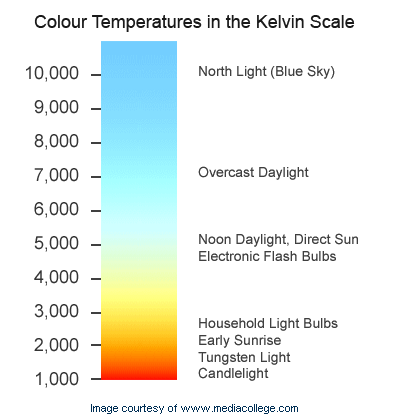
Light is simply the radiant heat operating at a temperature that your eyes can see. The cooler the fire, the darker it is. The hotter, the whiter it is. Temperature of the flame maps out to specific colors:

colour-temperature.gif


Smoke represents the degree of combustion. Low combustion results in lots of black, choky smoke. High combustion results in low smoke, high heat fires.
 
Well, if you're comfortable with your explanation of it, in physical terms, as an energy transfer, I have no objections.

If you're good with thermodynamics, your answer is right there: it's a brutal form of waste energy within a system. There are different kinds of fire, based on gravity, atmosphere, and pressure, as you know. What we think of "fire" is very much a product of earth's environment: change a variable, and the fire looks and behaves differently. Ever seen zero g fire? Very weird looking.

Chemically, it's simply the rapid molecular acquisition of oxygen, which as KuRUpTD says, it's a form of oxidation. So is rust, by the way, but fire is much easier for people to watch in real time! :D

thats about what i was looking for :thumbup:
 
First – Fire is an exothermic reaction, a chemical reaction involving the oxidation of the fuel, in the case of organics producing carbon dioxide and water + other incomplete combustion products + heat.

Heat is the flow of energy from one body to another due to the difference in temperature. According to the 2nd law of thermodynamics, heat flows from a body of high temperature to a body or system of low temperature. My little dig here is to indicate that yes this 2nd law does describe your question at least with respect to the directionality of heat transfer and also sets up the visibility of the flame via production of convective currents (below).
Heat can flow by three different mechanisms. Conduction, convection and radiation.

Conduction involves the transfer of kinetic energy from one molecule to another by molecular collisions. So two objects in contact with another can experience heat flow via the kinetic energy of the hotter molecules colliding with the molecules of the cooler object at the contact point, with some of the vibrational energy transferring over to the cooler one. The 2nd method of energy flow is by convection. This is the organized movement of large groups of molecules – e.g. flow of gases or liquids. Heated gases flow on the basis of density changes (e.g. wind), when the heated gases contact or bombard a cooler body, they subsequently transfer heat via conduction.

Finally heat is transferred by radiation which in part gets to the issue raised in the OP. Radiation is the only form of energy that can be transferred through a vacuum. Light itself is a form of energy, quantized as photons. You are correct in that your detecting the presence of light being emitted means that less energy is being lost via the other two (conduction or convection). If an object is hotter than its surrounding, it emits more radiation than it absorbs. The loss of radiation causes it to cool (i.e. its molecules loose kinetic energy). With increases in temperature, an object releases more radiation. All objects, except those at absolute zero, radiate photons in a continuous spectrum of wavelengths. However, the spectrum of wavelengths produced is influenced by both the material being burned and the temperature. With increases in temperature there is a shift in the spectrum from predominant infrared spectrum, to red, bright yellow, blue to white. Photons in the white/blue spectrum carry more energy than a photon in the infrared or red spectrum. However, the numbers tell the story here. A large number of infrared photons collectively carry more energy than a small number of blue photons.

Back to the OP. Fire, heat and light. Fire is an exothermic combustion reaction that generates heat. The energy is generated at the site of the reaction, usually at the surface of the fuel in contact with the oxidant (O2). The generation of large amounts of kinetic energy at the reaction site has two effects. First conduction of heat to the air at the reaction site superheats that air causing a rapid change in air density which in turn sets up a convective current (or wind) in an upward direction (hot air rises). A large fraction of the heat you feel from the fire is the convection/conductive transference of energy from the wind generated at the flame.

Second, the wind generated at the surface of the reaction liberates tiny pieces of soot particles. Apparently, most of the light that comes from a fire reflects glowing soot particles that are swept up with the wind generated by the base of the reaction. It is these radiating or glowing (yellow light at the hotter parts and shifting to orange/red at the cooler parts) soot particles that we see as the flame. The soot particles are in fact following the current of the wind. The particles emit radiation according to both their composition and temperature. As the soot particles burn up and/or cool they no longer produce visible light, although they continue to radiate non-visible infrared light until the temperature of the particle (or what remains of it) equalizes with the air. The point where the soot particle cools below a temperature where visible light is generated represents the edge of the flame.

You get a bigger flame with more fuel because more soot particles are liberated and also the higher density current sets up a faster wind current so that the soot particle moves a further distance from the reaction edge before the tiny particle burns out/cools off. At the very base of the flame you notice different colours (blues and greens etc) produced as a result of emission spectroscopy based on the molecules involved in the exothermic reaction and due to their higher energy content. The bluish range comes from CH, C2, and CO2. The orange of the flame can also be generated by sodium.

So a portion of all that kinetic energy generated at the reaction is lost by the more mundane physical transference of heat via convection (setting up of an air current arising out of the flame) and conduction. You are of course also right that energy also escapes in the form of photons released by emission spectrometry, although more heat is lost by non-visible infrared photons than are lost by the visible ones just because the infrared ones are produced in much greater abundance relative to the higher energy containing visible ones. More efficient burning does signal a hotter temperature overall. More efficient burning also produces smaller amounts of soot. So with this in mind consider a gas stove which generates a great deal of heat but does not produce much light.

Finally, all is not lost with the generation of photons. Absorbance of photons by your skin or objects capable of absorbing the photons of a given spectra will heat up. This is why that shiny space blanket, set up behind you can reflect those photons back to your body, which absorb them and transfer the photon energy back into kinetic energy.
 
First – Fire is an exothermic reaction, a chemical reaction involving the oxidation of the fuel.............................................This is why that shiny space blanket, set up behind you can reflect those photons back to your body, which absorb them and transfer the photon energy back into kinetic energy.

Just what I said but with a lot more words.;)

Great explanation, I'm gonna save this for when I have to explain why turnin' the thermostat to 80 doesn't heat the house any faster then settin' it at 70 does.:D
 
kgd, thank you so much! that was incredibly helpful, and surprisingly, i pretty much understood the whole thing. saving this page to favorites.
 
Kgd, thanks for the in depth explanation. I've copied and saved it for a night when I'm not drinking. :rolleyes: :thumbup:

Doc
 
At the very base of the flame you notice different colours (blues and greens etc) produced as a result of emission spectroscopy based on the molecules involved in the exothermic reaction and due to their higher energy content. The bluish range comes from CH, C2, and CO2. The orange of the flame can also be generated by sodium.

As an aside, when you see an orangish streetlight, it's a sodium vapor lamp. The blue-green looking ones are mercury.

Science: it works!
 
Back
Top