pick apart a design (forge design)

Joined
Nov 26, 2012
Messages
121
I started reading about some of the guys building their own forges/heat treat ovens... so i started searching and there are alot of old threads with no pictures left... the few that i did see were eye opening to say the least... posed some interesting questions and made me think about the materials i can easily get ahold of compared to what i need to buy properly...i'm going off of things i can get locally and easily for this design... not sure on the secondary cylinder inside the first... the gap between the two cylinders is for fire brick and refractory mortar...
this: http://www.menards.com/main/building-materials/concrete-cement-masonry/cement-mix/medium-duty-refractory-mortar/p-1768860-c-5648.htm
if it's suggested to be better, then i may use the inside cylinder as a temporary form for the mortar to set up and then remove it... the location of the burner port can be moved forward or rearward... i placed it towards the front so that when warming the oven i could close the doors (channels with two simple fire blocks for doors) and leave the back doors open a bit and cause a nice swirl effect to create an even heat... the fire front and rear doors would be adjustable as just fire bricks slid in between the two pieces of channel and opened or closed as need be... ideally i should be able to close the doors completely after firing and use it to anneal as well... this is just the thoughts that were running through my head... so pick it a part and hopefully with some fine tuning i can put together a plan and get it built... it'll probably be just for the heat treating at first... but i hope to do some forging with it in the future... hoping to use propane.. but i've got a natural gas hookup on the side of the house if that's going to be a more effiecient fuel for it...

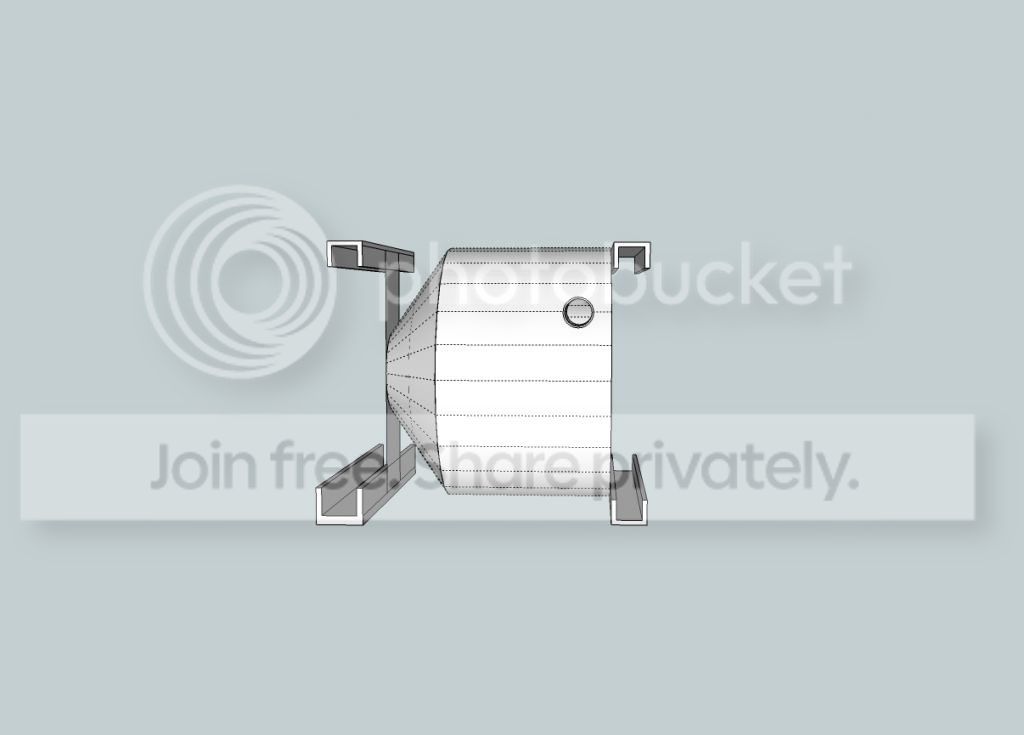
here's the design:
forgedesign1_zps4f3c70e7.jpg


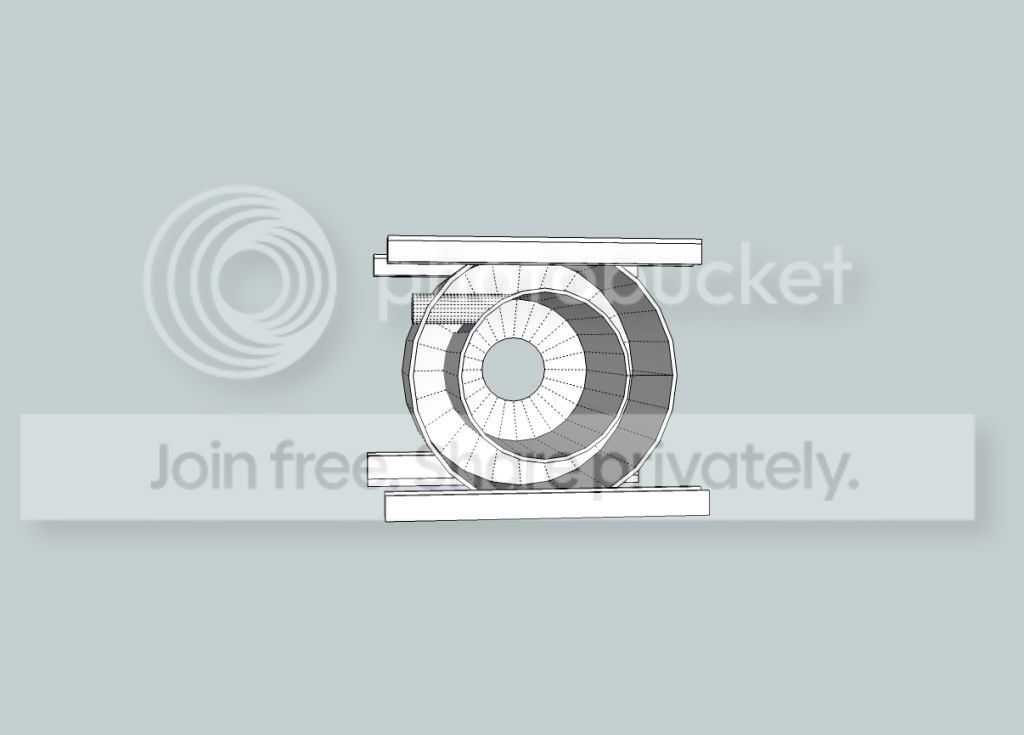
side view:
forgedesign2_zps4940d61c.jpg


inside diameter is variable, as is the outside... was originally planning 8" inside 12" outside 14-18" long... just big enough to get me started for my first couple of years... if it really takes off then i can build a bigger unit... but for now....

should i put a piece of catwalk acrossed the lower 1/3 section to set things on? or just some sort of tool holder at the front to prop a tool on and hold it suspended inside the burn chamber???

will the secondary cylinder inside the first help to reflect the heat and keep it inside the chamber or will it just serve to wick the heat away or would raw mortar/fireblock be better??? i saw many mention of refractory material... the mortar is proported to be medium refractory mortar... will this work or should i look at something ceramic???

i want to put a heat probe inside to monitor the temp inside and use the doors and fuel regulation to control the temp.. i know this will have to be done by fine-tuning after i build it... but is it likely to work this way??? or will i loose too much heat???
i'm not sure what this kaowool stuff is... will it hold to the top of the inside cylinder??? would it even be used in an application like this... i saw it in reference to a couple fire boxes... but with the swirling of hot gasses i'm not sure...

someone mentioned using a circular saw with a mortar blade to cut the fire block... so i figured i could cut fireblocks into strips and stack them into the space between the cylinder walls and then pour the mortar in to hold it all in place... let it cure... then test fire it... am I on the right track???
as for a tip i've got a few ideas... we use old welding tips brazed onto pipe for pre-heater tips at work... and depending on the size of the tip depends on how much fuel/burn we get out of them... so i figured on experimenting with that, unless there's an easier way... i saw mention of buying tips online... but untill i know how much fuel it needs how will i know what size tip to get?

your input and years of experience is appreciated... feel free to pick it apart...
 
getmike, I've been watching this thread because I was hoping to learn some of the same things. I am not an authority on forges so keep that in mind.

From your drawing -- which I really admire your ability -- is seems to me that the forge would be proportionally too shallow...meaning not deep enough front to back. This could be relatively easy to adjust.
I am particularly interested in the placement of your burner tube. Most designs have the burner in the middle, front to back. I have been building a forge with the burner in the rear portion to see what effect this design has. I wonder what the most effective placement would be for overall heating. It seems that this issue may be a compromise at best. If the burner is in the rear, as mine is, the tip of the blade will get too hot too fast. And if in the front, like yours, would the tip ever get hot?

If by "cat walk" you mean expanded metal, diamond plate, etc., I don't think it would last long in the forge temperatures. You would need ceramic standoffs instead.

I like your door design....it seems very versatile and easy to replace.

Hopefully after some stirring from my questions, this thread will attract some attention from the experts on here.
Good luck
Wayne
 
i was figuring on the forge being around 18" deep overall... i don't think it needs to be any larger than that i'd hope though the picture above looks abit shorter than that... that would be bigger than any blade i forsee myself building in the next several years... as for the location of the burner tube... i thougt about that alot... the way i figured it to pre-heat the forge i would close off the front "doors" completely and open the rear ones almost completely... that way the swirling gasses would work their way, much like a vortex in water, from front to back... this is all in theory... as for the "cat walk" i was referring to walkway grating... it consists of vertical bars connected with crossing rods and is quite heavy... it was more of an afterthought... i was wondering if i placed it sideways in there, so that the bars ran across the chamber instead of along it, the hot gasses would still swirl around the cylinder unimpeded... my original plan consisted of a leveraged tool holder extending out from the front so that the item in the chamber "floats" in the middle of the chamber... then i can close the doors around the tongs or whatever i end up using and try to keep the chamber nearly sealed... again... this all depends on the feedback i get here...
 
You have a decent start.
Keep it simple. Build one. Take all your ideas and see what works and doesn't.

Doors. Simple is best when they are 2,000 degrees.

Bars/catwalk. Make a flat bottom in your forge that is the same level from front to back. You can lay stuff on the bottom. Just make it with refractory cement.

What's your plan for a burner?

Honestly though. 8"x16" give or take. Add an inch or two of Inswool with some refractory cement. A couple bricks a burner and you are set.
 
Last edited:
While there is nothing greatly wrong with that design, it offers no advantage of a simple forge.

For about $100-150 you can do the following:
Get a piece of 8-10" pipe that is 16" long.
Weld some legs on it so it stands about 8" above the table.
Weld a 1.5" pipe at a tangent to the proposed 4-6" chamber, to be the burner port tube. It should be about 1/3 of the way from the back ( not front).
Roll a piece of 2" thick by 14" long Kaowool in a tube and place it in the forge shell.
Make 1" thick Insulboard cut outs ends to fit the shell with both having a 3-4" center hole.
Apply stiffener to the wool and let dry.
Apply 1/4" of satanite over the wool, mortar the ends in place, and let cure for a day. ( a few screws through the shell will hold the insulboard in place permanently)
Apply an ogee of Satanist at the inside end/side junctions. Let everything cure in a warm place for several days.
Place a blow torch in the burner tube, and heat the chamber slowly for at least an hour until it is fully dried. Patch any cracks.
Put a floor of bubble alumina in the forge. The floor should come almost up to the door opening holes.
After the floor is cured, trim the opening into a "D" shape to align with the floor.
Use the torch again to cure everything.
Apply a coating of ITC-100 to the inside of the forge. Let dry for a few days.
Put the burner you have for the forge in the tube and use the set screws to hold it in the proper place.
Ignite the burner and run on low for a few minutes. Adjust the burner placement for a smooth burn. Let run on low for 15 minutes more. Then turn up a bit for five more minutes, and keep increasing the temp SLOWLY over an hour until it is at full heat. The chamber should be a bright glow. Turn off and let cool overnight. Check for any cracks ,and repair as needed.
Enjoy a well built forge for many years of forging to come.
It will also do HT fairly well with some experience. Add PID control and you have quite a tool.

In use, the back doors can be blocked from the outside with a stack of firebricks if desired.

BTW, I would use a 1.25" blown burner.
 
I agree with Brian's suggestion for the flat bottom in your forge. The "catwalk" in my big forge is removable when it comes time to refurbish. There is a ledge welded onto the back wall that supports the floor; the front is held by the forge face.
bigburn.jpg%2520016.jpg
 
so it looks like i need to start sourcing different materials... thanks for the input guys...
 
http://www.indiangeorgesknives.com/building_a_forge.html

http://hightemptools.com/

Here are two links to help. Stacy nailed it for you.

I made a forge last week for a 16 year old in two hours.

6"x9" pipe. Bolted to a 3/8x12"x12" plate that was welded to a 30" base.
We drilled a 1-1/4" hole 2/3 back on a tangent.
Lined with 1" Inswool and a skim coat of refractory. Topped with ITC.
We bolted a 2" angle iron rail on the bottom only for air hanger 2 brick sliding doors like yours.

Added a simple venturi burner and he was forging in his own driveway 2 hours after he called for help.
(typically you let the refractory cure slowly so it doesn't crack but it was 48 hours and counting till Christmas. Lol )

I will say after using 5 different forges recently. BRICK DOORS SUCK compared to a hinged insboard door that easily swings open. Brick doors are easy. My forge build was done specifically with zero welding.

Round tube. Flat bottom. 8"-10" diameter.

One great easy forge shell is a freon tank. Almost every HVAC company in town will have a recycling bin full of them. They just are thin steel so welding doors on takes a bit more work.

E-mail me and I can send you pictures of the three I've built.

My first forge had great ideas. I'd love to share a picture and show you all the fancy ideas I had that simply don't work. Lol.

Good luck.

High Temp sells burners and forges as well as gas regulators, hoses, cement etc. One stop shopping.
 
brian, i sent you a message with my email address.. i couldn't see in your profile where you allowed emails... feel free to email me any pics you might have... as well as recommendations and ideas... thanks...

i thought about trying to do some hinged doors... but thought it might be overly complicated... if it's a better way to go... then i'll definately try it...
 
Hinged doors are harder to get right compared to sliding a brick on the initial build. It depends on your goal. Wanna forge tomorrow? Or in a week after taking extra time to build one with doors. Simple bricks doors are fine. I was slightly exaggerating. But, I am building a couple more forges soon and they will have a hinged side opening door.

It would be great if you could meet up with a knifemaker in your area and see his forge set up.

Another though is placement. At up to 2,500 degrees you don't want it tipping if you have to move it. My blown forge was on a rickety old sewing machine stand at first. Not good!! I have it on a bottom weighted heavy steel 4 wheel cart now. Easily moved just outside the shop door to fire it then safely wheeling it back after it cools.

Also, I have an 8"x20" blown forge. I rarely use the back 10". I'd have been better off having a small opening that was easily bricked off instead of a big door like I did and, it could be 16" OAL.

8" is kinda small for 2" Inswool. I could only get 1" to fit. If my 8" forge body wasn't free I'd build with 10", but, my forge as is, uses less than 2# an hour propane so I'm not sure if it matters.

With a 10" diameter forge you should be able to do 2" Inswool and add a muffle pipe for heat treat if you want.

Don't forget a PID. Auber makes a simple set up you can piece together. See the forge and salt pot sticky above.
 
i've done some searchin over the past few months... and while i've found several people who say they make knives... they aren't exactly bladesmiths... mostly they grind a piece of steel, then sand it, then heat it red hot and dunk it in used motor oil and put a piece of antler at the back... some are rather pretty... but that's not what i'm looking to do... i've found out that Ed Fowler lives about 150 miles from me... and i'd love to see his shop... but i can't afford the prices he asks for his classes... and it seems that's about the only way to see his shop is to take a class... plus if traveling more than 50 mile in winter here, you have to plan for an overnite, just in case... i've already registered with his forum... but have yet to post anything over there... same goes for sourcing materials... i've never been a fan of ordering things online... just kindof old fashioned that way... plus i worked as a shipping and recieving clerk for almost a year... so seeing how some things get shipped just scares me sometimes... i'm hoping to be forging/heat treating sometime this spring...thus i started looking into what it's going to take now, so that i can start collecting materials and figuring out what i have compared to what i need... the design above is all things i either have, or can be bought locally (we just got a menards about 1 year ago... i'm there regularly) plus... tax return time is coming... so splurging on a few items will then be possible... though buying my new bow is at the top of the list... so large purchases after that are not very feasable... i wasn't sure if the PID would be appropriate for a simple forge setup, so i quit reading about half way through with the thought that when i get further along i'd look into it more... so that was my mistake... i'll look at the sticky again... thanks again for your suggestions...
 
Gotmike, im in cheyenne you are welcome to visit and check out my forges if you like

Ive got 2 and a new one planned for later this year. I made both of them about 7-8-9? Years ago and they have worked well. Made them mostly from scrap except for the inswool and some pipe from homedepot. I think i have some more scrap pipe i could set you up with for the body for yours.
 
Last edited:
i'd love to make a trip to cheyenn to see your setup joe... hopefully later this spring i can get the time to head down there...

i may have found a supply for the kaowool here locally... a large company uses it extensively to stress relieve pressure vessels... i might be able to get some for free... or for a reduced price at least... and i might have a lead on an old air tank to use for a burn chamber... cut the end off and keep it for a door, build an atomspheric burner, and insulate it... what is this baffle setup that you're talking about... i did a search for it... and couldn't track it down... might have just missed it... but i'm not sure what i'm actually looking for... thanks guys...
 
Cool, let me know a few days in advance if you can.

Both my forges are like the one in The link above by indian george.

I looked at one of my scrap piles the other day and i have several air tanks and some propane tanks, that you could use for a body, as well as parts for legs and doors. I dont have any extra insulation though.
 
Update: throwing away my original design... kindof... found me an air tank... 14" overall diameter... just over 25" long, but i can cut it down a bit shorter... found a local source for kaowool... about $45 for a box of the stuff, 24" x 12' by 1"... planning on some refractory mortar, 2 layers of this kaowool giving me a center opening of between 8-10", and a "floating" piece of channel in the center for fire bricks, and/or a muffle... wondering if i can coat the back with the kaowool, put my thermocouple in the center, then, when i'm using a muffle, let it go tight to the back so that the thermocouple will register the temp in the muffle instead of in the burn chamber and the door will close and seal it with a view window on the front... on a side note... while searching for an air tank to use... someone offered me a propane tank to cut up for use... while i'm not willing to cut open a propane tank... regaurdless of how long it sits with the valve open as was suggested to me... but when i asked him if it was any good he mentioned that he had two that were fine, and i could have them if i came and got them... so i showed up and he presented me with two 100# tanks in great condition... cap's and all...

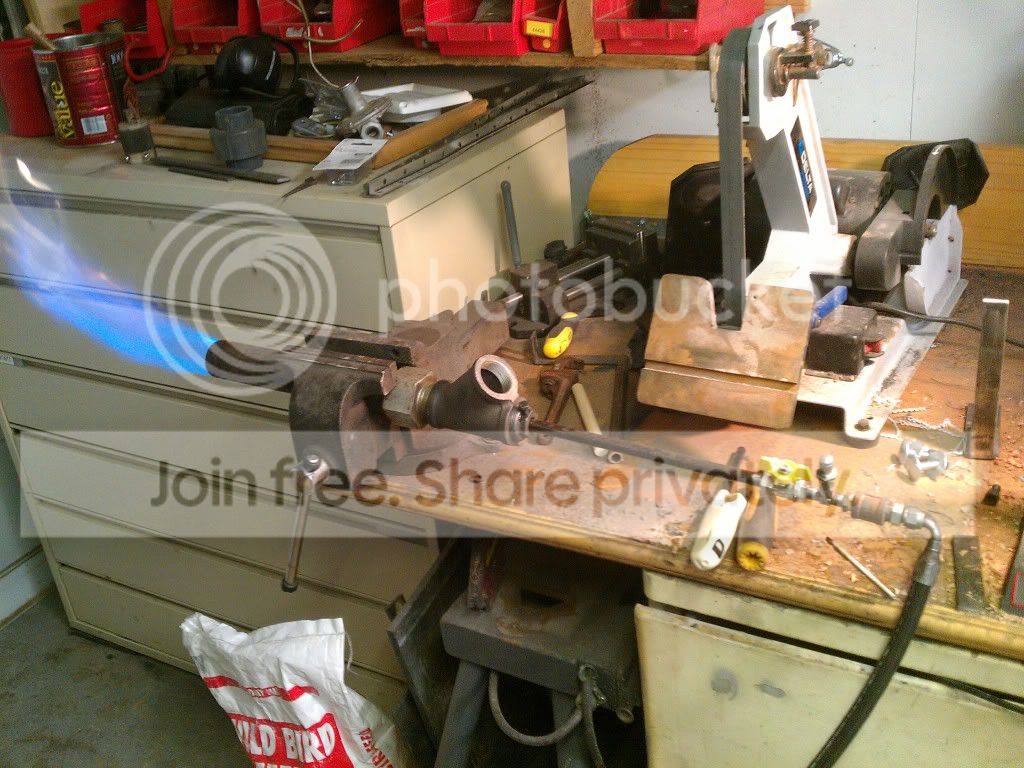
I've been working on a burner design...
IMAG0251.jpg

this is adjustable, so that i can move the burner in and out to dial it in... works really well when i put a blow dryer into the air inlet... so i'll probably make it forced air... but with the needle valve i can turn it up fairly high and it just puts out a roaring blue flame... i figure i'll get a regulated switch and a PID controller and just go at it... see how it turns out...
 
Judging from your flame shape, color and length I can say your burner design has a flaw.

The design works on a venturi principal; large pipe-small pipe-large pipe. Sorry I'm on my iPhone, no diagrams to help.

But, take that 1-1/4" lateral fitting, put an 1-1/4"x3/4" bushing in the outlet side add a 3/4"x8" or so nipple with a piece of 1" over that. You can flare the 1". Or make it from stainless.

What I see is a blue flame that is long due to lack of air. Adding a blower, hair dryer works. But adds noise and you'll want a gate valve/shutter to control the air flow and a regulator and needle valve to control the gas flow. Modifying your venturi burner to draft it's own air is the best plan IMHO.

Do you have a mig torch tip or something on the 1/8" nipple into the burner?


Burners will often run better inside the forge.

For a forge the size you are building you'd need two of these burners most likely.
 
stacy (i think) had mentioned in another thread that a forced air burner would be more efficient, and more controlled for heat treating... so i was always planning on hooking an air hose to it with a choke plate and a variable speed fan, then setup a pid with a pilot control and a muffle... if i can just get it up to heat treat temps for now that i'll be happy... then i can add another burner later for actual forging/welding when you get to a computer post up a diagram of what i need to do if you can... i'd appreciate it immensly... if i could get away with just a venturi and no fan then it'd be much simpler... and yes... i have a mig welder tip on the pipe... i threaded it for a diffuser from work and put a 1/16th tip in it... i braized the diffuzer holes closed and left the tip threadable so that i can change it out if need be... everything is adjustable right now... easily modified untill i get it tuned in... then i'll weld/braize things into place...
 
Cool. I've got your e-mail. I picked up all the parts to build 8 burners for a project tonight. I'll lay out the parts and e-mail you a picture and a diagram. Depending on how my projects go I'll try to post a picture of how I built the last two on this thread. Feel free to post my pics on this thread if you'd like.

Both were able to reach forge welding temps in small 8"x12" or so forges.

My big forge is blown with a PID for temps for heat treating. I like it and the temps and atmosphere are easily adjustable, but it's also noisy. I'm building a cabinet shroud for the blower and am adding an intake to the blower and with oversized piping for friction loss, and quick connects will run the intake and exhaust away to reduce the noise.

My second forge I'm building will have two venturi burners and will have one of them with an idle switch to conserve gas when the blade is on the anvil being forged and the door is open.... I'm thinking just a longer handle on a ball valve mounted to brackets so it's easily switched on and off with tongs or a hammer head.

PS. I am not an expert. Just learning along with you. Please don't invest your life savings on my advice.

http://zoellerforge.com/sidearm.html

Here is a link to a real experts sight that I forgot to mention. I am basically making that exact burner but 4 will use a parallel fitting(wye) like you used.
 
Last edited:
Back
Top