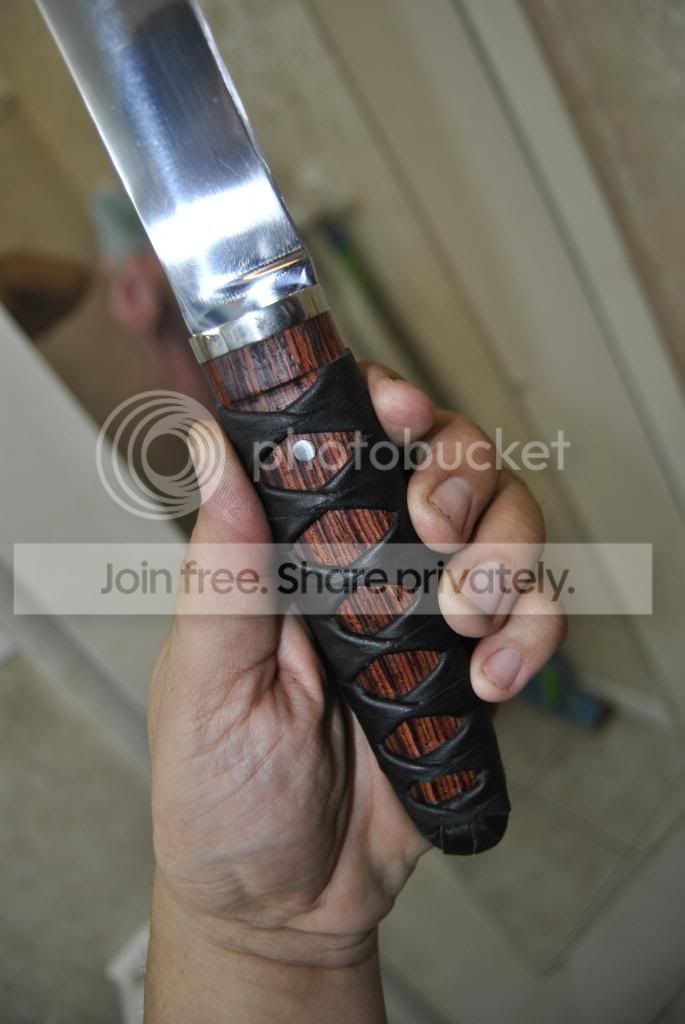
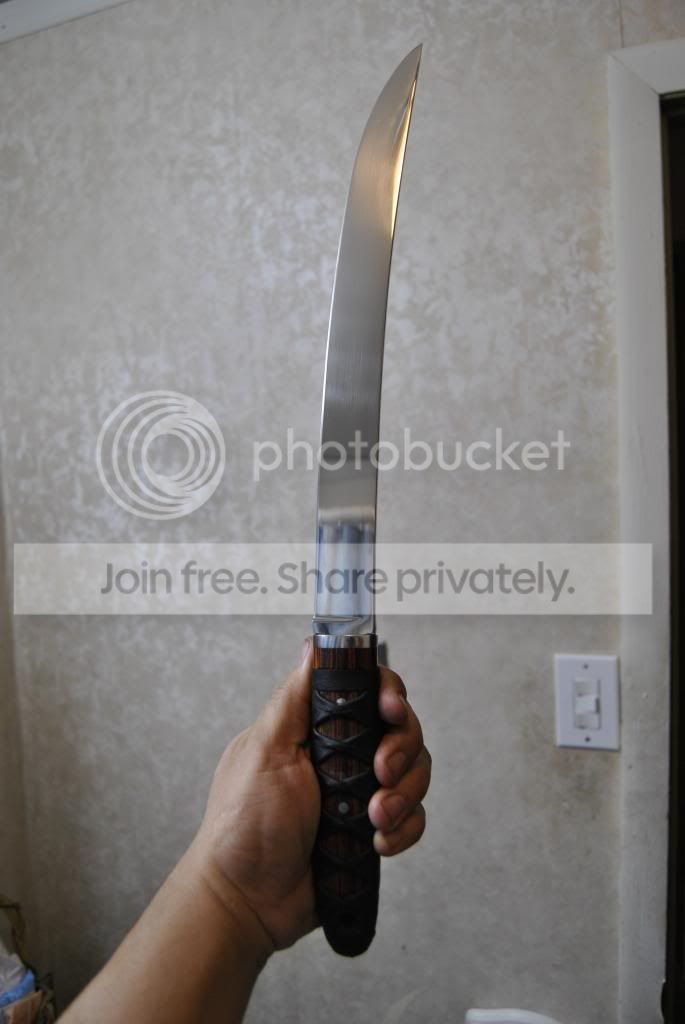
Pics of my first ever forged blade! 3rd blade ever. But I need help.

Joined
Jan 13, 2013
Messages
221
As the title says, this is my first forged blade. Up until now, the other 2 blades I have completely finished have been stock removal. What I need help with is classifying this blade. I wanted to make a wakazashi, and from what I have read, blades over 12" long are considered a wakazashi, and under 12" are considered a tanto. This blade is 12 1/2" long, and the overall length is 18 5/8". So I suppose I should just come to the best source for an answer to this....Bladeforums. Anyways, about the blade.... Its 5160, and the handle is cocobolo and I used leather rather then the traditional silk to wrap the handle with. As always, critique is welcome and appreciated.
_DSC0107_zps17ad720f.jpg

_DSC0108_zps3a757ed8.jpg

_DSC0110_zps26fb027d.jpg
 
"....third blade ever"

Riiiiiiiiiiight.... sure it is. :p

RJ - That's a dandy looking piece of work.

My only thought would be that you could spend a bit more time on the hand sanding.... especially around the plunge. Its, for me at least, the toughest area to get rid of all those little faint scratches before moving on to the next grit.

Well done sir!!

-Peter
 
I like your simple and well executed blade.

The blade is at the max end of tanto size. The blade is hira-tsukuri, meaning full bevel with no center ridge. The handle and fittings are Aikuchi, which means "Long knife with no guard". I would classify this knife as O-aikuchi, which means "Long aikuchi".

If the blade had habaki and small tsuba it would be shoto-wakizashi, which means short wakizashi.

Japanese blades traditionally don't have a plunge line, but instead have a habaki, which acts as the same thing in some respects. your fusion style blade is nicely done.
 
Last edited:
I like your simple and well executed blade.

The blade is at the max end of tanto size. The blade is hira-tsukuri, meaning full bevel with no center ridge. The handle and fittings are Aikuchi, which means "Long knife with no guard". I would classify that as O-aikuchi, which means "Long aikuchi".

If the blade had habaki and small tsuba it would be shoto-wakizashi, which means short wakizashi.

Japanese blades traditionally don't have a plunge line, but instead have a habaki, which acts as the same thing in some respects. your fusion style blade is nicely done.

Stacy,

Your interpretations to the Japanese I find very interesting. Many times I will look them up son I can put a name to the part you are discussing.

I appreciate you taking the time to do so. :thumbup:
 
Thanks Stacy. Other then seeing pictures and working the steel to make it "look" similar to what I have seen, I don't really know much about them. I just wanted to make something that was truly functional, but will probably never get used.
Big Blue, honestly, this is my 3rd finished blade. I have about 5 or 6 other blades in the works, but have only finished 3. And actually, this one is not quite finished because I haven't made a scabbard for it. I have an advantage over most other amateur knife makers. I have access to a machine shop, and have 22 years of experience metalworking. I make sanitary static inline mixers for the food industry. The stainless steel has to be formed and welded and polished without any pits or scratches for bacteria to grow in.
Check out this link. All these parts in the pics were made by me by hand. http://www.koflo.com/static-mixers/sanitary-static-mixers.html
Blades are completely new to me. But with my experience, I hope to be able to know what I am doing in a shorter amount of time then it would take most. I really enjoy this stuff, and I really like coming onto this forum and learning things I didn't know. Stacy is great for helping with that!
 
BTW Big Blue. as far as the hand sanding goes I agree. I wasn't exactly looking for a mirror finish, and wanted a faint, uniform grain direction. But As you can see in the close-up of the handle, there are some slight grit lines that shouldn't be there. This is my motivation to do more and get it right!
 
I think it is a cool piece. Kind of looks like cocobolo in biker's leathers....or one of those outfits the ladies with the whips wear.

What kind of tooling do you use to polish your mixer blades?

www.brachknives.com
 
Paul, they used to be done by taking the welds down with unitized abrasive wheels, and then buffed with a buffing wheel. But now they are mostly run in a centrifugal tumbler. The tumbler takes them to about 90% of what we used to do by hand, in less time and a lot less effort.
 
Back
Top