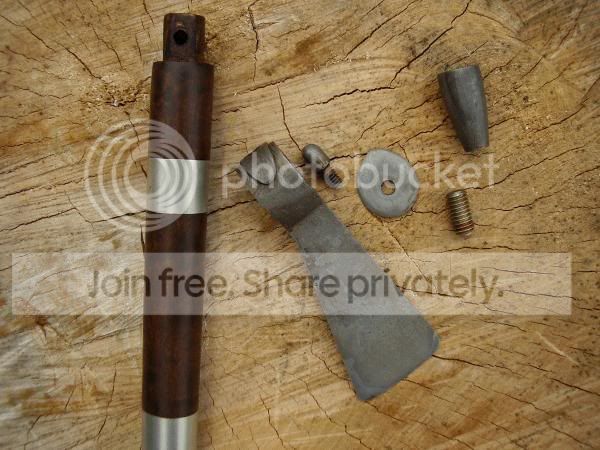
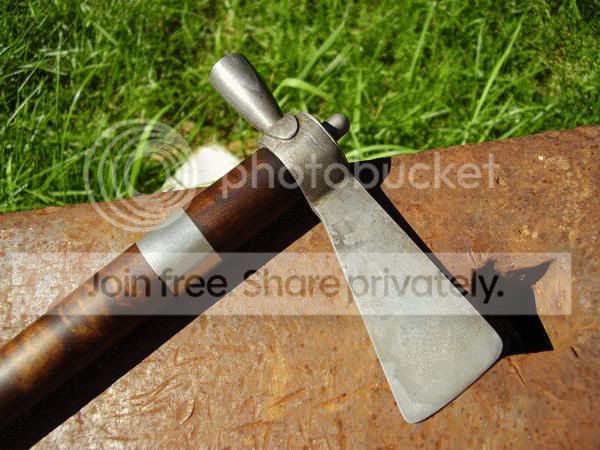
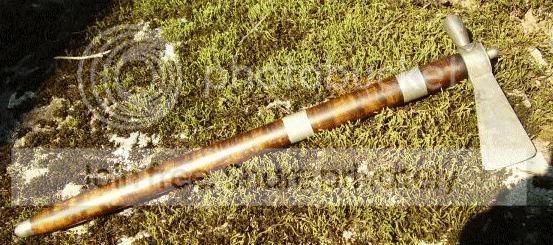
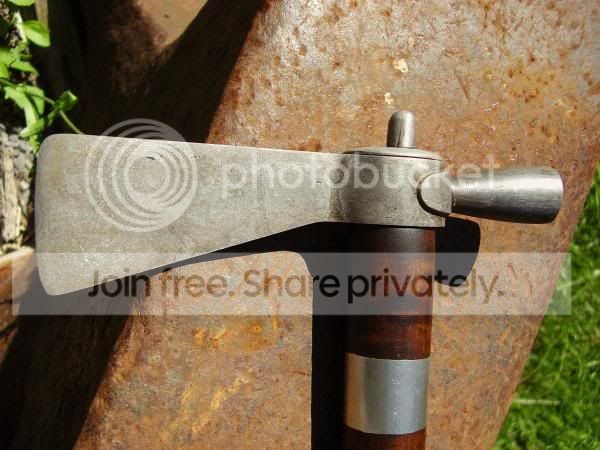
Thanks Michael the bands and mouthpiece are cast in place pewter sanded to 400 grit. Here is how i done the cast in place pewter. This tut. was sent to me by Alan Longmire with his permision to share it.
Bob
The way I do it, not that it's the only way, is to carve the grooves about 1/4"
deep. 3/16" can work, but you risk not getting a full pour if it freezes too
soon.
I use a coping saw to cut the outlines of the grooves, then a narrow chisel to
cut out the waste, then I clean up the edges with either a chisel or a file.
Then I may drill a 13/32 hole or two through the handle inside the groove just
for insurance. I've been told that the pewter will flow better if you color in
the groove with a pencil, the theory being that the graphite helps the flow. I
haven't noticed much difference though. The damming is done with plain boxboard,
cut to have about half an inch overhang on either side of the groove. I leave
the ends so they're just touching, with a litle "V" cut out to leave a small
hole for the funnel, which is also made of boxboard.
Before I make the funnel I run several thicknesses of masking tape around the
handle and boxboard to make a good seal. Don't do it too tightly, or the groove
can be not filled enough. I like to have a little pewter run over between the
boxboard and the wood, that way I know it's full.
The funnel is just a rolled tube of the same cardboard about 1/2" in diameter.
I make it narrow at the handle end, and cut two "V" notches in it. I spread the
notches out to make a kind of swallowmouth shape that fits over the V-hole left
in the dam, then tape the hell out of the junction with lots of narrow strips of
masking tape, taking care that the funnel body itself has at least two
thicknesses of tape on it the whole way up. It also helps if the edges of the
funnel overlap a little, because masking tape burns out pretty quick!
I melt the pewter in a steel ladle I made for the job over a propane torch. You
want it pretty hot, but not so hot it gets that gold-sheened layer of crap on
the molten surface. Sometimes I flux it with a little beeswax melted onto the
ladle before I add the pewter. Skim it if you need to right before you pour,
and pour as fast as you can while keeping it smooth. Fill it to the top of the
funnel. It'll bubble and hiss and smoke and may even spit at you, and the tape
will turn brown and sizzle. At this point, LEAVE IT ALONE! Hopefully you have
it clamped in a vise, so just walk away and leave it until you can hold it over
the pewtered bit with your bare hand, about 15-20 minutes.
Unwrap the tape, remove the boxboard, and you'll have an ugly mess with a pewter
peg where the funnel was. I saw off the peg with a coping saw, then use a
fairly coarse file to remove the excess pewter and level the groove. When
you're done, hopefully you'll have a nice band. If it has a few pinholes or
didn't go all the way around, you might be able to save it with a big soldering
iron. Repairs like that will show up, but are pretty normal on the originals so
I don't worry about it.